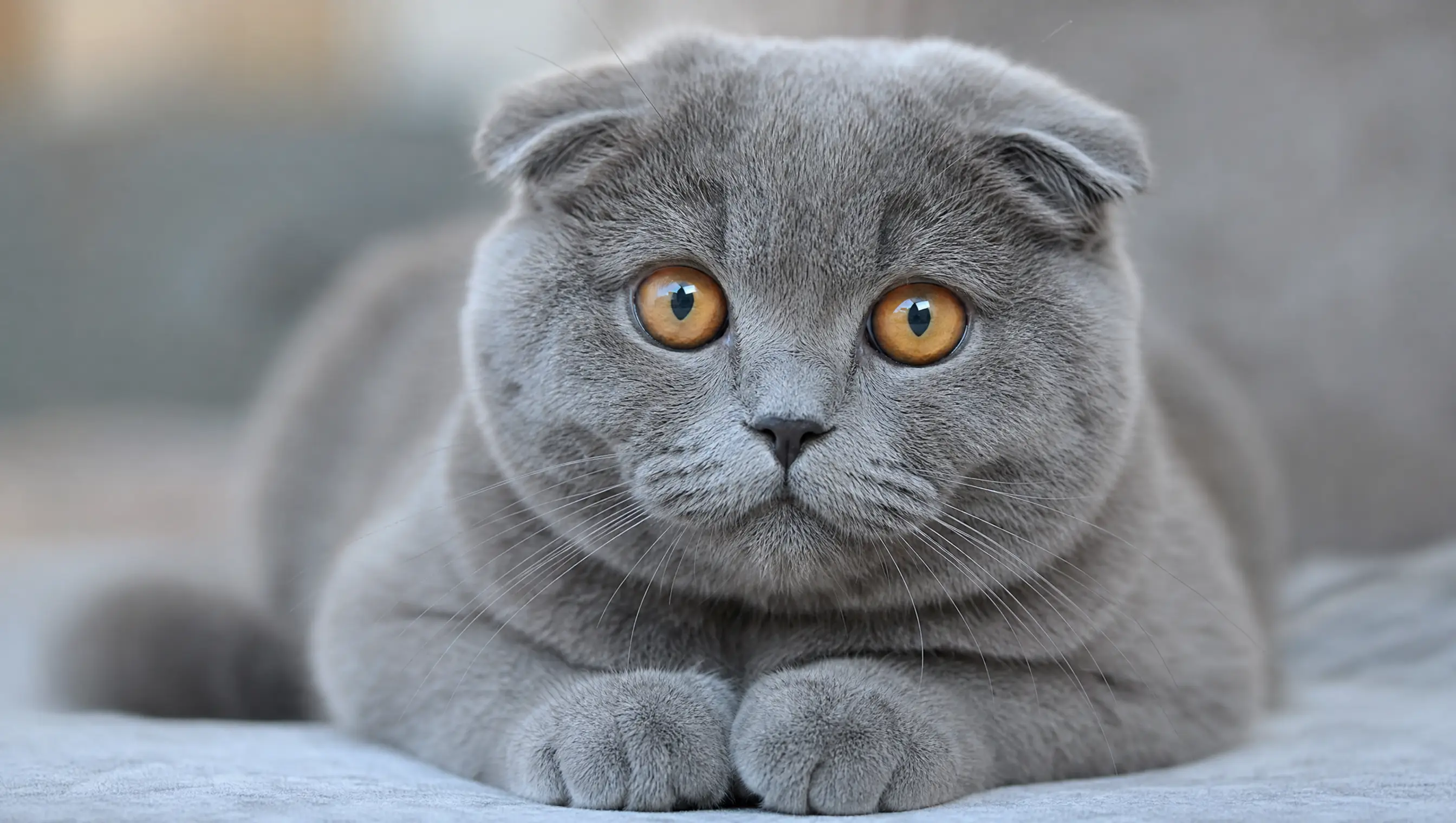
Scottish Fold
The owl-faced charmer whose signature ears come with a hard genetic catch.
Vital stats
| Size | Medium · rounded, compact build |
| Weight | 3–6 kg · males heavier |
| Life expectancy | 11–14 years |
| Energy | Low to moderate — calm homebody |
| Shedding | Moderate, seasonal |
| Coat | Short and dense (or longhair 'Highland') |
| Group | Shorthair |
Breed traits
Friendliness
Care
Mind
Temperament
Scottish Folds are easygoing, people-oriented cats that stay close without demanding constant attention. They're quiet — a soft, occasional voice rather than a running commentary — and tend to settle wherever the household is rather than patrol from a height. They handle children, other cats and calm dogs well, and cope with routine better than most. You'll often catch one sitting bolt upright with legs splayed or flat on its back like it's been switched off; these poses are part of the breed's charm but, given the joint issues below, some owners read a cat that sits oddly still as comfort-seeking rather than clowning. Affectionate, undramatic, and content to be a shadow rather than a supervisor.
Habits & quirks
The Buddha sit
Folds often sit upright on their haunches with legs stuck out front — endearing, and worth noticing, since discomfort can drive some of the odd postures.
Ears that aren't fixed
Kittens are all born straight-eared; the fold appears around three weeks, and littermates who never fold ('Straights') are healthier but just as sweet.
Quiet company
A low-volume cat that trails you room to room and asks for closeness with a chirp rather than a yell.
Cool head
Takes noise, visitors and change in stride, which makes them steady in busy or child-filled homes.
Care
| The fold gene (read this first) | The gene that folds the ears is linked to osteochondrodysplasia — a malformation of cartilage and bone that can cause painful, progressive arthritis, especially in the tail, ankles and knees. There is no cure. Breeding two folded cats together is condemned by welfare bodies and vet associations for exactly this reason. |
| Watch the joints | Stiffness, a thick or inflexible tail, reluctance to jump, or an odd gait warrant a vet and X-rays. Pain relief, joint supplements and a soft, low-effort environment help, but you're managing a lifelong condition, not fixing it. |
| Ears and coat | The tight fold traps wax and debris, so check and gently clean the ears regularly. The short coat is low-maintenance — a weekly comb, more for the longhaired Highland Fold. |
| Buying honestly | A responsible breeder pairs a Fold only with a straight-eared cat, screens for heart disease (HCM), and won't sell tiny kittens as 'guaranteed folded'. Steer clear of anyone breeding fold-to-fold for a fuller ear crease. |
Common questions
Are Scottish Folds in pain?
Not all of them, but the risk is real and built into the breed: the same gene that folds the ears affects cartilage everywhere, and many develop arthritis over time — sometimes early. Some cats stay comfortable for years, others don't. Regular vet checks and joint care matter for every Fold, not just the obviously stiff ones.
Why are some kittens in the litter not folded?
Ear fold is caused by a single dominant gene, so in a typical Fold-to-Straight pairing only about half the kittens fold. The straight-eared 'Straights' have the same temperament and appearance minus the crease, and they avoid the worst of the cartilage problems — many people consider them the kinder choice.
Is it ethical to buy one?
It's genuinely debated, and several countries and registries restrict or ban the breeding. If you want one, at minimum insist on Fold-to-Straight breeding, health-tested parents, and a breeder honest about the risks — or consider a straight-eared Fold or a rescue instead of funding fold-to-fold litters.