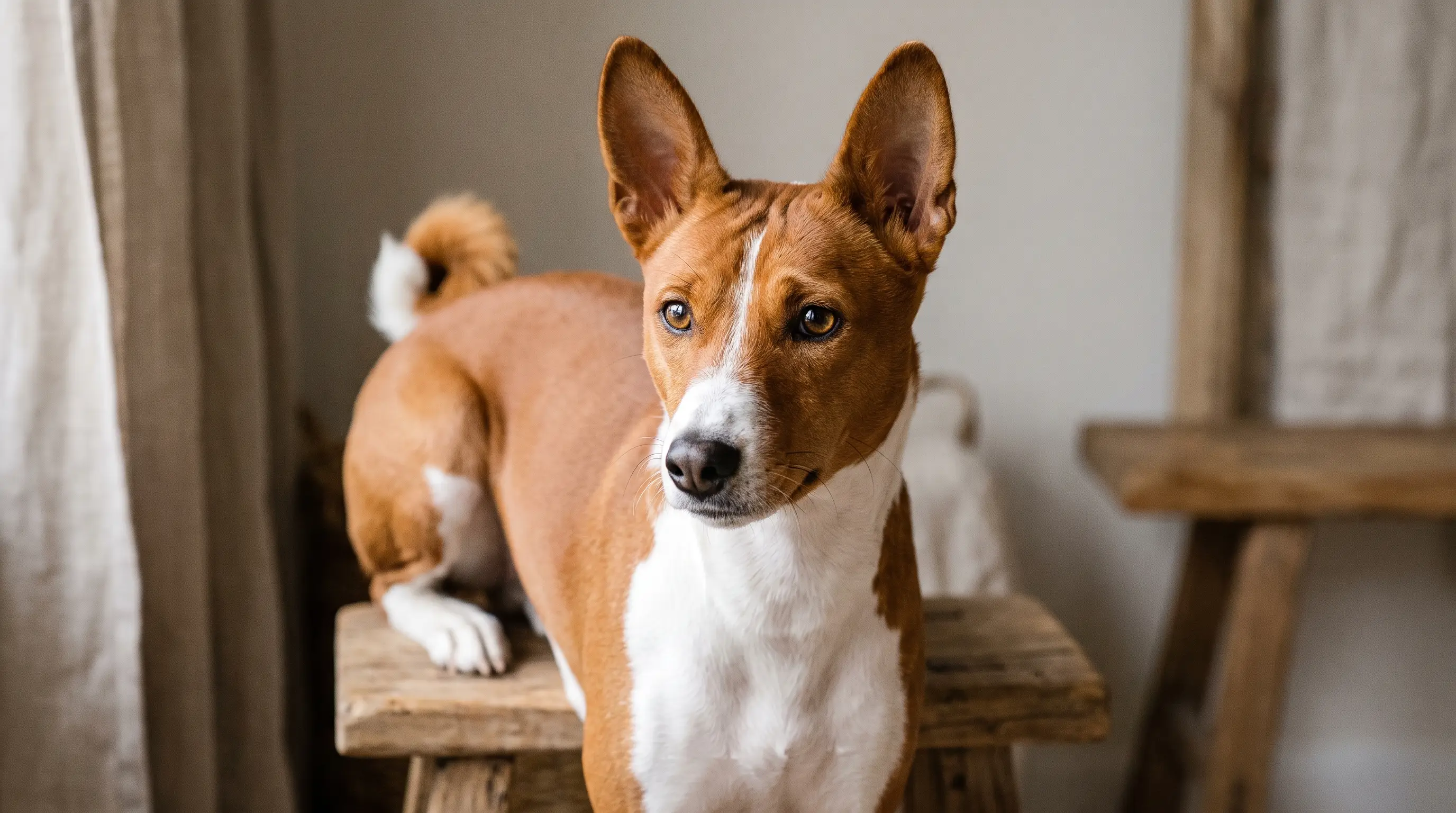
Basenji
The barkless hunter of the Congo — cat-clean, fox-quick, entirely its own dog.
Vital stats
| Size | Small · 40–43 cm |
| Weight | 9–11 kg |
| Life expectancy | 13–14 years |
| Energy | Moderate-high — 60 min/day |
| Shedding | Low |
| Coat | Short, fine · red, black, tricolour, brindle — all with white |
| Group | Hound · FCI №43 / AKC |
Breed traits
Friendliness
Care
Mind
Temperament
For thousands of years the Basenji flushed game into nets for Central African hunters, working far ahead of humans and thinking for itself. That wiring survives intact: this is a clever, watchful, self-possessed dog that solves problems — including the problem of your fence — and offers affection on its own terms.
Habits & quirks
The yodel
Its flat larynx can't produce a bark — happiness arrives as a rolling 'barroo' instead.
Cat-wash
It grooms itself fastidiously with its tongue, which is why Basenjis barely smell of dog.
Rain refusal
A desert-adjacent heritage shows: many Basenjis flatly decline to go out in wet weather.
The vertical survey
Expect it up on hind legs — or the sofa back — scanning the horizon like a little sentry.
Care
| Exercise | An hour a day of walks and sprints in safe, enclosed spaces — a bored Basenji redecorates. |
| Containment | Fences must be tall, dig-proof and climb-proof; this breed treats escape as a hobby. |
| Training | Short, rewarding sessions work; repetition and raised voices simply switch it off. |
| Health | Ask breeders for Fanconi syndrome and PRA test results — screened lines have transformed the breed's outlook. |
Common questions
Do Basenjis really never bark?
Correct — the shape of the larynx makes a true bark near-impossible. They yodel, chortle and, when properly outraged, scream instead.
Are Basenjis good for first-time owners?
Usually not. They're clean, quiet and small, but their independence and escape skills frustrate owners expecting a biddable companion.
Do Basenjis smell?
Barely at all. They self-groom like cats and have a short, fine coat — one of the least doggy-smelling breeds there is.