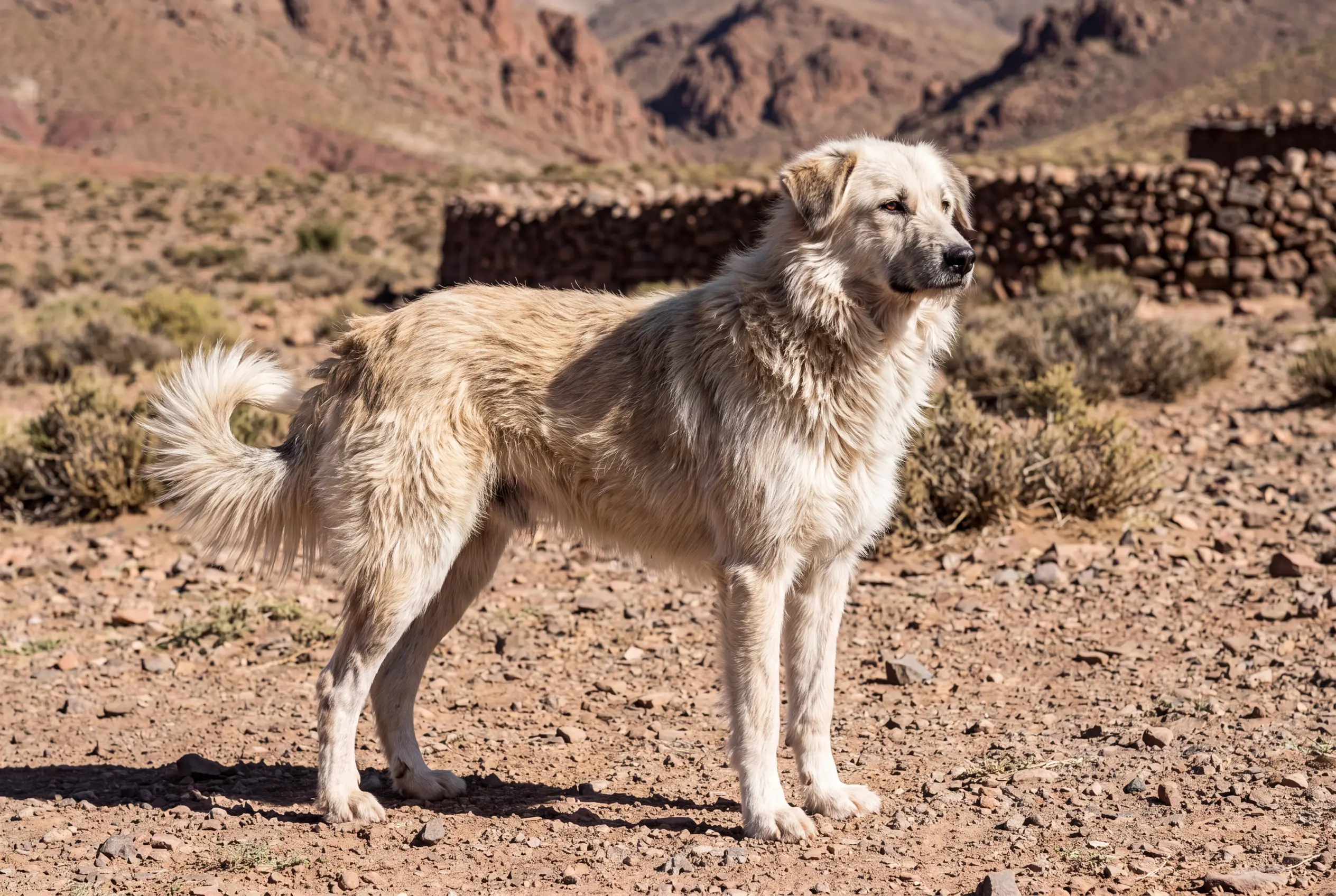
Aïdi
The Atlas guardian, at roughly a third the weight of the mastiffs it shares a group with.
Vital stats
| Size | Medium-large · 52–62 cm · one range for both sexes |
| Weight | Not set by the standard · commonly quoted at 25–30 kg |
| Life expectancy | 10–12 years |
| Energy | Moderate to high — built to keep trotting, not to lie at a gate |
| Shedding | Heavy — thick half-long coat with seasonal drops |
| Coat | Thick, harsh, about 6 cm, with a neck mane · fawn, brown or black, white spotting allowed |
| Group | Working · Mountain Dog (FCI №247, Group 2) |
| Origin | The Atlas Mountains and plateaux, Morocco |
Breed traits
Friendliness
Care
Mind
Temperament
The standard is warmer about family than most guardian standards manage: very faithful, affectionate and docile with its owner and family members. The working clause sits right behind it. Always alert, it instinctively measures the gravity and proximity of any danger and provides an appropriate and efficient response. That word measures is the one to hold on to, because it describes a dog that assesses and then acts on its own reading, without checking. Day to day the Aïdi is territorial, loud, and switched on to whatever moves at the edge of its ground. It sorts people into its own and everyone else, and the sorting is its call rather than yours. Where the heavy guardians tend to plant themselves and let their size do the arguing, this one covers the distance. It is quick off the mark and light enough to keep going, so a boundary it decides to work gets worked properly. None of that makes it difficult with its household. It makes it a working dog that happens to be affectionate at home, which is not the same thing as a companion breed.
Habits & quirks
Trots, and keeps trotting
The standard names the natural gait as a short, fast trot, single-tracking, and says that at this pace the dog seems tireless. Guardians built on mastiff lines are described walking; this one is described covering ground. It is the practical difference between the Aïdi and almost everything else in its section, and it sets the exercise bill.
The coat is equipment
Thick, harsh hair about 6 cm long, a mane over the neck and throat, long hair on the breeches, and a tail carried low and heavily plumed. The standard treats all of it as working kit rather than decoration: the fleece is protective armour against jackals, and the richness of the plume is said to denote pure breeding. Short coat and insufficient plume are both eliminating faults.
Guards the camp, not only the flock
The utilization line covers flocks and belongings together, and the history section spells out the tent. A dog bred to hold a movable camp reads a boundary as whatever it has been placed inside, which in a house means the garden, the door and the car. Moving does not reset it; it takes the job with it.
Finds what the Sloughi runs down
In Morocco the Aïdi is often paired in hunting with the Sloughi, the North African sighthound. The division is straightforward: the Aïdi has the nose and locates the game, and the Sloughi, which is faster than it by a long way, does the chasing. Worth being exact here, because the two get muddled in print. They are separate breeds with separate standards, and the FCI standard for the Aïdi describes a guardian and says nothing about hunting at all. The pairing is regional practice, not a second job on the paperwork.
Care
| Exercise | More than the guardian label suggests. Reckon on an hour and a half to two hours of real ground a day, at a pace the dog sets, with hills and long lines rather than laps of a lawn. It has the frame for it and it was never a dog that stayed put. A garden alone produces a bored, vocal Aïdi that starts finding work for itself along the fence. |
| Coat | A weekly brush handles the thick harsh hair, with more attention through the seasonal drops and to the three places the hair goes long: the neck mane, the breeches and the tail. The coat is built for sun and mountain cold at once, so leave it alone rather than clipping it. There is no dewlap and the lips are thin and tight, which means almost no drool, and the whole face stays a lot cleaner than a mastiff's. |
| Training and boundaries | Reward-based, early and wide. The Aïdi is more biddable with its own people than most livestock guardians, and it still will not hand over the decision about a stranger. Fence properly, teach a settle and a reliable recall before adolescence, and plan on managing introductions for the dog's whole life rather than socialising the guarding out of it. It does not exist to be socialised out. |
| Health | Generally hardy, and there is not much published on it. No breed health survey worth quoting exists, and there is no established screening scheme in Morocco, so the useful questions are about the parents: hips, eyes, and whether the breeder can show you the working dogs behind the litter. In hot climates plan around the middle of the day, since this is a heavy-coated dog well outside the range it was bred for once you move it north or into a city. |
Common questions
Does an Aïdi suit a home with no livestock?
For most households, no. The guarding does not switch off when the sheep are gone; the dog transfers it to your family and your boundary and works those instead, which makes flats, shared entrances and a steady stream of unfamiliar visitors the hardest setting available. It also needs a lot more daily movement than its size implies, and it barks, because barking a predator off before anything happened was always most of the job. What it takes to do well is secure fencing, ground to cover every day, someone who will manage every introduction for a decade, and neighbours far enough away. People who have kept a livestock guardian before and want this one in particular tend to get on with it, partly because it is light enough to physically manage and cleaner in the house than the mastiff-type guardians. Anyone hoping for an easygoing family dog in a moderate package should look elsewhere.
Can you get one outside Morocco?
Rarely, and the market around it is a problem. Almost the whole population sits in Morocco, there is no established breeding base in Europe or North America, and the purebred Aïdi is reported to be declining at home as semi-nomadic pastoralism does. Moroccan press and breed advocates have described puppies being bought up and moved abroad at high prices, which is worth knowing before you go looking. The other trap is naming. North Africa has plenty of loose-living village and camp dogs of no fixed breed, and some of them are sold as Aïdi on the strength of a thick coat. If a dog is offered with no pedigree, no traceable parents and no connection to the Moroccan club that keeps the breed, treat the name as decoration.
Is it a shepherd dog, and is it related to the Sloughi?
No on both counts, and both come up often enough that the standard addresses the first one directly. The Aïdi is still sold in some places as the Atlas Shepherd Dog, a name that goes back to how the breed was first written up, and the current standard rejects it outright: there are no sheepdogs in the Atlas region, and this dog has never herded anything. It guards. As for the Sloughi, that is a separate FCI breed, a smooth-coated sighthound of a completely different build, and the two are linked only by working together, one finding and one chasing. A thickly coated, half-dropped-eared guardian of 52 to 62 cm has nothing in common with it beyond a country.