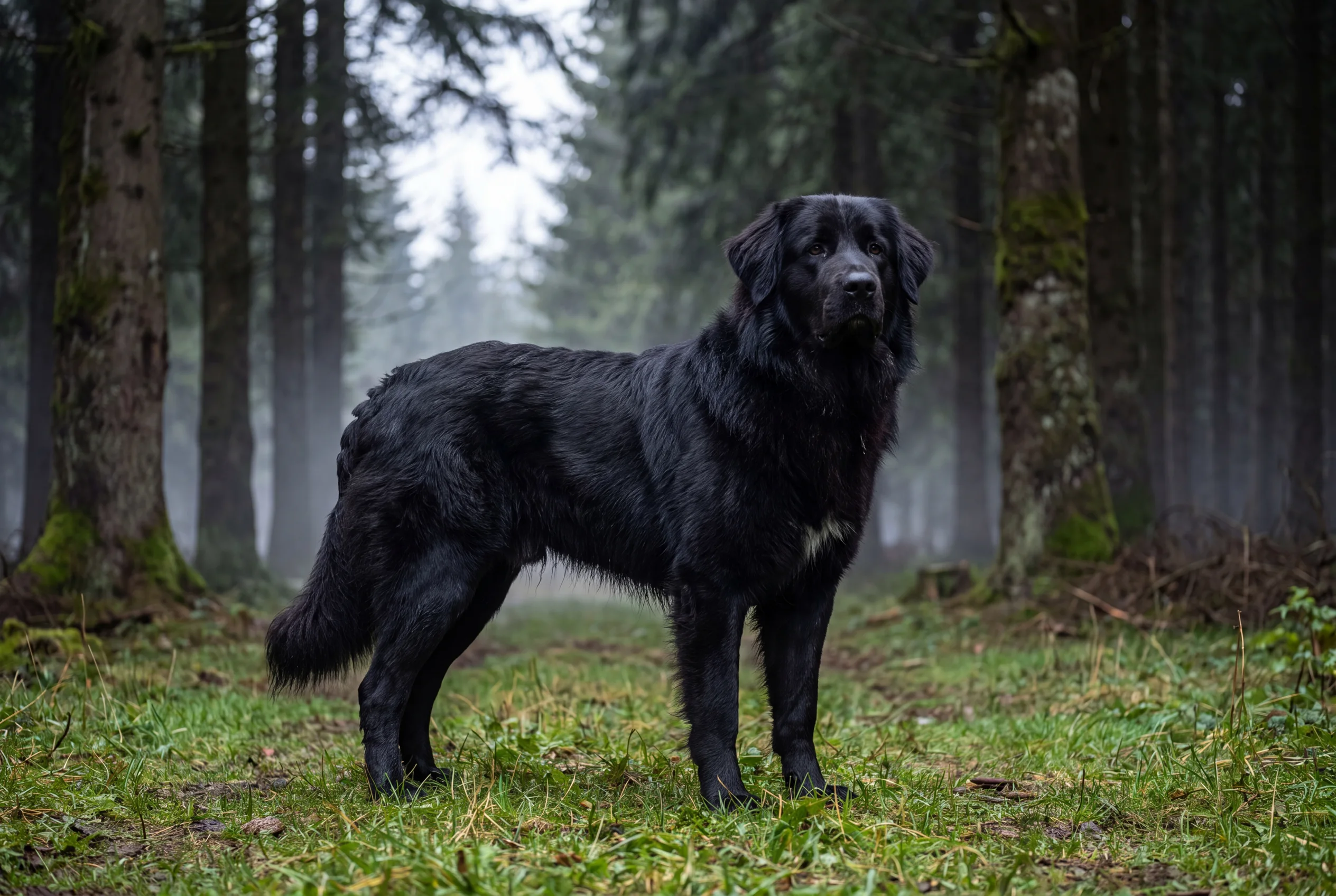
Ciobănesc Românesc Corb
Romania's raven-black guardian, whose standard counts the white.
Vital stats
| Size | Large · 70–80 cm males, 65–75 cm females |
| Weight | Not set by the standard · commonly cited 45–65 kg |
| Life expectancy | 10–12 years |
| Energy | Moderate — a patroller's pace, held in reserve |
| Shedding | Heavy — long rough coat over a dense undercoat |
| Coat | Long (7–10 cm), flat and rough · black, or over 80% black with white on chest and forelegs |
| Group | Working · Mountain Dog (FCI №373, Group 2) |
| Origin | The southern Carpathians and sub-Carpathian Romania |
Breed traits
Friendliness
Care
Mind
Temperament
The standard opens with balanced and calm, then adds a well developed guardian instinct, obedient and attached to his masters, and diffident towards strangers. That word obedient is worth pausing on, because most livestock guardian standards go out of their way to describe a dog that decides for itself. The Corb is written as more handler-oriented than that, and owners describe the same thing: a dog that stays near its people, takes direction from them, and does not argue for the sake of it. What the word does not mean is biddable in the way a working shepherd dog is biddable. The job was still to hold ground at night, at distance, against animals the standard names outright — bear and wolf — and a dog bred to make that call does not hand the decision back. Around the house a settled Corb is quiet and undemanding and spends most of the day lying where it can watch the approaches. Strangers get logged, not greeted. The bark is written into the standard as loud, profound and audible from a great distance, which is a feature on a mountainside and a problem on a terraced street.
Habits & quirks
The colour is a measurement
Most standards describe a colour. This one counts it. More than 80 percent black; white confined to the chest and forelegs; white on the front of a foreleg stopping below the metacarpal joint but permitted almost to the elbow behind; more than 30 percent white on the body a disqualification; white on the tips of the hind toes overlooked. There is even a tie-break, in which the blacker of two otherwise equal dogs is preferred. No other colour may appear on the white.
Summer turns it rusty
A coat this dark bleaches, and the standard refuses to hold it against the dog: a reddish tinge from prolonged exposure to the sun over summer is not to be penalised. It is a small clause that tells you what kind of dog the writers had in mind — one that lives outdoors through the season rather than one presented in a ring.
Mane, fringes and trousers
The head and the fronts of the legs carry short hair. Everything else is 7–10 cm of rough, flat, straight coat over a dense undercoat, drawn out into a mane over the neck, fringes down the back of the forelegs, full culottes behind and a bushy natural tail. A coat under 6 cm is listed as a severe fault, so the length is deliberate rather than incidental.
A skull given in centimetres
Breed standards rarely put a tape measure on a head, and this one does: skull width 16–18 cm in males and 15–17 cm in females, with the skull's length and width approximately equal, so it reads square from above. Slightly domed from the front, almost flat from the side, with V-shaped ears set just above eye level and carried close to the cheeks.
Care
| Exercise | Less than the frame suggests and more than a mastiff needs. An hour to ninety minutes of steady walking a day suits an adult, ideally on hill ground rather than pavement, and the dog will happily spend the rest of the day still. It is not built for running sports and has no interest in fetch. Growth is the constraint that catches people out: keep a youngster off stairs, jumps and long forced distances well past its first birthday. |
| Grooming | This is the real workload, and it is where the Corb parts company with the smooth-coated southern guardians. A long rough outer coat over a dense undercoat needs a thorough brush weekly, working right down to the skin rather than skimming the top. Mats form behind the ears, in the mane and in the culottes. When the undercoat goes, twice a year, expect daily sessions and a great deal of black hair. Do not clip it; the coat is the insulation, in both directions. |
| Training and visitors | Do all of it while you can still physically manage the dog, which is a shorter window than most people plan for. Lead manners, a settle, a place command and a rehearsed routine for the doorbell should be solid at 25 kg, not attempted at 60. Reward-based work suits the breed and heavy handling does not. Socialise hard and widely through the first two years, then keep managing introductions for life — the guarding does not switch off because the dog met a lot of people as a puppy. |
| Health | There is no breed-specific health scheme to lean on. The breed is new to the FCI, the documented population is small, and nobody publishes screening statistics for it, so you are relying on the individual breeder. Ask for hip and elbow scores on both parents as a minimum, plus an eye check and a look at the heart. A deep chest on a dog this size carries a real gastric torsion risk, so split meals, keep exercise away from them and learn the signs. Treat any confident claim about the breed's health as an opinion until someone shows you the paperwork. |
Common questions
How is it different from Romania's other shepherd dogs?
Colour separates them fastest. Romania has four shepherd breeds and only the Corb is black. The Mioritic (FCI №349) is the long shaggy one, white-based with well-defined black or grey markings, or solid white or grey. The Carpatin (FCI №350) is pale fawn overlaid with black, so it reads wolf-grey, with a shorter coat and a lighter, faster build. Both of those sit in FCI Group 1 with the sheepdogs. The Bucovina (FCI №357) is the closest comparison, because it shares the Corb's Group 2 mountain-molossoid classification and a similar size, but it is a white or white-beige dog carrying distinct grey or black patches. Its standard does technically permit a solid black dog while discouraging it, which is the one place the two overlap on paper. In practice the Corb's habitat sets them apart as well: the Corb belongs to the southern Carpathians and the counties below them, the Bucovina to the north-east.
Does a Corb suit a home without livestock?
For most households, no. Take the sheep away and the guarding does not stop; the dog simply promotes your family and your boundary to the job, which makes shared entrances, a garden onto a public path and a steady flow of unfamiliar visitors the hardest possible setting. The bark alone will decide the matter in many places — the standard specifies a voice audible from a great distance, and it was selected for exactly that. Against this, the Corb is described as calmer and more attached to its handler than several breeds in its class, and it is genuinely quiet indoors once mature. It can do well with secure fencing, ground of its own, neighbours at a distance, an owner who will manage introductions for a decade, and time set aside for the coat. Anyone hoping for a large easy-going family dog should look at something else first.
Is it a fully recognised FCI breed?
Not yet. The FCI accepted the Ciobănesc Românesc Corb on a provisional basis on 17 September 2024, with the standard published the same month as number 373. Provisional acceptance is real recognition: the dogs go into FCI stud books, they can be entered and judged at international shows, and they can compete for the CAC. What they cannot yet win is the CACIB, the international beauty championship certificate, which stays closed to a breed until its acceptance becomes definitive. That takes time by rule — the FCI asks for a minimum of five generations and at least ten years from provisional recognition before a member country can even apply — so the earliest the Corb could move to definitive status is September 2034. Romania's own kennel association had approved a national standard well before any of this, on 14 November 2008, updated in 2011. It is not an AKC breed and has not been accepted into the AKC's Foundation Stock Service either, unlike the Mioritic and the Carpatin. Practically, this is a young entry on the international register, and figures quoted for population, weight and lifespan come from breed sources rather than published registry returns.