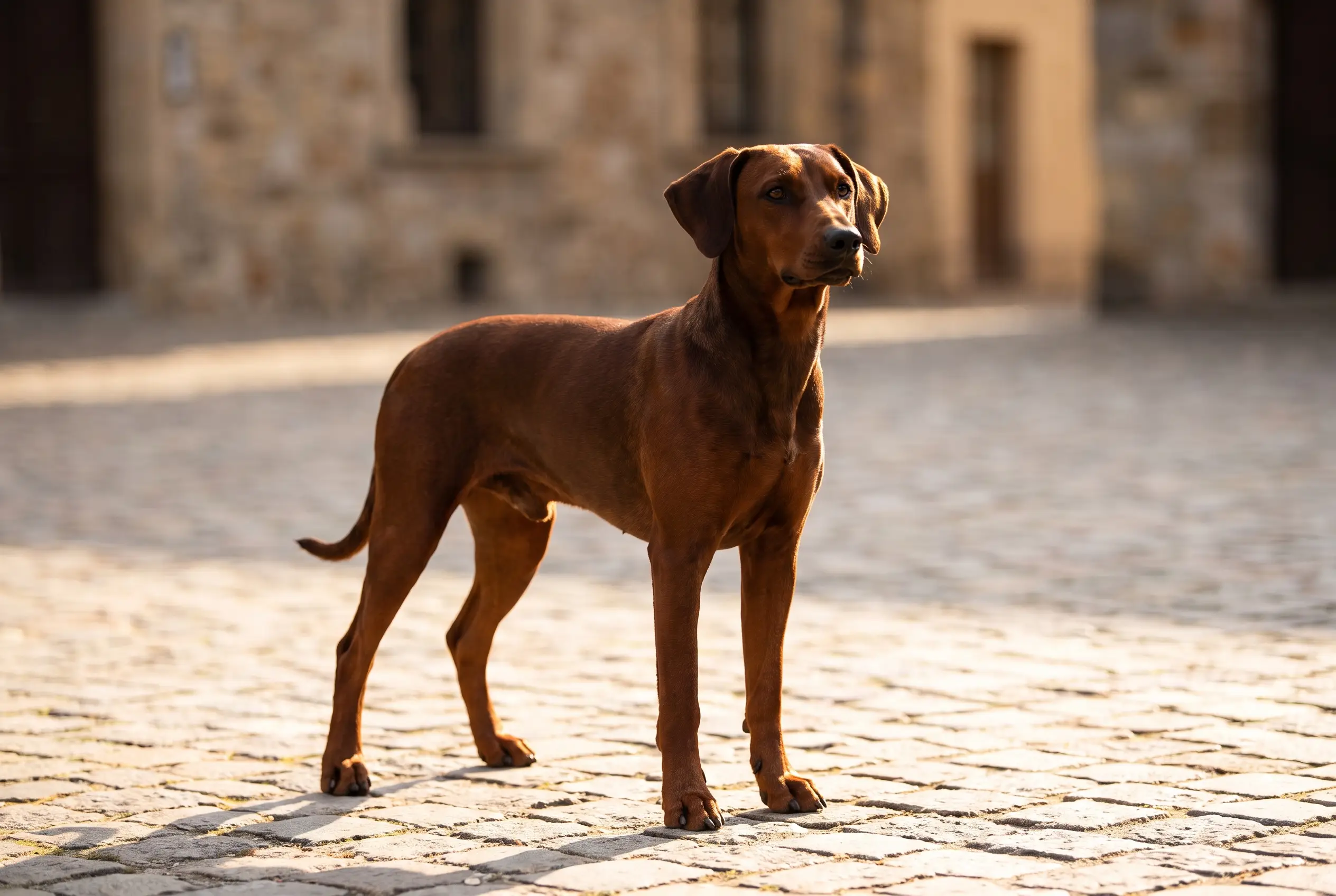
German Pinscher
The pinscher the others came from, and it never stopped working.
Vital stats
| Size | Medium · 45–50 cm |
| Weight | 14–20 kg |
| Life expectancy | 12–14 years |
| Energy | High — a daily hour plus work for the brain |
| Shedding | Low — short single coat, light drop year-round |
| Coat | Short, smooth and glossy · black-and-tan or shades of red |
| Group | Working · Pinscher (FCI №184, Group 2) |
| Origin | Germany |
Breed traits
Friendliness
Care
Mind
Temperament
The German Pinscher is alert, self-assured and permanently switched on. It was kept to notice things — rats in the feed, strangers in the yard — and it still notices everything. It learns fast and works with real drive, but it also thinks for itself, so training has to stay interesting or the dog starts improvising. The prey drive is genuine: small animals that run will be chased. With its family it is affectionate and playful, often attached to one person above the rest; with strangers it holds back and watches. Without early training and enough to do, the watching turns into announcing.
Habits & quirks
Perimeter check
Every trip to the garden starts with a patrol of the fence line. Ratting was the original job, and the shift never officially ended.
Under the blanket
The coat is short with almost no undercoat, so on a cold evening the dog is inside the duvet, not on top of it.
The announcer
Doorbells, delivery vans, the neighbour's cat — everything gets reported. Training teaches it what counts as news; nothing makes it stop broadcasting.
One eye open
Even flat out on the sofa it tracks the room. Guarding was half the job description, and it takes that half seriously.
Care
| Exercise | An hour a day at minimum, with running and games that use the nose or the brain. A worked German Pinscher is fine in a flat; an underworked one redecorates it. |
| Training | Start early, keep sessions short and rewarding, and be more consistent than the dog. Recall needs lifelong practice — prey drive beats obedience the day a squirrel runs. |
| Grooming | A weekly rub-down with a hound glove keeps the short coat glossy. Shedding is light and baths are rare; nails and teeth need more attention than the coat does. |
| Health | A hardy breed overall. Ask breeders for hip, eye and cardiac screening, and for von Willebrand's disease testing — some lines carry it. |
Common questions
Is the German Pinscher just a bigger Miniature Pinscher?
It is the other way round: the German Pinscher is the original, and the Miniature Pinscher was bred down from it. The Doberman also began with foundation stock from this breed, selected upward in size for guard work. All three share the outline; the German Pinscher is the mid-size the family started from.
Do German Pinschers make good apartment dogs?
Yes, if the flat comes with an active owner. The breed is compact, clean and nearly odour-free, and it settles well once exercised. What a flat does not fix is the voice — an untrained German Pinscher announces the whole stairwell, so daily outings and training are part of the rent.
Why are German Pinschers so hard to find?
The breed nearly disappeared after the Second World War, and Werner Jung re-founded it in the late 1950s from oversized Miniature Pinschers. Numbers recovered but never grew large — the AKC only recognised the breed in 2003. Expect a waiting list, and a breeder who interviews you right back.