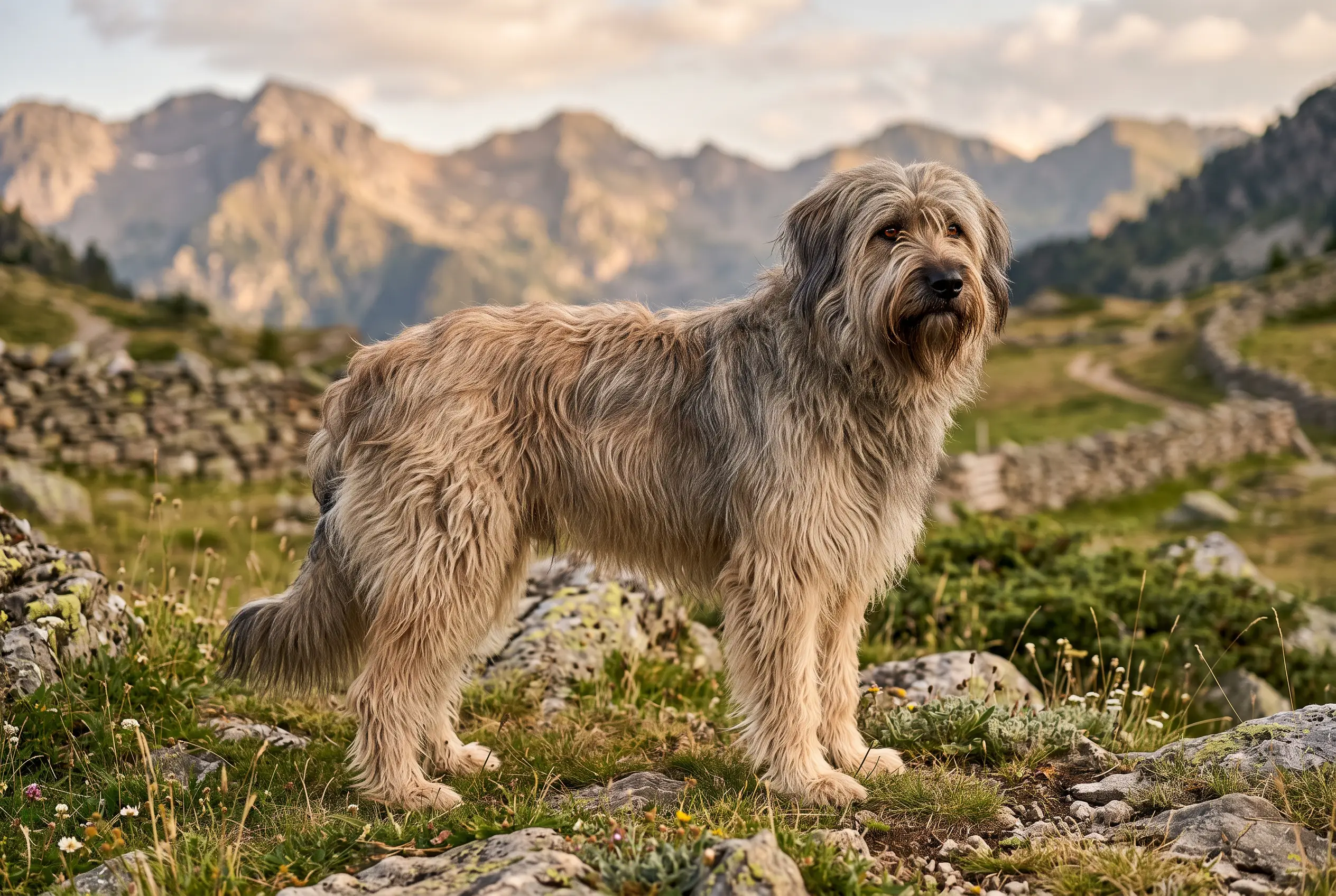
Gos d'Atura Català
A beard, a fringe, and a flock to keep together.
Vital stats
| Size | Medium · 45–55 cm |
| Weight | 16–25 kg — the standard sets none and published figures vary |
| Life expectancy | 12–14 years |
| Energy | High — a herding dog that wants a job, not only a walk |
| Shedding | Moderate to high — the moult comes in two waves, front half first |
| Coat | Long, flat or slightly wavy, harsh, with thick undercoat over the rear third · fawn, sable or grey |
| Group | Herding · Sheepdogs, without working trial (FCI №87, Group 1) |
| Origin | Catalan Pyrenees, Catalonia (Spain) |
Breed traits
Friendliness
Care
Mind
Temperament
The FCI standard asks for a sedate, active, intelligent dog with a noble expression, hardy and pleasant, devoted to the shepherd and the flock entrusted to him, and wary of strangers, 'which at times make him seem unsociable'. That description survives the move into a house almost word for word. The breed usually picks one adult and stays with them, learns quickly, works for praise rather than pressure, and takes visitors at its own speed. It was also selected to think for itself: the same standard credits it with directing a flock on its own initiative, stopping animals from breaking away without being told to. A Gos d'Atura with nothing to organise finds something to organise — the children, the other dog, the person at the gate. Early and patient socialisation is what keeps the built-in reserve from setting into suspicion.
Habits & quirks
Moults in two halves
The standard describes it and owners live with it: the front of the coat goes first, so for a few weeks the dog looks like two different dogs joined at the ribs. Then the back half follows and it evens out again.
Picks a person
Bred to spend the whole day beside one shepherd, it tends to choose one adult in the house and shadow them from room to room. Everyone else is family. That one person is the job.
Makes the call itself
It was kept for holding a flock together without instructions, and it does not switch that off. Expect a dog that reads the situation and acts a second before you say anything.
Answers the gate
Wary of strangers is written into the standard. There will be a bark at the door, a wide arc around the visitor, and a dog that only relaxes once its person has.
Care
| Grooming | The real running cost of the breed. Brush down to the skin at least twice a week and go straight for the places that felt first: behind the ears, the beard, the armpits, the trousers and the tail. Scissors make mats worse; a slicker and patient line-brushing take them out. Leave the coat on — it works against summer heat as well as winter. |
| Exercise | An hour or two a day, with part of it as work rather than distance: herding lessons, agility, tracking, scent games, trick training. This is one of the breeds that fills agility clubs, and for good reason — it stays interested long after most dogs have had enough. |
| Training | Fast, willing and thin-skinned about a raised voice, so reward-based work wins. Start socialising at eight weeks and keep going: strangers, traffic, livestock, other dogs. The reserve is normal for the breed and needs steering, not suppressing. |
| Health | A hardy mountain breed. Hips are the main screening priority, with eyes worth checking too — progressive retinal atrophy and cataract both appear. Because the modern population was rebuilt from very few dogs in the 1970s, ask a breeder about the inbreeding coefficient of the litter as well as the test results; the Generalitat's own dossier names consanguinity as the breed's open problem. |
Common questions
Is a Gos d'Atura Català a good family dog?
In an active household, yes. It lives close to its people, is gentle with the children it grows up with, and at 16–25 kg fits almost anywhere. Two honest caveats. It is reserved with strangers by design, so socialisation is not an optional extra. And it was built to work all day next to a shepherd; without exercise and something to think about, it will herd the household and give an opinion on everything that passes the window.
How much grooming does that coat really need?
More than the photos suggest. The long harsh outer coat and the dense undercoat over the rear third felt up behind the ears, in the beard, under the elbows and along the trousers, and the moult arrives in two waves instead of one. Twice a week to the skin keeps it under control; skip a month and it becomes a strip-out at the groomer. There was once a short-haired variety that avoided all of this, and it is effectively gone.
Was Cobi, the Barcelona 1992 mascot, a Catalan Sheepdog?
Yes. Javier Mariscal drew Cobi as a Gos d'Atura for the 1992 Olympic Games, in a cubist style that keeps the ears, the muzzle and the origin and very little else. If you were looking for the breed in that mascot and could not find it, that is why.