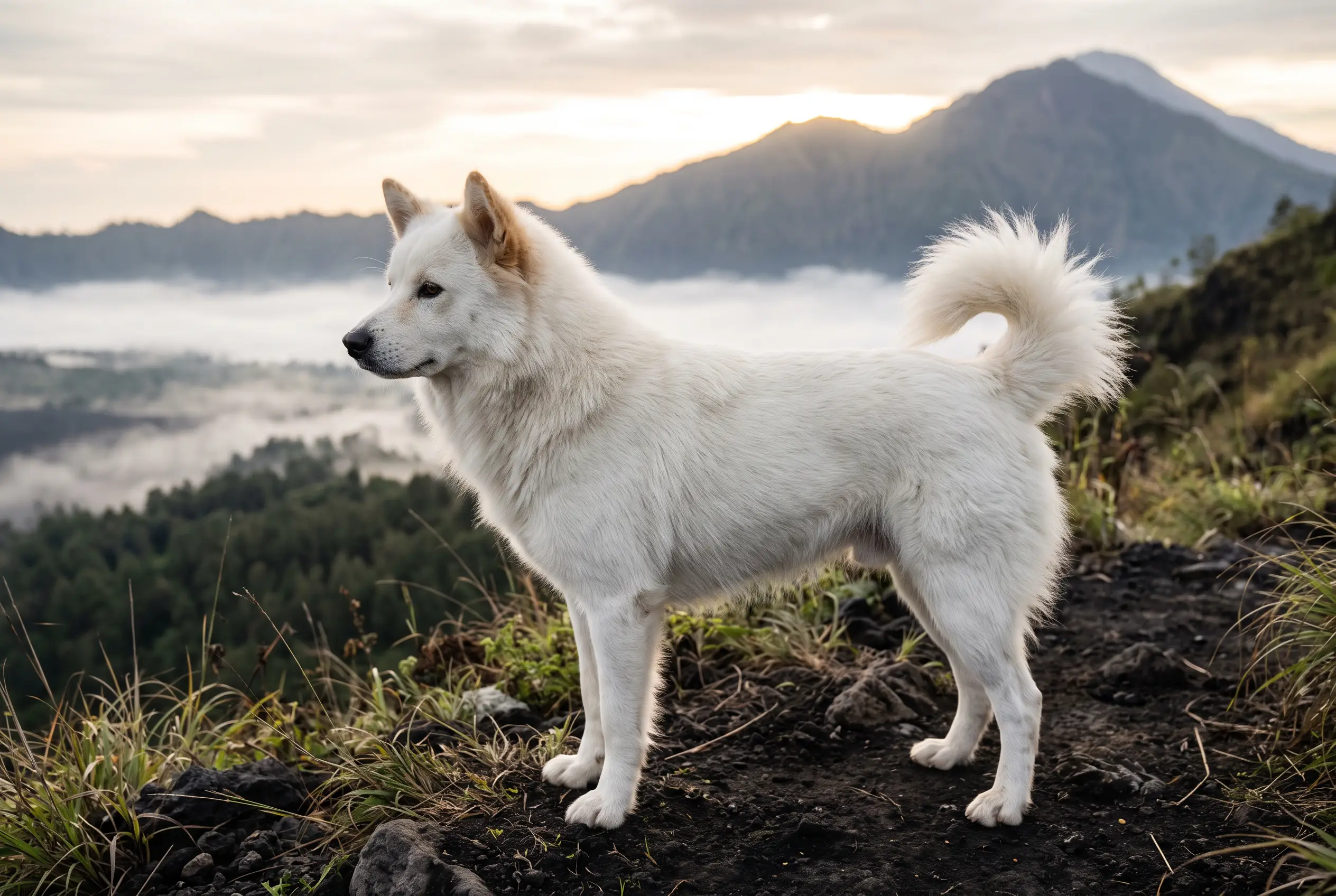
Kintamani
Bali's mountain spitz, white with biscuit-edged ears, and the first Indonesian breed on the FCI list.
Vital stats
| Size | Medium · 49–57 cm (males), 44–52 cm (females) |
| Weight | 15–18 kg (males), 13–16 kg (females) |
| Life expectancy | 12–15 years — breed literature; the standard sets none |
| Energy | Moderate to high — 1–2 hrs/day by breed literature |
| Shedding | Steady year-round, heavier when the undercoat goes |
| Coat | Harsh double coat with a neck ruff · white, black, fawn or brindle only |
| Group | Non-Sporting · Asian Spitz and related breeds (FCI №362, Group 5) |
| Origin | Sukawana, Kintamani district, Bali, Indonesia |
Breed traits
Friendliness
Care
Mind
Temperament
Watchful, intelligent, alert, gentle, loyal and easy to train: six words, and the whole of what the standard says about character. Utilization is listed as companion dog, aggressive or overly shy dogs are disqualified, and there is no working trial. Breed literature from Bali and from the genetic work on the breed reads harder than that, describing an independent, territorial dog that guards a compound and picks its people. Both descriptions are honest about the same animal. It bonds hard and close, takes training well from someone it has decided about, and treats an unannounced visitor as a problem to be reported. Meeting other dogs and other animals is where it costs most: the temper that made it useful around a Balinese household does not come with an interest in sharing the yard. Early, patient socialisation is the difference between a good watchdog and a dog that barks at everything.
Habits & quirks
Four colours, no fifth
White, black, fawn or brindle. Any other colour is a disqualifying fault, which puts an otherwise typical dog out of the ring on coat alone. White dogs are meant to have biscuit-coloured ear edges, and a plain white ear is accepted but not preferred.
Badong and bulu gumba
The long harsh hair that rings the neck has a name in the standard, badong, and so does the longer coat over the withers that carries around the back, bulu gumba. Both are heavier on males, and a judge looking at two dogs of the same colour will see the sex in the shoulders first.
Ears up by the first birthday
Fully erect ears are required after 12 months of age, and a dog whose ears are not up at twelve months or later is disqualified. They sit slightly below the top of the skull, wide apart, triangular with rounded tips, and face forward.
Whelps underground
Bitches are reported to dig burrows in the earth and litter in them, a habit the breed kept from the free-roaming Bali dogs it came out of. This comes from the research literature rather than the standard, but it is the detail owners on Bali mention first.
Care
| Exercise | One to two hours a day of walking, exploring and play, on a long line where livestock or loose dogs are around. Bred as a companion rather than for a job with a trial attached, so it needs less mileage than a sledge or herding breed, and it still gets restless and loud on a schedule of short garden trips. |
| Grooming | A thorough brush twice a week, daily through the seasonal shed, with extra attention to the ruff and the feathered tail where the undercoat mats. Bathing every six weeks or so is plenty. Thin coat on the tail is a disqualifying fault, which is worth knowing before anyone reaches for clippers. |
| Training | The standard calls it easy to train, and the family part is. The stranger part is the work: socialise the puppy to visitors, traffic, other dogs and other species from the day it comes home, and reward quiet as deliberately as you reward obedience. Short sessions, clear rules, no heavy handling — an independent spitz that decides you are unfair simply stops cooperating. |
| Health | Numbers are the honest gap here. There is no breed health survey, the FCI recognition is only a few years old, and the 12–15 years quoted everywhere comes from breed literature rather than study data. The founding population is broad, which helps, but ask a breeder for hip and eye results and for the pedigree behind the dog. Coming from a cool highland at 1,500 m, it needs shade, water and early walks in a hot lowland climate, and the double coat picks up humidity, so check skin under the ruff. |
Common questions
Is the Kintamani officially recognised?
Provisionally. The FCI published standard No. 362 on 13 June 2018 and accepted the breed on a provisional basis on 20 February 2019, which is what Indonesian press reported at the time as international recognition. Provisional status means the breed appears in the nomenclature and can be shown at FCI events, but it is not yet eligible for the international beauty championship title, and the FCI page lists no definitive date. It is the first Indonesian breed to get that far.
Is it just a Bali street dog with papers?
It came from them, and the genetics say so plainly: the 2005 Journal of Heredity study found the Kintamani evolved out of Bali's free-roaming dogs with little loss of genetic diversity, sitting closer to the Australian dingo than to the AKC-recognised Asian breeds. What separates the two now is selection and a written standard — a fixed size, a rectangular outline, erect ears by twelve months, a harsh double coat with a ruff, and four permitted colours. The Bali street dog population is short-coated and comes in everything.
Is it a good family dog?
For its own family, yes, and firmly so. It is affectionate at home, easy to train with people it trusts, and a natural watchdog without needing to be taught. The caveats are real: it is territorial with strangers, often difficult with other dogs and small animals, and it wants a household that socialises seriously from puppyhood. Outside Indonesia it is also hard to find, and a hot, humid climate is harder on it than on most tropical breeds, precisely because it came from a cool mountain, not a beach.