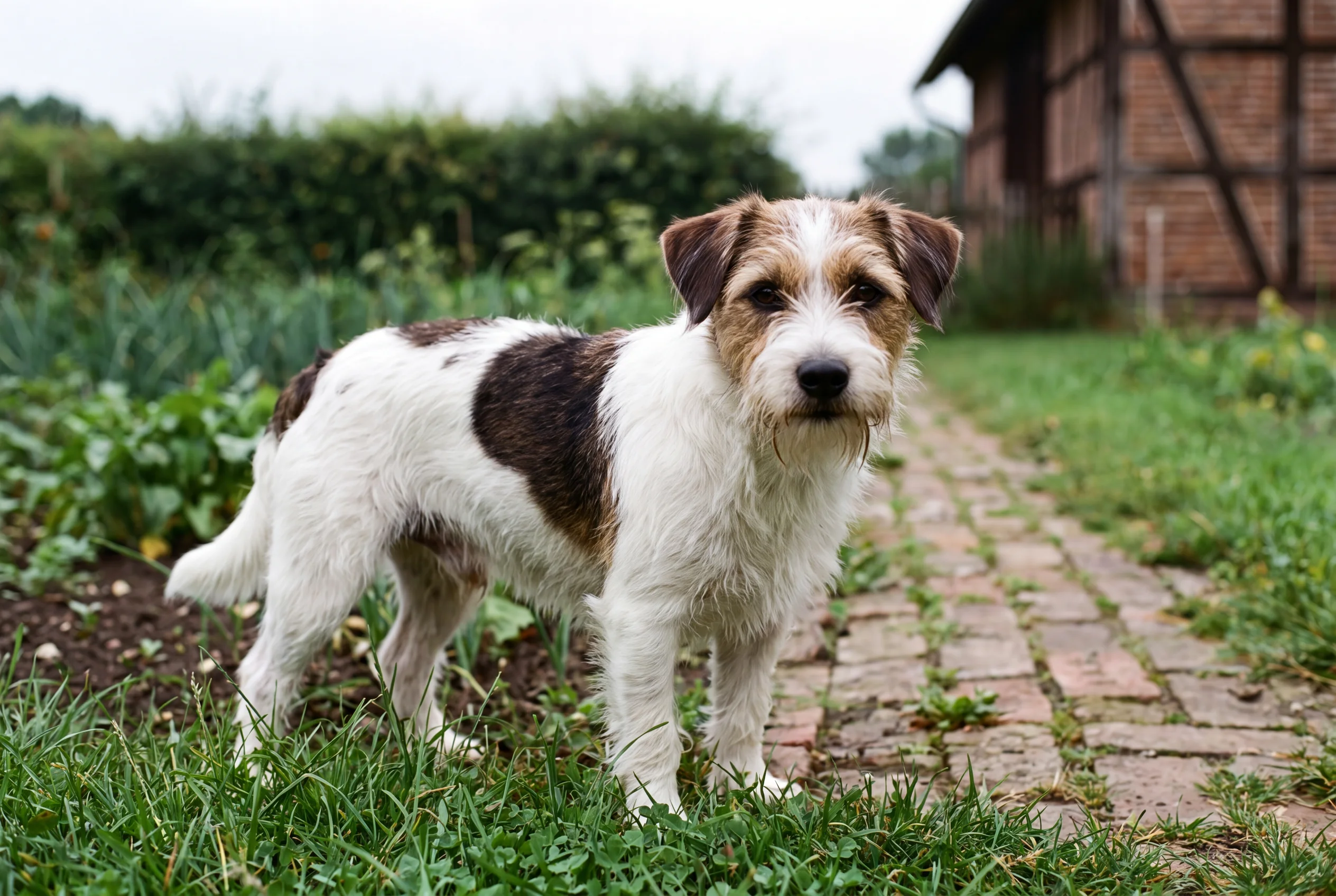
Kromfohrländer
A whole breed built out of one stray called Peter.
Vital stats
| Size | Medium · 38–46 cm |
| Weight | Males 11–16 kg · females 9–14 kg |
| Life expectancy | 13–15 years |
| Energy | Moderate — a long daily walk, not a working schedule |
| Shedding | Moderate — both varieties carry a soft undercoat |
| Coat | Rough-haired with beard or smooth-haired · white with light to very dark brown markings |
| Group | Non-Sporting · Companion (FCI №192, Group 9) |
| Origin | Siegerland, North Rhine-Westphalia, Germany |
Breed traits
Friendliness
Care
Mind
Temperament
The FCI standard calls it adaptable, docile and high-spirited, somewhat reserved about strangers, with a little hunting instinct. Owners put it more bluntly: the dog picks a person and spends the next fourteen years within a couple of metres of them. It was bred for no work at all, only for company, and it shows in how badly it takes being left alone for long stretches. Visitors get barked at first and assessed second. Most Kromis need ten minutes to decide about a guest and then attach themselves to that guest for the evening. The terrier survives in the alarm bark and in the occasional rabbit, not in the temper, and this is not a dog that starts anything. It is thin-skinned about correction. Heavy-handed training does not produce an argument, it produces a dog that stops offering behaviour at all.
Habits & quirks
Sneezes at you
A lot of Kromfohrländer greet people with a sneeze, and many pull the lip back into something that reads as a grin. Neither behaviour is in the standard and neither has been studied, but they come up in almost every owner account of the breed.
Follows you room to room
It settles wherever you settle and gets up when you get up. Owners who work from home rate this highly; owners who leave the house for eight hours usually need a plan, because separation problems are one of the commonest complaints in the breed.
Announces the door
Quiet most of the day, loud about anyone who approaches the house. The barking is answerable with training but it is there by default, which is worth knowing before you take one into a flat with thin walls.
Keeps just enough hunting instinct to matter
The standard allows it a little, and a little is what you get: a Kromi will follow a rabbit line for thirty seconds and then look back at you. That is a different problem from a scenthound, and most owners get a workable recall out of it.
Care
| Exercise | About an hour a day of walking and sniffing covers it, and it will happily do five hours on a Sunday. There is no working drive to burn off, so nosework, tricks and training games do more for a Kromi than extra distance. |
| Grooming | Neither coat is clipped. The standard caps the hair at 7 cm over the back and about 3 cm on the sides, and both varieties sit on a short soft undercoat. Brush weekly, more in the moult, and clean the beard on a rough-haired dog after meals. Feathering on a smooth-haired dog mats behind the elbows and thighs if you skip it. |
| Training | Reward-based and light-handed, from a breed that reads tone. Socialise early and deliberately against the reserve toward strangers, and teach short absences from the first week home rather than after the first destroyed door frame. |
| Health | This is the part to take seriously. A two-dog founding population left the breed with hereditary footpad hyperkeratosis, von Willebrand disease type I, idiopathic epilepsy, cystinuria, hyperuricosuria, hereditary cataract and autoimmune conditions including haemolytic anaemia and polyarthritis. DNA tests exist for footpad hyperkeratosis, von Willebrand type I, degenerative myelopathy and prcd-PRA. There is no test for the epilepsy, which is why pedigree honesty matters more here than a test certificate. |
Common questions
Rough-haired or smooth-haired?
Same breed, same standard, and temperament does not track coat, so choose on upkeep. The rough-haired dog has a beard and a harsh jacket that collects mud and needs the muzzle wiped after every meal. The smooth-haired dog has no beard, a coat lying flat to the body, and feathering on the ears, throat, chest, tail and the backs of the legs that will mat if it is ignored. Both shed. Under VDH clubs all the hair varieties are approved for breeding and cross-variety matings are permitted, which is why two rough-haired parents can still produce smooth puppies; two smooth parents produce only smooth.
How bad is the health picture, and what do I ask a breeder?
Bad enough that it should decide your choice of breeder. Ask for DNA results on both parents for hereditary footpad hyperkeratosis and von Willebrand type I, not a verbal assurance. Ask what the inbreeding coefficient of the planned mating is and over how many generations it was calculated, because a low number over five generations means very little in a breed this closed. Ask directly whether any dog in the last three generations has had seizures, and listen to how the answer is given. German breeding is split on exactly this question: the VDH-affiliated Rassezuchtverein breeds inside a closed stud book, because the VDH declined the proposal to open it, while ProKromfohrländer e.V., founded in 2010, crosses to the Dansk-Svensk Gårdshund and backcrosses F1 dogs to purebred Kromfohrländer through F2 and F3. Those project dogs are not FCI-registered. A buyer is picking a side, and a breeder who cannot explain their side is the wrong breeder.
Does the whole breed really come from one dog?
Effectively, yes. Peter and Fifi had seven litters, nine offspring went into the stud book, three of those bred on, and the book was closed on that base. A 2019 study of the von Willebrand type I variant is a fair measure of what that costs: of 87 Kromfohrländer genotyped, 65.5 per cent carried one copy of the mutation and 15 per cent carried two, giving a mutant allele frequency of 48 per cent. Nothing about the founding story was reckless at the time, and the breed is a genuinely nice dog to live with. It is also a working demonstration of what a closed stud book does to a population that started with two animals.