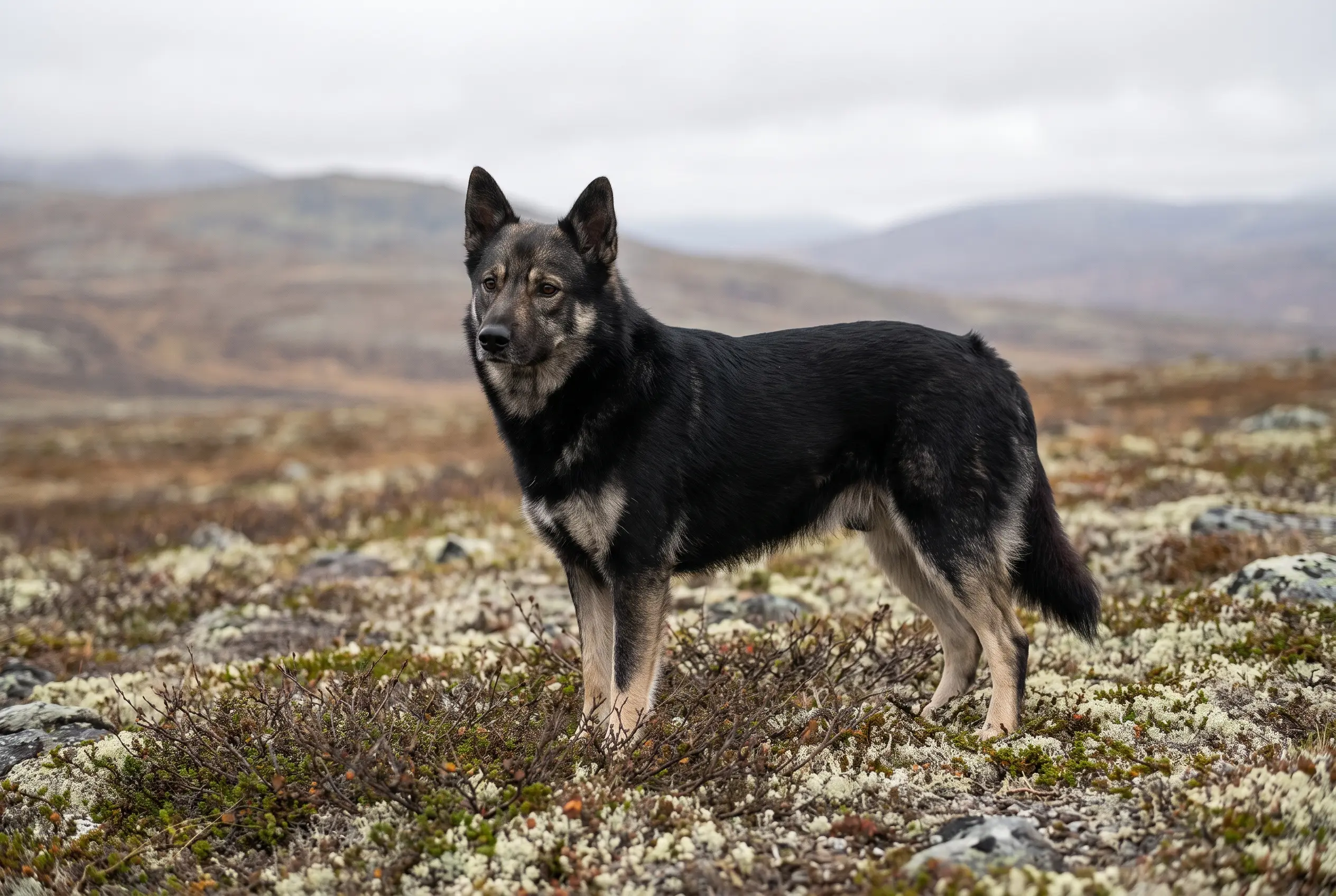
Lapponian Herder
The reindeer herder with the spitz coat and the tail that stays down.
Vital stats
| Size | Medium · 48–54 cm (dogs), 43–49 cm (bitches) |
| Weight | About 18–23 kg — breed literature; the standard sets none |
| Life expectancy | 12–14 years — breed literature, not survey data |
| Energy | High — a working reindeer herder: 1–2 hours a day, plus a job |
| Shedding | Heavy, with two seasonal blows |
| Coat | Harsh, rather erect medium-to-long topcoat over a fine dense undercoat · black, grey or dark brown with lighter markings |
| Group | Herding · Nordic Watchdogs and Herders (FCI №284, Group 5) |
| Origin | Lapland, Finland |
Breed traits
Friendliness
Care
Mind
Temperament
The standard's words are docile, calm, friendly, energetic and willing to work, followed straight away by "barks readily when working", which is the honest part. Herding reindeer across open fell means moving animals you cannot touch and cannot outrun, so the tool is the voice, and the dog that does it well is the dog that uses the voice freely. At home that setting does not switch itself off; it needs something to point at. The Finnish Kennel Club puts it bluntly on its own breed page: friendly to people, but not suited to being a companion dog only, because it demands action. The standard finds room for one more detail worth repeating. The expression is intelligent, and in bitches also humble. This is a soft dog in the sense that it wants to work with you, not in the sense that it will settle for a walk.
Habits & quirks
The tail stays down
Low-set, hanging at rest, carried level with the back in movement, and never over it — a curled tail is a fault. It is the quickest way to tell a Lapponian Herder from a Finnish Lapphund at fifty metres.
Barks at work
The standard says it barks readily when working, and reindeer are moved at a distance by voice. A Herder with nothing to do will find something to herd and announce it.
Built long, not square
About 10% longer than it is tall, with a body half as deep as it is high. That is a covering-ground shape rather than a compact one, and the trot that comes with it is tireless.
Slightly floppy ears pass
Pricked is the norm, but the standard accepts slightly floppy ears, then disqualifies proper drop ears. Tipped ears are a fault, not a catastrophe.
Care
| Exercise | An hour or two of movement with a task on top of it. This is a dog whose whole history is working next to a person all day, and one with nothing to do becomes one with opinions. Herding lessons, obedience, rally, tracking and long walks all land. A garden does not. |
| Grooming | A harsh, rather erect outer coat over a fine dense undercoat, longer on the neck, chest and the back of the thighs. A brush once a week for most of the year, then two heavy moults where a rake and a bin bag are the entire job. It is never trimmed. |
| Training | Quick, willing and easy to teach: the standard says willing to work and means it. What it will not do is nothing. Keep sessions short and varied, teach a settle on purpose, and give the barking a channel early, because a herding voice that is never asked for still gets used. |
| Health | No breed-wide health survey exists. Finnish breeders screen hips and eyes; ask for both, and ask about the pedigree, because 334 puppies a year is a small pool to breed from. The 12–14 years in breed literature is not a study. |
Common questions
How is it different from a Finnish Lapphund?
They were the same registered breed until 10 December 1966. The Finnish Lapphund is the profusely coated one, closer to square, with the classic spitz tail curled over the back, and it is now mainly a family dog. The Lapponian Herder is leggier, about 10% longer than tall, with a harsher and shorter coat, and its tail hangs low and never rises over the back. The FCI keeps them as standards 189 and 284.
Is it a good first dog?
Only if your life already has room for a working dog. It is friendly, biddable and not aggressive, which sounds easy. But the Finnish Kennel Club states outright that it is not suited to being a companion only, and the barking is a working trait rather than a fault to train away. An active household that wants a sport or herding partner will get on with it. A quiet flat will not.
Does it need to live outdoors?
No, though it can. The coat is built for the Arctic and plenty of Finnish working dogs live outside all year. Indoors is fine as long as the day held enough work for the dog to switch off. Heat is the real constraint on where one can live comfortably.