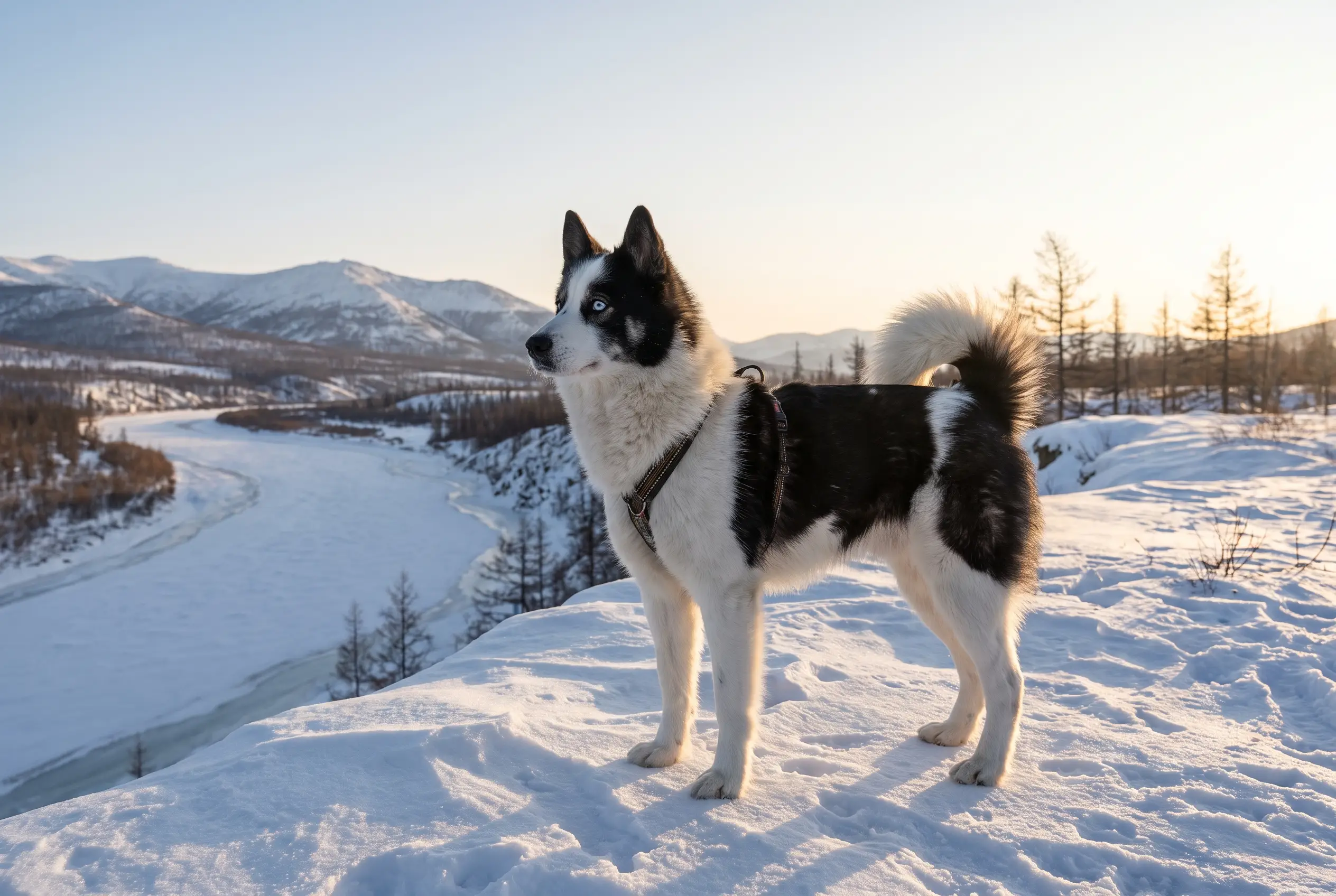
Yakutian Laika
Yakutia's piebald sledge dog, often blue-eyed, and the laika bred to live close to man.
Vital stats
| Size | Medium · 55–59 cm (dogs), 53–57 cm (bitches) |
| Weight | 18–25 kg — breed literature; the standard sets none |
| Life expectancy | 10–12 years — breed literature, not survey data |
| Energy | High — 2 hrs/day, ideally in harness |
| Shedding | Heavy, with two seasonal blows |
| Coat | Thick, glossy double coat with a mane · white with patches, bicolour or tricolour |
| Group | Working · Nordic Sledge Dogs (FCI №365, Group 5) |
| Origin | Yakutia (Sakha Republic), Russia |
Breed traits
Friendliness
Care
Mind
Temperament
Bold, lively, close to man, friendly, sociable and energetic: six words from the standard, and 'close to man' is the one that separates this laika from the others. The hunting laikas were bred to range far ahead of a single hunter and tend to hold strangers at a distance; the Yakutian lived in the middle of the settlement, pulled the family sledge, watched the house and shared the yard with the children, and it shows. Expect a dog that greets visitors, wants to be in the room where things happen, and does poorly left alone. The engine underneath is real. This is a breed judged with a working trial, made to pull all day in cold that stops machinery, and a bored one digs, chews and sings about it. It keeps a hunting side too — the standard's utilization line reads 'sledge and hunting dog' — so small running animals are a temptation and recall needs early, patient work, in the husky manner if not to the husky extreme.
Habits & quirks
White first, then patches
The colour section is one line: white and any patching, bicolour or tricolour. Solid white is allowed; any other solid colour is a disqualifying fault. A self-black or self-red Yakutian Laika cannot be shown at all.
Blue eyes, in writing
Dark brown, blue, odd eyes with one of each, or blue segments on a brown iris — the standard permits all four, and a depigmented eye rim is excused where it sits against white.
Dressed for Yakutia
Thick, glossy, coarse hair over a dense undercoat, a mane on the neck that is heavier in males, feathering down the backs of the legs, and a brush of hair between the toes. On the move, the ears fold back.
The whole settlement's dog
The standard's history lists the jobs in a single sentence: help hunt, watch the home, herd reindeer, transport goods. Sledding was the headline work — the 1958 standard it grew from was written for the 'North-East Sled Dog' — but this was the keeper of the household, and its manners still are.
Care
| Exercise | Two hours a day, and pulling is the shortcut. This is a sledge breed judged with a working trial, and harness sports — canicross, bikejoring, a rig or a sled in winter — meet it where it was made. Long hikes and running partnership work too; a walk round the block does not. |
| Grooming | A thorough weekly brush, then daily raking through the two seasonal blows, when the undercoat leaves in handfuls. Never clip the coat: it insulates against heat as well as cold, which matters, because this dog was built for deep frost and needs shade, water and early walks in a warm summer. |
| Training | Quicker to please than the hunting laikas and friendlier with strangers, and still a spitz: short sessions, real rewards, early socialisation. Start recall young and keep a long line around wildlife. The standard calls it a sledge and hunting dog, and the hunting half surfaces exactly when a rabbit does. |
| Health | A hardy village breed with no breed-wide health survey. Outside Russia the population is young and small, so pedigree depth deserves real attention; ask breeders for hip and eye results, and treat the 10–12 years in breed literature as a habit of the type rather than study data. |
Common questions
Is a Yakutian Laika the same as a Siberian Husky?
No — a separate breed with its own standard, though the FCI files both in Nordic Sledge Dogs. The Husky was standardised in America from Chukchi dogs a century ago; the Yakutian was rebuilt in Yakutia from local sled dogs, given a Russian standard in 2005 and accepted provisionally by the FCI in 2019. In the ring the colour rule splits them: a Husky may be any colour, a Yakutian must be white with patches, and it stands a touch taller with a heavier coat.
How is it different from the other laikas?
The Russo-European, West Siberian and East Siberian Laikas are hunting dogs in a different FCI section, bred to range ahead of a hunter and bark game to a standstill, and they tend to be reserved with strangers. The Yakutian is the sledge dog of the family: same northern Russia, same spitz outline, but a team animal that lived inside the settlement, and its standard asks for a dog close to man, friendly and sociable.
Are they good family dogs?
Made for it. The standard wants a dog close to man, friendly and sociable, and the breed's history is household history: it pulled, watched and herded for the same family it lived with. The honest caveats are the exercise bill of a sledge breed, two heavy moults a year, a hunting streak around small animals, and a coat that makes hot climates hard work.