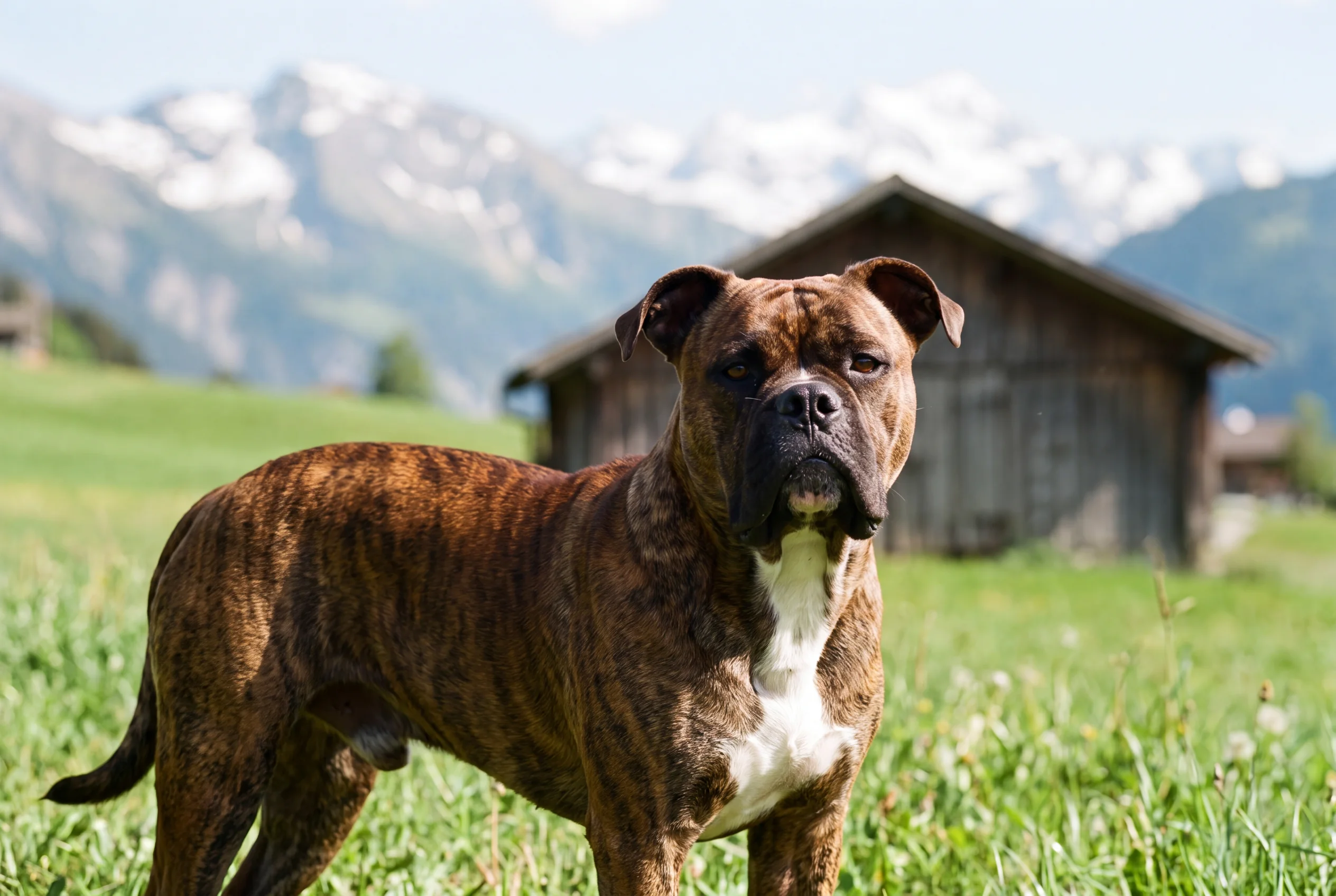
Continental Bulldog
The bulldog Switzerland redrew around a working airway.
Vital stats
| Size | Medium · 42–50 cm (males), 40–48 cm (females) |
| Weight | 20–30 kg |
| Life expectancy | 10–12 years — breed-source estimate, no published data |
| Energy | Moderate — an hour of varied ground, then off duty |
| Shedding | Moderate, year-round |
| Coat | Short, close, glossy · fawn, brindle or black, with or without white markings or a dark mask |
| Group | Non-Sporting · Bulldog (FCI №369, Group 2) |
| Origin | Switzerland |
Breed traits
Friendliness
Care
Mind
Temperament
The standard asks for four things: attentive, self-confident, friendly, neither aggressive nor shy. Day to day that comes out as a dog that greets visitors instead of screening them, settles well with children, and usually reads other dogs without picking anything up. The bulldog stubbornness survived the cross. A Conti hears a cue, weighs it against whatever it was already doing, and answers on its own schedule, which makes short reward-based sessions worth far more than drilling. What separates it from its ancestor shows up outdoors: it will do a long hill walk, keep pace on rough ground, and take to scentwork or a beginner agility class without running out of air.
Habits & quirks
Hears you, thinks about it
The recall lands, gets weighed against whatever it was already doing, and comes back late. Food and short sessions keep a Conti honest; repetition drills lose it inside a minute.
Parks on the nearest person
It picks whoever is home, follows them room to room and settles across their feet. Indoors it is a quiet dog that sleeps most of the day against something warm.
Snores anyway
A longer muzzle is not a long one. Most Contis breathe quietly awake and still snore asleep, and breeders treat noise on the move as a fault to screen out rather than a breed quirk.
Has an off switch
Ninety minutes of field and hill is well within it, and so is an afternoon doing nothing. Owners coming from the English Bulldog tend to describe the first half of that as the surprise.
Care
| Exercise | About an hour a day of varied ground, split across walks, suits most adults. Build up slowly through the first year, because heavy-boned puppies and long runs do not mix. Athletic for a bull-type dog is not the same as a running partner. |
| Heat | A shorter face than average still means less cooling surface than a shepherd has. Walk early in summer, carry water, stop at the first heavy panting, and never leave one in a car. |
| Grooming | Short coat, a brush once a week, moderate shedding all year. The standard calls for elastic skin without wrinkles on the body, but wipe and dry whatever folds the individual dog does have around the face after a wet walk. |
| Health | The breed is young and the data is thin, so lean on the breeding rules. The Swiss club requires hip and elbow scores (HD A–C, ED 0–1) read by Vetsuisse Bern or Zurich before a dog is approved for breeding; the German club adds an airway grade of BOAS 0 or 1 from twelve months, a DNA profile, and tests for DVL2 and cystinuria. Ask to see all of it, for both parents. |
Common questions
Is it actually healthier than an English Bulldog?
The anatomy the standard demands is better: a muzzle a third of the head's length, nostrils big and wide open, elastic skin without body wrinkles, and disqualification for any dog that makes breathing noise moving or standing. Those are the exact places the English Bulldog runs into trouble. What is missing is population-scale evidence. The breed is barely twenty-five years old and small, so almost nothing has been measured independently. When Finland reviewed six years of official kennel-club airway tests (Lilja-Maula and colleagues, Acta Veterinaria Scandinavica, 2024), four Continental Bulldogs had been tested against 245 English Bulldogs. Healthier by design is the breeding goal, and the build supports it, but it is not a guarantee about the puppy in front of you. Judge the individual dog and its parents' test results, not the breed name.
Can they mate and whelp naturally?
That was the point of the programme. A longer muzzle and a roomier pelvis are the visible parts of it, and Swiss and German breeders report bitches mating and whelping without help. The claim is harder to check than it sounds, because no registry publishes caesarean rates for the breed, and some Continental Bulldogs still end up in surgery. Ask a breeder how many of their litters were born naturally and how many by section, across several years rather than the last one, and treat a breeder who cannot answer as a breeder who has not counted.
Is it recognised, and where do puppies come from?
The FCI accepted it on a provisional basis on 30 March 2022 under standard No. 369, which means internationally registered but not yet definitively recognised; that status runs at least ten years. The AKC does not recognise the breed and it is not in the Foundation Stock Service either, so no American puppy comes with an AKC pedigree. Nearly all breeding sits in Switzerland and Germany under the Swiss and German clubs, with waiting lists to match. A puppy sold as a Continental Bulldog without a Swiss stud-book or VDH pedigree behind it is a crossbreed with a good name.