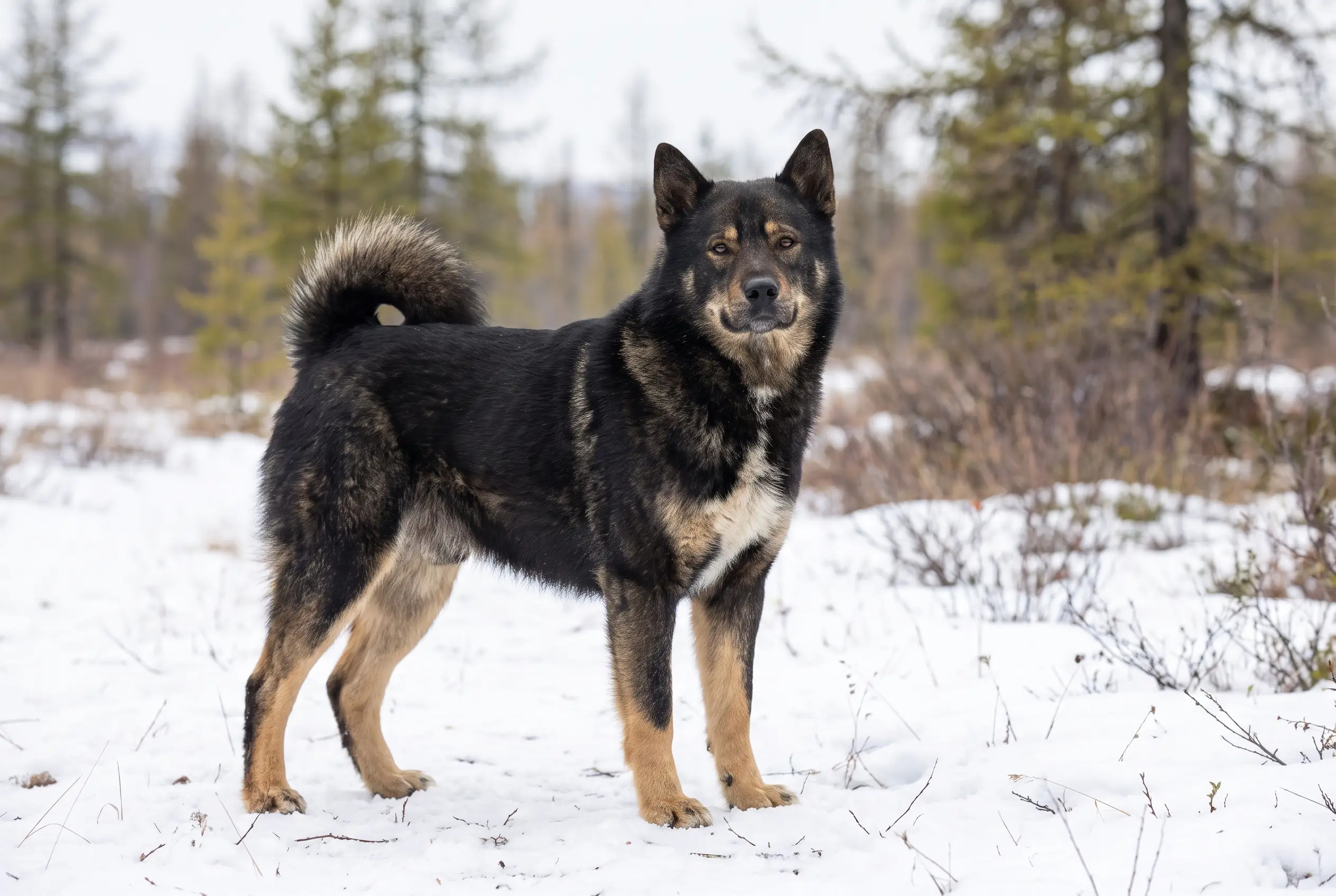
East Siberian Laika
The tallest laika, black and tan out of the taiga east of the Yenisei, and the only one its standard calls kind.
Vital stats
| Size | Large · 57–64 cm (dogs), 53–60 cm (bitches) |
| Weight | 18–29 kg — breed literature; the standard sets none, and sources disagree |
| Life expectancy | 12–15 years — breed literature, not survey data |
| Energy | Very high — a big-game taiga hunter; two hours of outdoor work a day |
| Shedding | Heavy, with two seasonal blows |
| Coat | Harsh straight topcoat over a soft woolly undercoat, with collar and side-whiskers · black and tan, black, black and white, white or piebald |
| Group | Hound · Nordic Hunting Dogs (FCI №305, Group 5) |
| Origin | Central and East Siberia, Russia |
Breed traits
Friendliness
Care
Mind
Temperament
Steady, balanced temperament opens the character clause, and then the text does something neither of the other laika standards does: it asks for a dog that is friendly, kind and trustful towards people, and lists slight intolerance to people as a severe fault, one rung below being sent out of the ring. The working lines sit in the same paragraph. A very well developed sense of scent, a pronounced passion for hunting and especially for larger prey, and four words that decide how the dog lives: very independent when hunting. Around the house it is the easiest company of the three, slow to take offence, uninterested in announcing the postman, happy to sleep through an evening. On a track it stops consulting you, and that is not a training failure. A dog holding a moose or a bear in mountain forest has to make decisions the hunter, several hundred metres behind, cannot make for it. Owners and breeders also describe a long adolescence, with the settled adult character arriving later than in the smaller laikas.
Habits & quirks
Karamis leads the colour list
Black and tan comes first among the typical colours, ahead of black, black and white, white and piebald, and Russian breed writing has its own name for that pattern: karamis. Slight specks in shades of the main colour are allowed on the legs. Genetic brown, genetic blue, brindle and albino all disqualify.
Biggest of the three, officially medium
Dogs measure 57–64 cm and bitches 53–60, the tallest figures in the Nordic hunting laikas, and the standard describes a dog of medium size with strong and compact build. More than 2 cm outside those heights is a severe fault, so the size is meant to be read strictly even where the wording is loose.
The tail rule loosens up
Curled or sickle-shaped over the back is the ideal, and then the standard accepts a sickle tail carried clear of the back, or even semi-dropped. The Russian-European standard grants no such latitude. A natural stumpy tail still puts the dog out of the ring here, as it does there.
A sled dog that got reclassified
Before the 1940s the native laikas of eastern Siberia hauled sledges, herded reindeer and hunted, often the same dog through one winter. Soviet cynology then sorted dogs by specialisation and kept the hunting laika, which is why the breed the FCI registers is a hunting dog for all-round purposes and nothing else, and why the sled work survives only in breed literature.
Care
| Exercise | Two hours of outdoor work a day, in country with cover in it. The standard describes normal movement as a far-reaching trot alternating with gallop or walking pace, which is a dog designed to be out for half a day rather than half an hour. Scent games, tracking, long hill walks, skijoring and carting all fit the frame, and so does hunting where it is legal. Cold and distance suit it far better than a small garden and a short lead. |
| Grooming | A harsh straight outer coat over a soft, rich, woolly undercoat, short and shining on the head and ears, longer over neck and shoulders as a collar, with side-whiskers on the cheekbones and trousers at the rear. One thorough brushing a week handles the settled months. Twice a year the undercoat comes away in sheets over a fortnight or so, and a rake earns its keep. Clippers never touch it: coat too short, coat too long, or no undercoat at all, and the dog is disqualified. |
| Training | The friendly, trustful character makes the first six months pleasant, and the very independent when hunting clause makes the next ten years interesting. It takes handling well and learns quickly, then applies its own judgement in the field, which is exactly what generations of hunters selected for. Short reward-based sessions, and a long line kept well into the second year, because this breed matures slowly and its recall usually gets worse before it gets better. A stop cue for the voice belongs on the early list, since the barking is a working signal rather than a nuisance to erase. |
| Health | A functional dog from a large native population, with no breed health survey to cite anywhere. Litters outside Russia and Scandinavia come from a thin import base, so ask how many dogs actually stand behind the pedigree, and ask to see hips and eyes screened on both parents. Published weights run from roughly 16 kg to 30 kg depending on which reference you open, which is a fair measure of how loosely the breed is documented outside its home range. |
Common questions
How is it different from the West Siberian and Russian-European Laikas?
Three Russian breeds in the same section, all accepted by the FCI on the same day in June 1980: Russian-European 304, East Siberian 305, West Siberian 306. This one is the tallest and the longest in body, the only one whose standard lists black and tan as a typical colour, and the only one whose character clause asks for a dog friendly, kind and trustful towards people. It is also the least uniform. Breed literature still separates Evenki and Irkutsk types, with Yakut, Amur and Tofalar strains behind them, which is why the final standard took until 1981 while the other two were settled in 1952. The Russian-European is the compact black-and-white treeing specialist from west of the Urals; the West Siberian is the leggier grey-to-red dog of the Ob basin and the most numerous laika in Russia.
What does it hunt?
The standard says hunting dog for all-round purposes, with a pronounced passion for hunting and especially for larger prey, and that emphasis on size is unique to this one among the three. In Siberian practice the same dog works sable, squirrel, marten and forest grouse for fur and the pot, and then bays moose, boar and bear. The method is the family method, finding game by scent and holding it with voice, but the standard's own wording expects it to be pointed at the heavy end more often than its cousins are.
Can it live in a family home?
More easily than either cousin, and still not easily. The written character is the friendliest of the three, it is patient with children in its own household, and it treats visitors as unremarkable rather than as a problem. The costs are unchanged: two hours of outdoor work a day, a voice built to carry across a valley, small pets that register as game, and a hunting independence that the standard actively asks for and no amount of training removes. It also grows up slowly, so the adolescent stage lasts longer than new owners expect.