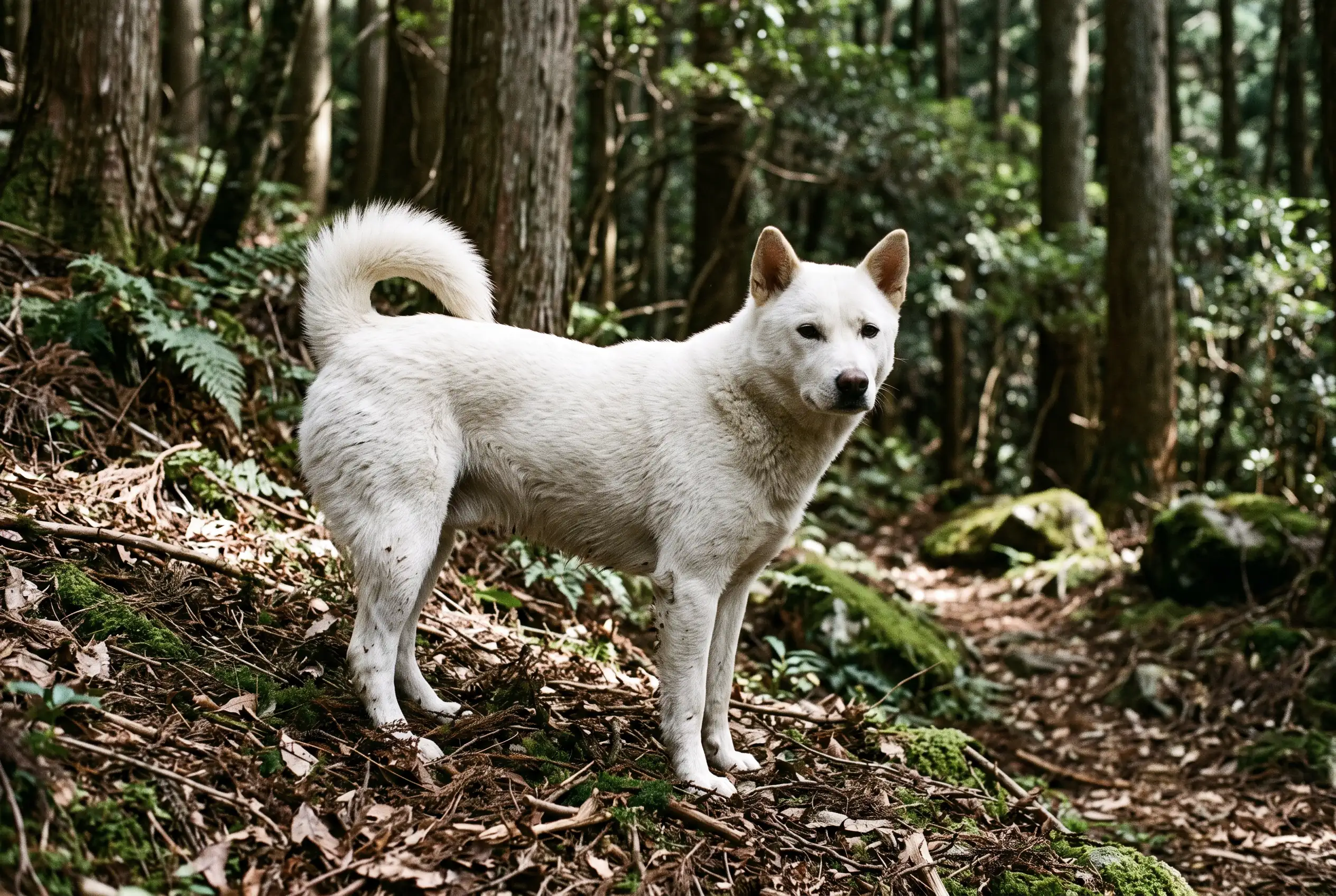
Kishu Ken
Japan's white boar dog, hunting with the sound turned off.
Vital stats
| Size | Medium · 49–55 cm |
| Weight | 14–27 kg |
| Life expectancy | 11–15 years |
| Energy | High — bred to work boar across mountain ground |
| Shedding | High in season — two heavy moults a year |
| Coat | Harsh straight outer coat over dense undercoat · white, red or sesame |
| Group | Non-Sporting · Asian Spitz (FCI №318, Group 5) |
| Origin | Kishu region (Wakayama and Mie), Japan |
Breed traits
Friendliness
Care
Mind
Temperament
The standard asks for endurance, nobility and dignity, and for a dog that is faithful, docile and very alert. In a house that reads as a dog with the volume down: it follows you room to room, lies where it can see the door, and rarely comments on anything. Docile is doing quiet work in that sentence. A Kishu takes direction from someone it respects and declines it from anyone it doesn't, without argument and without moving. It usually picks one person in the household and shadows them. Strangers get inspection rather than enthusiasm, and the hunting wiring never switches off — a cat on the wall, a rabbit in the hedge, a strange dog of the same sex on a narrow path. None of that fades with age.
Habits & quirks
Works with the sound off
Most boar dogs bay. The Kishu closes in quietly and pins the animal with its body and its stare, which is also why a silent Kishu at the end of the garden is not necessarily a relaxed one.
Picks one person
It will live politely with the whole household and still choose a single human to follow through the day, waiting outside doors and settling wherever that person lands.
Screens visitors from across the room
The standard greeting is a long look from a distance. Kishu warm to new people on their own schedule, and hurrying the introduction only sets it back.
Keeps score with other dogs
Same-sex friction is the usual trouble, and a Kishu that has made up its mind about another dog rarely revises it. Neutral ground, one dog at a time.
Care
| Exercise | One to two hours of real ground a day: long hikes, running, tracking games, a long line in open country. This is a dog built to follow boar through mountain scrub, so a garden and two short walks will not come close. |
| Grooming | The harsh outer coat sheds mud on its own and wants a weekly brush. Twice a year the soft undercoat comes out over a fortnight, and that is daily raking or you wear it. |
| Training | Short reward-based sessions from the week the puppy arrives, plus heavy socialisation through the first two years. Pressure gets you a dog that stops offering anything at all. Recall is the honest weak point: train it properly, then keep the long line anyway wherever game lives. |
| Health | Sound on the whole, with a known leaning towards autoimmune problems — hypothyroidism and Addison's disease both turn up in the breed, and food and environmental allergies are the complaint owners raise most. Ask breeders about thyroid testing, entropion and hip scores. |
Common questions
Why are Kishu almost always white?
A hunter's preference that hardened into the breed. A white dog is easy to tell from a boar in low light and thick cover, so the white hunting lines were bred from hardest and the gene spread through the population. Around seven in ten Kishu were something other than white when standardisation began; marked coats were shut out in 1934 and had disappeared by 1945. Red and sesame remain on the FCI standard and are still bred, but you may wait years to meet one.
Is a Kishu a sensible first dog?
For most people, no. This is a working boar hound with a strong prey drive, real reserve towards strangers, little patience for other dogs of its own sex, and no interest in obeying for its own sake. Once the relationship is built it is quiet, clean and undemanding indoors, which is exactly what makes the breed easy to underestimate. Getting there asks for two years of deliberate socialisation, the acceptance that off-lead freedom may never be safe, and enough experience to read independence as independence rather than defiance. Anyone starting here should line up a breed mentor before the puppy, not after.
Are they really that quiet?
Yes, and it is easy to misread. Kishu bark little, hunt without giving tongue, and can cross a room without you noticing. Quiet is not low drive: a Kishu staring at a hedge is fully switched on, and the same dog will work a mountain trail for hours. If you want a dog that announces the doorbell, this is the wrong breed — it is more likely to stand up and watch the door in silence.