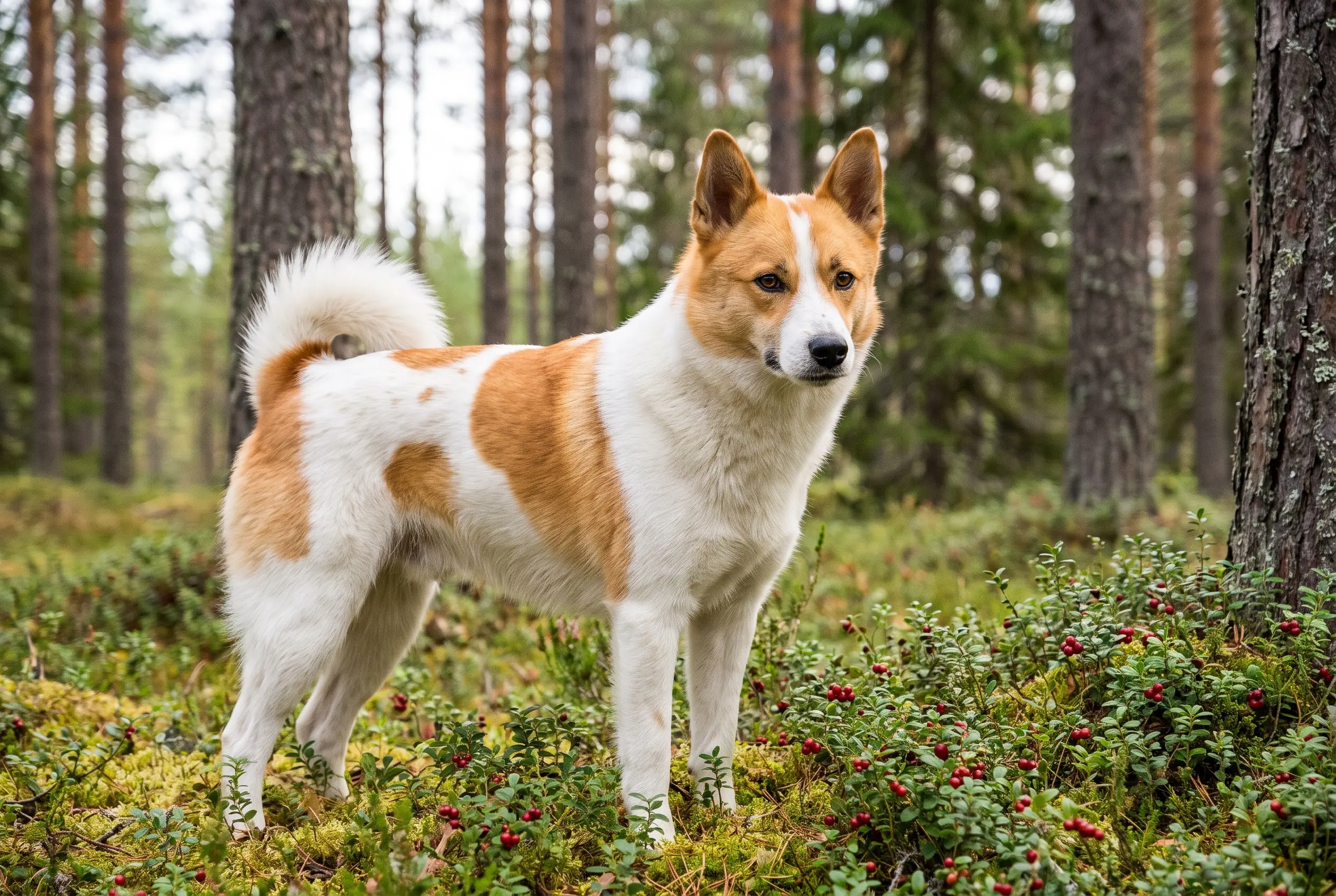
Norrbottenspets
Declared extinct in 1948, found living as somebody's pet, back in the stud book by 1967.
Vital stats
| Size | Small · 43–47 cm (dogs), 40–44 cm (bitches) |
| Weight | 11–15 kg — breed literature; the standard sets none |
| Life expectancy | 13–15 years — breed literature, not survey data |
| Energy | High — a hunting spitz, 1–2 hours a day |
| Shedding | Moderate to heavy, with seasonal blows |
| Coat | Hard, close-lying double coat · pure white with red or yellow patches |
| Group | Hound · Nordic Hunting Dogs (FCI №276, Group 5) |
| Origin | Norrbotten, Sweden |
Breed traits
Friendliness
Care
Mind
Temperament
The standard asks for attentive and bold on the hill and a kind disposition off it, and that pairing is the whole appeal. It is keen, lively and self-confident, and it is genuinely easy to live with: smaller than the other Nordic hunting spitz, less aloof than a Karelian, and fond of people in a way big-game dogs usually are not. What comes with it is voice. A bird dog whose method is to put a grouse up into a tree and bark underneath it until the gun arrives has an on-switch for barking and an outdoor volume setting. It is also fast, and it works on air scent, which means a Norrbottenspets that has found something interesting is a Norrbottenspets that has already left.
Habits & quirks
Hunts birds by barking
It finds a capercaillie or a black grouse, puts it up into a tree, and stands underneath barking until the hunter arrives. The size, the voice and the nerve all come from that one job.
Patches, never ticking
A pure white ground with big, well-defined patches, ideally red or yellow, covering the sides of the head and the ears. Roaning and ticking are severe faults, and so are tan markings.
Bays elk at 13 kg
It is classed with the Nordic hunting dogs and the standard says it can bay elk as well as work fur game. That is a third of the weight of a Jämthund doing the same job.
Small dog, hunting-dog range
Compact and easy in the house, and still a spitz that hunts on air scent. Loose in open country it will follow a line a long way before it remembers you exist.
Care
| Exercise | An hour or two, ideally in woodland where the nose has something to do. It is small enough to live in a flat and completely unsuited to being walked like a flat dog, because the breed is built for stamina over rough ground, and a bored Norrbottenspets barks. Scent games are the cheapest way to tire one out. |
| Grooming | A hard, short, close-lying topcoat over a fine dense undercoat, with the length varying by body part: shortest on the nose bridge, skull, ears and front of the legs, longest on the neck, the back of the thighs and under the tail. A brush once a week, more through the moults. It is a clean, low-odour coat and it is never trimmed. |
| Training | Bright, willing and sociable, and easier to train than most of the Nordic hunting spitz. Two caveats. Recall has to be built young and maintained forever, because the hunting instinct is fully intact. And the barking will happen: it is the working method, so it gets trained down to a liveable level rather than out. |
| Health | The breed came through a real genetic bottleneck in the 1950s and 60s, which is worth asking breeders about directly. It is generally healthy and long-lived; patellar luxation and eye conditions are among the things Swedish breeders test for. No breed-wide survey exists, and the 13–15 years quoted comes from breed literature. |
Common questions
Was it really extinct?
Officially, yes. The Swedish Kennel Club declared the breed extinct after registrations dried up when the fur trade collapsed. It was wrong: dogs of the right type were still living as pets and watchdogs on small farms in inland North Bothnia. A small group of enthusiasts found them, bred from them, and got the breed re-entered in the register in 1967. Every Norrbottenspets alive descends from that recovery.
Is it the same as a Finnish Spitz?
No, though both are small northern hunting spitz that hunt birds by barking. The Finnish Spitz (FCI 49) is red-gold all over and slightly taller. The Norrbottenspets is white with red or yellow patches, and its standard, its registry and its country are Swedish. The two do much the same job in neighbouring forests.
Does it suit a family?
Better than most hunting spitz. It is friendly, hardy, good with children and small enough for an ordinary house. The two things to be honest about before taking one on are the barking and the recall, and neither is a training failure — they are the breed doing exactly what it was kept for.