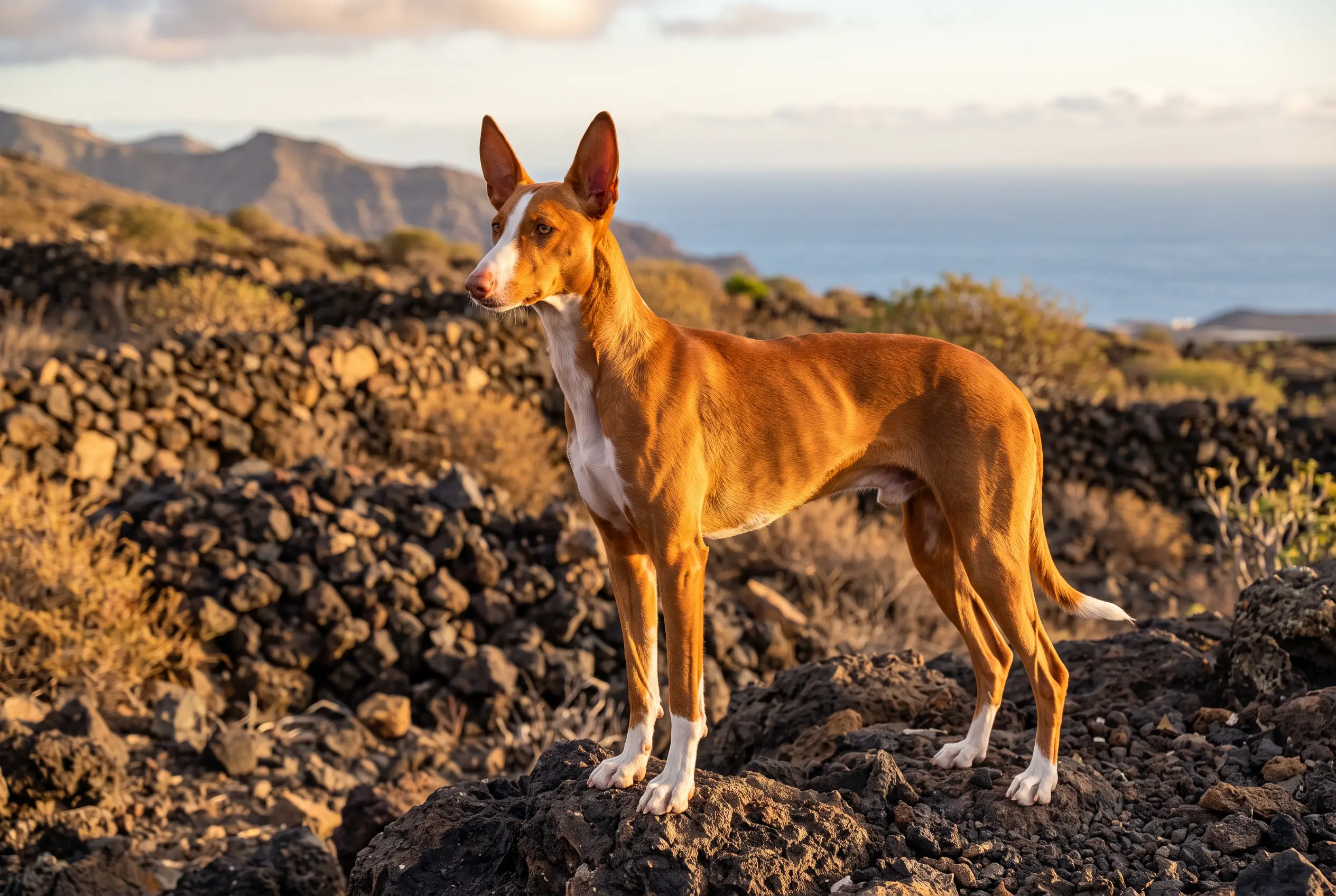
Podenco Canario
The Canaries' rabbit hunter — lean to the bone, big-eared, and silent on the trail.
Vital stats
| Size | Medium · 55–64 cm (dogs), 53–60 cm (bitches), ±2 cm for terrain |
| Weight | 20–25 kg — breed literature; the standard sets none |
| Life expectancy | 11–13 years — breed literature, not survey data |
| Energy | Very high — bred to hunt from dawn to nightfall |
| Shedding | Low — smooth, short, dense coat |
| Coat | Smooth, short and dense · red and white, orange to mahogany |
| Group | Hound · Primitive type – Hunting Dogs (FCI №329, Group 5) |
| Origin | Canary Islands, Spain |
Breed traits
Friendliness
Care
Mind
Temperament
The standard's own words are 'courageous, nervy, agitated, and of an enthusiastic dynamism' — an honest description of a dog that runs hot. It follows them immediately with 'imposing but not at all aggressive', and aggression appears twice in the fault lists, so the edge is energy, never menace. At home that translates to a devoted, sensitive hound, attached to its person — the standard says 'with abnegation' — and gentle once the engine is off. The engine matters, though: this dog was selected to work rough volcanic ground all day, and without an outlet the nerviness turns inward into pacing, whining and escape projects. Prey drive is the other constant. A dog bred to find rabbits by scent, sight and sound treats every small running animal as a job offer, so recall needs years of work and cats need careful introductions. With strangers expect polite reserve rather than a greeting committee.
Habits & quirks
Hunts with all three senses
The utilization section leads with the 'prodigious nose', then sight and hearing. That is why the FCI files it with the primitive hunting dogs rather than the sighthounds: it tracks rabbits into cover a pure runner would gallop past — crevices, wall cracks, stone heaps, volcanic tubes.
Silent on the trail
The standard is explicit: a tracker that 'must neither bark nor catch the game during his scenting work'. When it does take a rabbit, it usually carries it in its mouth, and it traditionally works alongside a ferret — a hunting method authorised on the islands.
Ears up, ears back
The big pointed ears prick into a slightly divergent V the moment something interests it, and tip backwards when it rests. Read the ears and you know whether a rabbit — real or imagined — has entered the conversation.
Lean is the standard
No layer of fat, ribs and spine and hip bones visible, muscle contractions showing through the skin — all of it written into the standard. A correct Podenco Canario looks underfed to people used to Labradors, and the tail usually ends in a white tip.
Care
| Exercise | Bred to hunt from dawn to nightfall, so a walk is a warm-up. Give it an hour or two of real exercise daily, with free running in a securely fenced space — this is a hunter with spring-loaded quarters, and an open gate or low fence is an invitation. It handles heat unusually well; plan around that in summer, not against it. |
| Grooming | The smooth, short, dense coat needs a weekly rub with a mitt and little else. The other half of grooming is warmth: with no fat layer and minimal hair, it feels cold and hard floors keenly, so northern winters call for a coat and soft bedding. |
| Training | A primitive hunter, not a herding dog: it works with you, not for you. Short, rewarding sessions beat drills, harsh handling shuts it down, and recall around wildlife needs a long line for years. Channel the nose — scent games at home spend energy the legs cannot. |
| Health | A hardy working population with no breed-wide health survey and no documented screening scheme; most dogs still earn their keep in Spanish hunting kennels. Buy or adopt from someone who can speak to the individual dog's history, and remember that its visible ribs are breed-correct before assuming the worst. |
Common questions
Is the Podenco Canario a sighthound?
Not to the FCI, which files it in Group 5 among the primitive-type hunting dogs, two groups away from the greyhounds. The standard explains why: it hunts by nose, sight and hearing together, works cover like a scenthound, and even its outline is qualified — the underline is drawn up 'without being as whippety as the Galgo'. In practice it runs like a sighthound and searches like a scenthound.
How is it related to the Ibizan Hound and the Pharaoh Hound?
They are the same family on different islands: prick-eared, red-and-white rabbit hunters of the Mediterranean and Atlantic islands, each with its own FCI standard. The Canarian is the Canary Islands' member, and of the three it has stayed closest to plain working life. All their official histories tell a version of the ancient Egyptian story — this standard says the type goes back seven thousand years — though modern genetics is far less romantic about it.
Are they good family dogs?
Good ones for the right family: affectionate, clean, quiet indoors once exercised, and gentle with children who respect them. The non-negotiables are serious daily exercise, tall secure fencing and patience with prey drive. Across Europe, rescues rehome many adult podencos retired or abandoned by hunting kennels — an adult with a known character is often the easiest way into the breed.