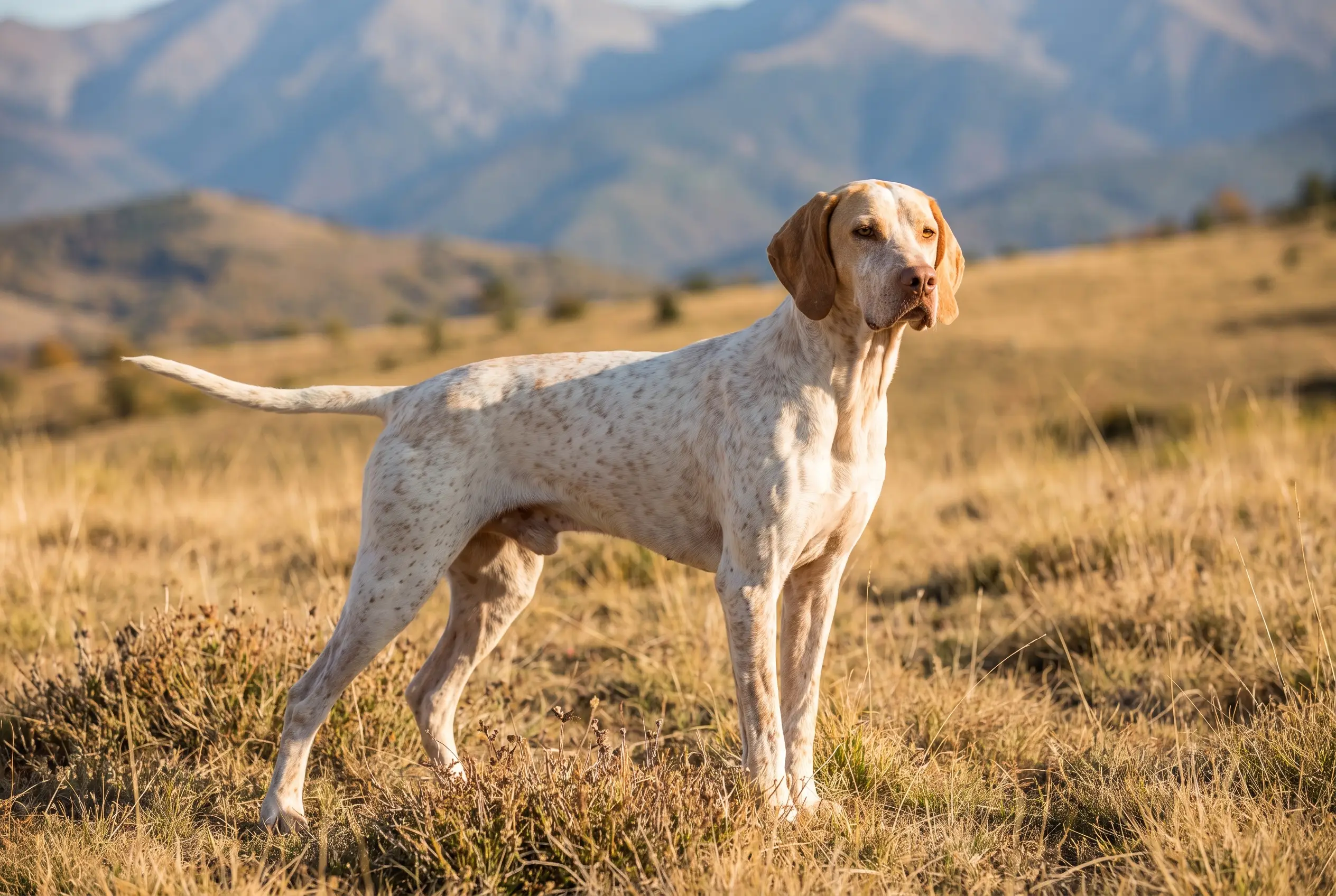
Braque de l'Ariège
The white-and-orange braque of the Pyrenean foothills, kept alive by a handful of huntsmen and rebuilt since 1990.
Vital stats
| Size | Large · 58–65 cm (dogs), 54–63 cm (bitches) |
| Weight | 25–30 kg — breed literature; the standard sets none |
| Life expectancy | 12–15 years — breed literature, not survey data |
| Energy | Very high — a working pointer bred for long days on rough ground |
| Shedding | Low to moderate — a short single coat |
| Coat | Short, thick, glossy · white-dominant over pale to vivid orange-fawn, sometimes ticked · never black |
| Group | Sporting · Continental Pointing Dogs, braque type (FCI №177, Group 7) |
| Origin | Ariège, France |
Breed traits
Friendliness
Care
Mind
Temperament
'Stable and sociable with humans and other dogs' is the whole behaviour clause of the standard, and for a hunting braque the second half matters: this is a dog written up as easy company in a mixed kennel, not a loner. The same clause calls it adapted to all types of hunting, 'resistant, docile, and easy to train' — hunters' shorthand for a pointer that takes direction and keeps working through a full day on the hill. Beyond the standard there is very little published temperament literature, because there are very few dogs. Expect what the breeding selects for: a high-energy field companion that points, ranges wide, needs open ground and a job, and settles at home only once both are provided. Treat any finer-grained personality claim about this breed with suspicion — the sample size does not exist.
Habits & quirks
White that takes over
The colour clause describes a solid orange-fawn coat overrun by white — 'very extended or invasive white patches', sometimes ticked — in every shade from pale to vivid, with a little brown permitted. The result reads as a white dog wearing orange, most visibly on the head and ears.
Nothing black, anywhere
A black nose, black nails or a single black spot on the coat are each a disqualifying fault. The nose runs from orange to more or less pale brown to match the coat, and even the skin must carry no black patches.
Ears with a curl
The leathers are quite fine, long and curled in, set at eye level and carried away from the head; unstretched, they reach the beginning of the nose. Flat ears set high on the head are eliminatory — the curl is part of the breed's face.
The tail question
The standard has the tail traditionally docked by six-tenths but admits the natural long tail, carried horizontally and never above the topline. In the many European countries where docking is banned, the full tail is what you will see.
Care
| Exercise | Budget a couple of hours a day with genuine running in it. This is a breed judged with a working trial and bred to quarter rough Pyrenean foothills; hunting, field-trial training or long off-lead work in safe country suit it best, and a lead walk round the block does not count. |
| Grooming | The short, glossy coat asks for a weekly rub-down with a hound glove and little else. The long, folded leathers are the real job: check and dry them regularly, as with any drop-eared gundog, because a closed ear canal traps moisture. |
| Training | The standard calls it docile and easy to train, and the breed's survival depended on hunters who worked it, so it takes direction well. Start recall early all the same — a wide-ranging pointer follows its nose, and birds are its business. |
| Health | No breed-wide health survey exists, and the modern population descends from a small 1990 rebuild, so pedigree depth deserves real questions. Ask breeders about hip results and general soundness, and treat the 12–15 years in breed literature as a habit of the type rather than study data. |
Common questions
How rare is the Braque de l'Ariège?
Rare enough that its own standard tells the story: numbers collapsed through the World Wars, a few Ariégeois huntsmen kept the breed working, and in 1990 a team of breeders took on its survival and renewal. No reliable current registration count is published, but nearly all breeding remains in France, and finding a puppy elsewhere means a waiting list and a journey.
How is it different from the other French braques?
It is its own breed with its own FCI standard, No. 177, recognised definitively in 1955. Per the standard's history it grew from the old French braques, lightened in the 19th century by crossings with southern braques of white-and-orange coat — and that coat became its signature: white-dominant over orange-fawn with black banned outright, where its cousins commonly carry brown or chestnut. It also stands at the tall end of the family, up to 65 cm.
Is it a good family or first dog?
It is sociable by standard — stable with people and other dogs — and breed sources describe a calm house companion once exercised. But this is a rare working gundog: most puppies go to hunting homes, the exercise bill is a working pointer's, and an under-run one will invent projects. Suit it to an active rural home, ideally one that shoots or does field sports, rather than a first-dog flat.