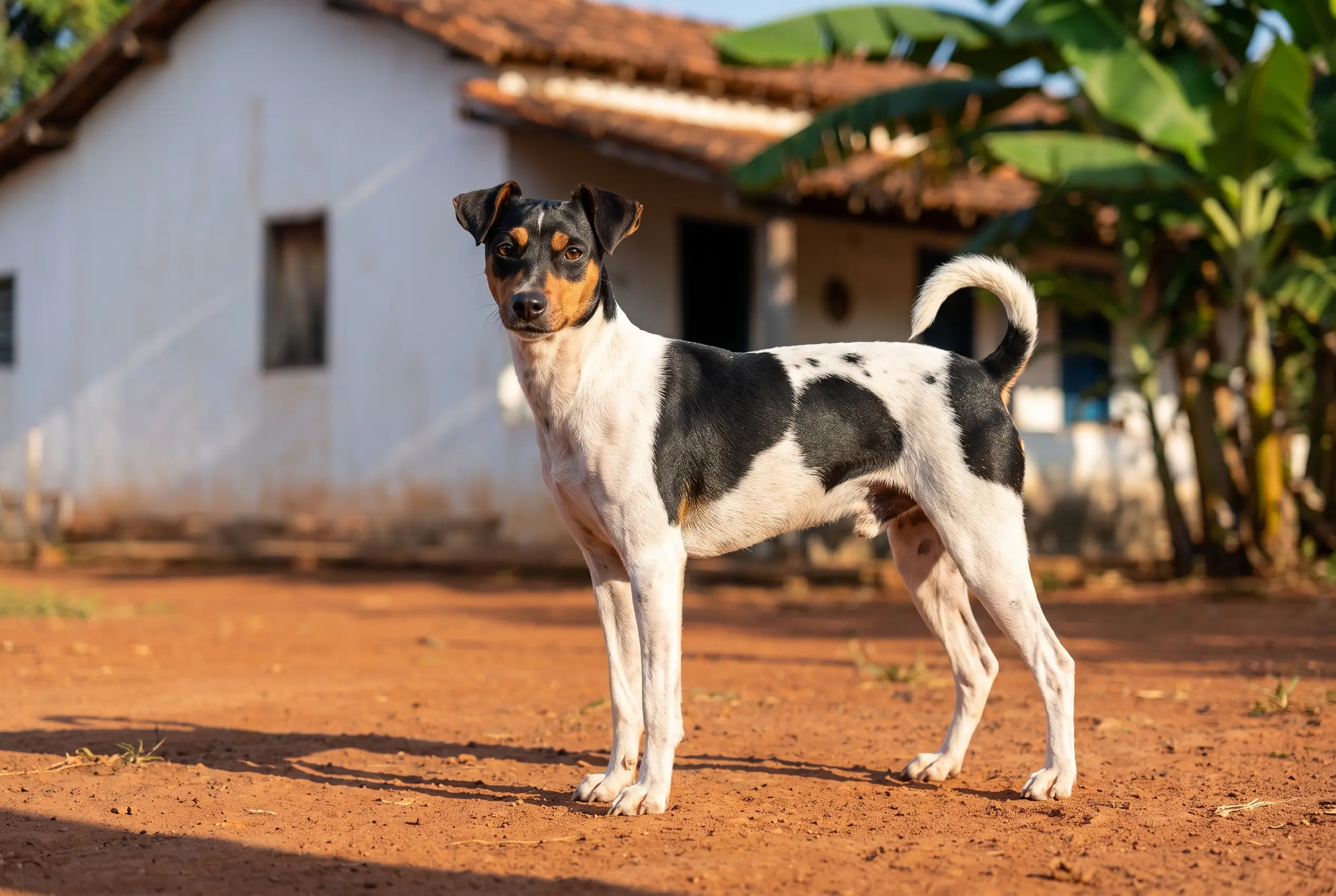
Brazilian Terrier
Brazil's farm ratter, tricolour by rule and never off duty.
Vital stats
| Size | Small–medium · 33–40 cm |
| Weight | 6–10 kg |
| Life expectancy | 12–14 years |
| Energy | Very high — a working ratter in a 9 kg body |
| Shedding | Low to moderate — short coat, all year |
| Coat | Short, fine, close-lying · always tricolour on white |
| Group | Terrier · Large and medium sized Terriers (FCI №341, Group 3) |
| Origin | São Paulo, Brazil |
Breed traits
Friendliness
Care
Mind
Temperament
The standard asks for a dog that is restless, alert, active and keen, friendly with its own people and reserved with strangers, and that is exactly what turns up. At home it is affectionate and physical, the sort of terrier that burrows under a blanket against someone's leg. Outside it is working: scanning hedges, following movement, chasing anything that bolts. The prey drive is the reason the breed exists and it does not train out, which rules out households with hamsters, rabbits, birds or free-roaming cats. It is also loud. Visitors, delivery vans and a noise two gardens away all get announced, and the bark carries further than a 9 kg dog has any right to. Bright, funny, easy to teach and hard to bore — but a ratter first and a lap dog somewhere further down the list.
Habits & quirks
Rat radar
A rustle in the hedge ends every other conversation. Brazilian farms rated this dog above the barn cats for a reason, and the equipment is still fitted.
A doorbell with legs
It reports visitors, vans and sounds you never heard. Watchdog rather than guard dog — the barking is the whole plan.
Springs from a standstill
Short legs, serious launch. Furniture, low fences and any gap worth investigating are all treated as reachable, because they usually are.
Digs when under-employed
An hour short on exercise turns into holes in the lawn and a hole under the fence. Give it something to hunt for and the garden survives.
Care
| Exercise | About an hour a day, split into two, with hunting built in — thrown toys, scatter feeding, nose games, a garden to patrol. Walking on a lead alone does not touch the sides. |
| Grooming | The easiest part of the dog. A rubber brush once a week keeps the short coat clean; it sheds a little all year and needs a bath only after something regrettable. Check nails and teeth on the same schedule. |
| Training | It learns fast and questions the third repetition. Short reward-based sessions, heavy socialisation with people and dogs from puppyhood, and a recall trained long before you need it — a Brazilian Terrier on a scent stops listening. |
| Health | A hardy breed with no widespread disorder on record. Ask breeders about patellar luxation, hip dysplasia and eye disease, and about how closely related the parents are: outside Brazil the population is small. |
Common questions
Is a Brazilian Terrier just a Jack Russell?
Shared ancestors, separate breed. Jack Russell and smooth Fox Terrier imports are in the foundation, but the Brazilian Terrier was then bred for a century in Brazil to local farm dogs. It is taller than a Jack Russell at 33–40 cm, squarer in outline, smooth-coated only, and always tricolour — no solid or two-colour dogs, and the tan markings above the eyes are compulsory.
Does the coat have to be tricolour?
Yes. FCI standard No. 341 asks for a predominantly white ground with black, brown or blue markings, plus tan markings above the eyes, on both sides of the muzzle and inside and on the edge of the ears. The head must always carry the dark marking on the forehead and ears; a white blaze is allowed alongside it. A Brazilian Terrier without the tricolour head is not a show dog, whatever else it is.
Can one live with cats or small pets?
Small pets, no — rabbits, hamsters, birds and rodents are what this breed was built to catch, and cages are not a plan. A cat raised with the dog from puppyhood often works out; a strange cat crossing the garden will be chased. Take the prey drive at face value rather than hoping to train it away.