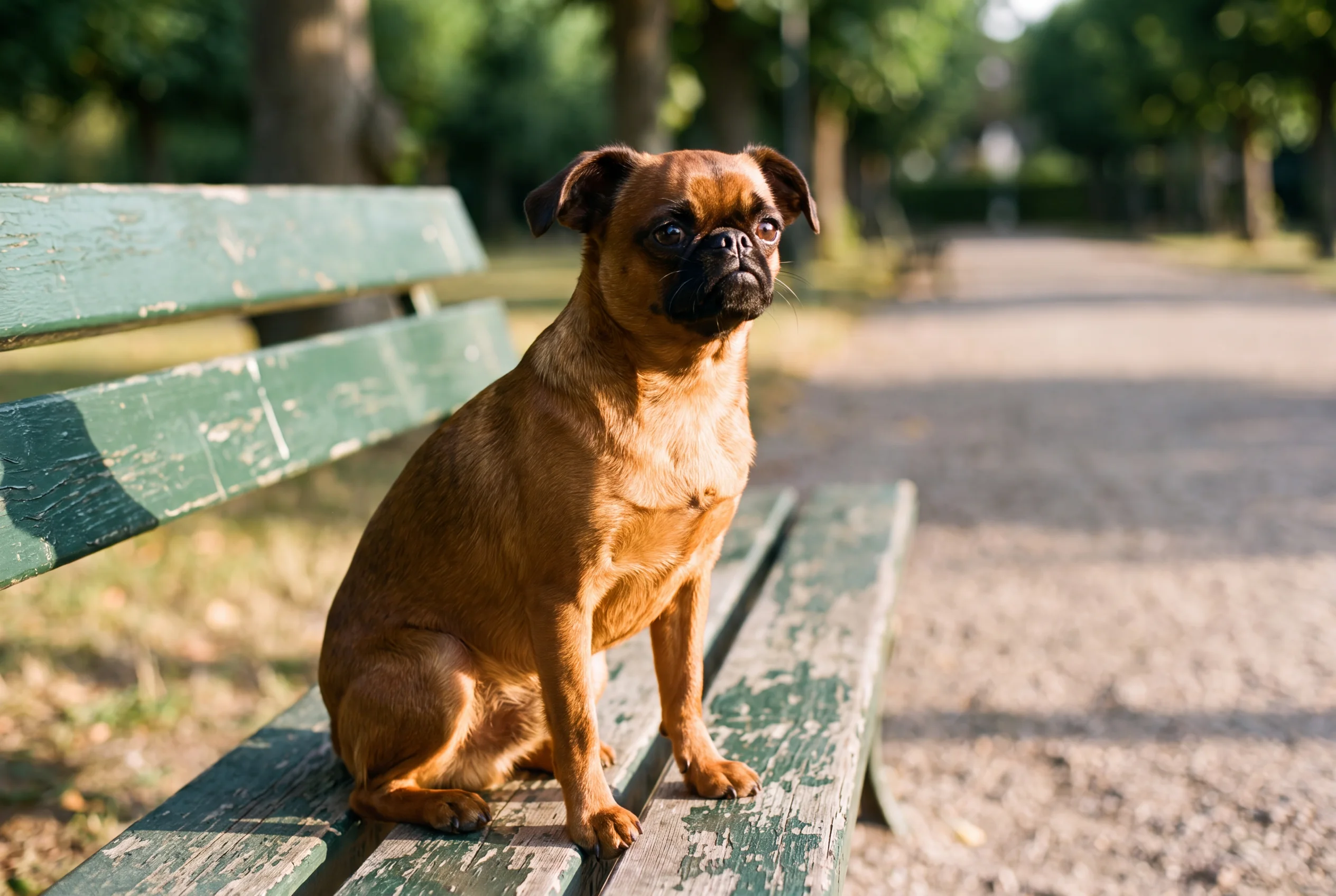
Petit Brabançon
The griffon without the beard: same dog underneath, its own FCI number.
Vital stats
| Size | Toy · 18–25 cm |
| Weight | 3.5–6 kg |
| Life expectancy | 12–15 years |
| Energy | Moderate — two short walks, taken outside the heat of the day |
| Shedding | Moderate — short hairs, year round |
| Coat | Short, harsh and flat, 2 cm at most · red, black, or black and tan, with a dark mask |
| Group | Toy · Companion (FCI №82, Group 9) |
| Origin | Brabant, Belgium |
Breed traits
Friendliness
Care
Mind
Temperament
The FCI gives four words and they hold up in a living room: alert, proud, very attached to its owner, very watchful. The standard still lists the job as small guardian and companion, and the guarding half has not worn off. A Petit Brabançon announces the lift, the post and the neighbour's door, then climbs back onto you. It is neither timid nor aggressive by the standard's own wording, which day to day reads as a dog that meets a stranger square on and makes up its mind at its own speed. The attachment is the part people underestimate. This is a breed built to sit beside one person all day, first on a coachman's box and later on a lap, and long empty afternoons go badly.
Habits & quirks
Looks longer in the muzzle
Set one beside its rough-coated siblings and the foreface seems to gain a centimetre. Nothing has changed but the hair. The standard says outright that a correct foreface simply appears longer on this breed, because there is no beard growing over it.
Claims the warm spot
Radiators, laptop vents, the square of sun on the floor. A short flat coat carries very little insulation, and the dog will locate the warmest twenty centimetres in a room and settle there.
Has an opinion on noises
It was kept to raise the alarm from a carriage and still does the job unpaid. Doorbells, corridor footsteps and a bag rustling in the kitchen all get a comment.
Shares a litter with two other breeds
Rough and smooth puppies turn up in the same box, so a Petit Brabançon can have a Griffon Bruxellois brother. Which of the three a puppy is registered as follows the coat it grows, not the pairing it came from.
Care
| Grooming | The one chore the rough griffons need is the one this dog skips: no hand-stripping, no trimming bill, no beard to rinse after dinner. A rubber mitt once a week lifts the loose hair. Short griffon hairs are stiff and show up on dark trousers, so smooth coats shed more visibly than rough ones do. |
| Heat and breathing | The standard caps the foreface, nose included, at 1.5 cm, and a nose that short moves less air. Walk early and late in summer, keep it off hot pavement, and use a harness rather than a collar. Snoring, gagging after mild effort or gums going dull are vet questions, not breed quirks. |
| Eyes | Large, round, set forward, with very little face in front of them. Grass seeds, cat claws and carpet all reach them. Look at them daily, and treat a squint, a paw at the face or a cloudy patch as same-day work, because corneal ulcers on this head shape turn serious fast. |
| Training | Quick to read a room and easily flattened by a raised voice. Keep sessions short and paid in food. Corrections shut this dog down and it remembers who delivered them. Housetraining takes longer than the training books promise, as it does with most toy breeds. |
Common questions
How is a Petit Brabançon different from a Brussels Griffon?
Coat and colour, and that is the entire list. The FCI publishes one standard for three Belgian breeds: the Griffon Bruxellois (n°80) is rough-coated and red, the Griffon Belge (n°81) is rough-coated and black or black and tan, and the Petit Brabançon (n°82) is short-coated in any of those colours, with a dark mask. Body, head, size and temperament are written in the same paragraphs for all three. They are bred to one another, and a single litter can produce more than one of them. In the United States the AKC recognises one breed, Brussels Griffon, and treats rough and smooth as coat types of it, which is why an American reader may never have heard the name. Belgium and the FCI count three breeds.
Is the Petit Brabançon a healthy breed?
It is long-lived for its size and it carries two problems that come with the head shape. The standard limits the foreface, nose included, to 1.5 cm, and a nose that short can mean noisy breathing, poor tolerance of heat and exertion, and in the worst cases airway surgery. Chiari-like malformation, where the skull runs out of room for the back of the brain, has been reported on MRI in up to 65% of griffons scanned, and a 2014 study of American Brussels Griffons put it near half the dogs examined, most of them showing no signs at all. A minority go on to syringomyelia, which is painful and shows up as scratching at the neck, yelping and dislike of being touched there. Whelping fairly often needs a caesarean. That list is why the breeder decides this purchase: ask about MRI screening, patella grading and eye certification, ask how the last litters were born, and keep looking if anyone tells you the snoring is charming.
Does the smooth coat mean less work?
On the coat, yes. No stripping, no groomer's bill, no beard to wash after every meal and wipe after every drink, and a weekly rubber mitt covers most of it. The trade is visible shedding: short stiff hairs weave into upholstery in a way a rough coat does not. Everything else costs exactly the same. The eyes still need a daily check, the flat face still rules out midday summer walks, and the dog is no less glued to you for having short hair.