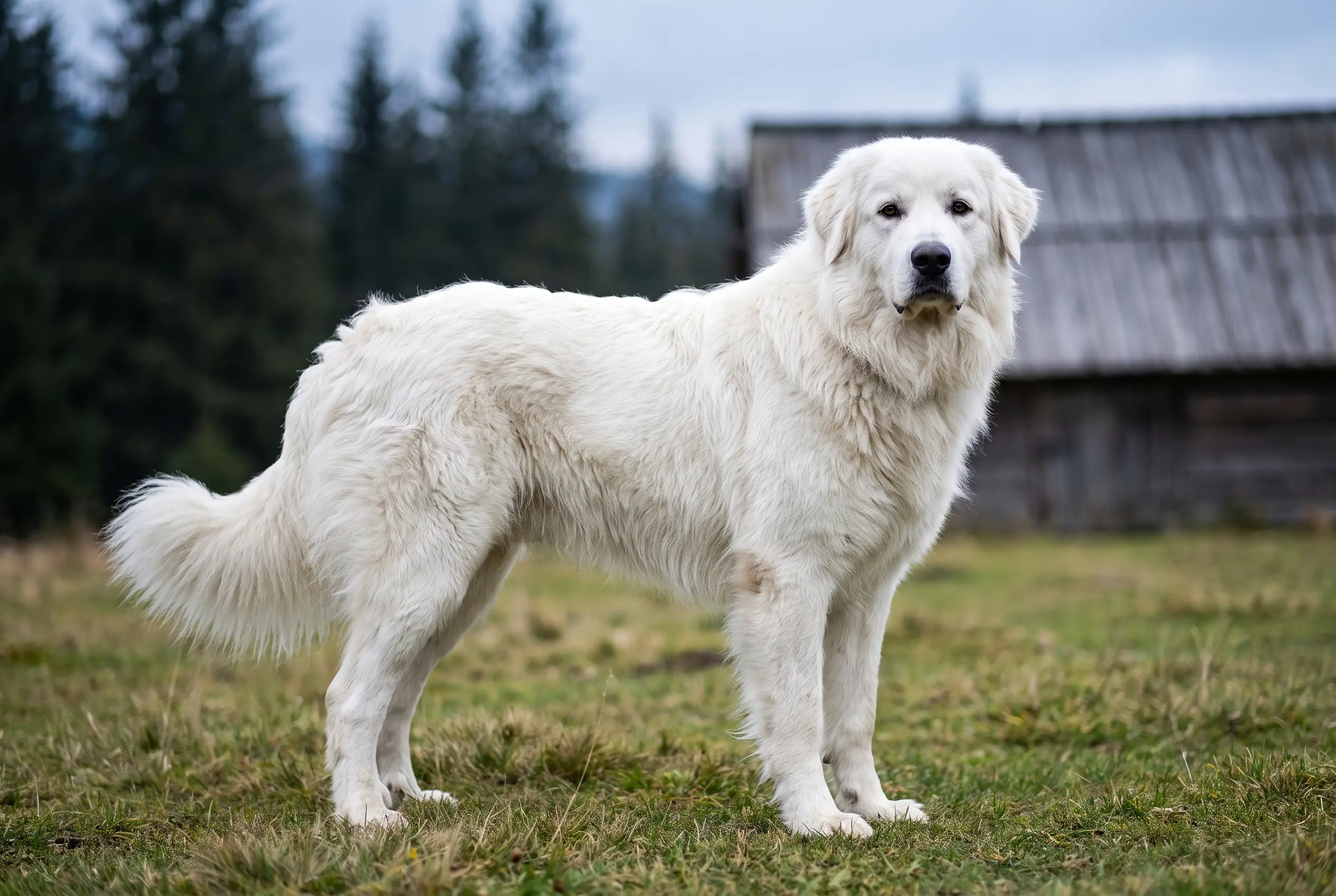
Slovenský Čuvač
Bred white on purpose, so a shepherd could tell dog from wolf in the dark.
Vital stats
| Size | Large · 62–70 cm (dogs), 59–65 cm (bitches) |
| Weight | 36–44 kg (dogs), 31–37 kg (bitches) |
| Life expectancy | 11–13 years |
| Energy | Moderate but all day — it patrols on its own schedule, much of it after dark |
| Shedding | Heavy — the whole undercoat comes away over early summer |
| Coat | Wavy double coat, topcoat 5–15 cm · white only, yellow patches disqualify |
| Group | Herding · Sheepdogs, without working trial (FCI №142, Group 1) |
| Origin | Tatra Mountains, Slovakia |
Breed traits
Friendliness
Care
Mind
Temperament
The standard asks for a dog that is boundlessly faithful and courageous, ready to fight off any intruder, bears and wolves included. Take that literally. A Čuvač is warm and playful with its own household, steady with the children it grew up beside, and flatly uninterested in visitors nobody introduced it to. It was bred to work out of the shepherd's sight and settle things without being told, so it hears a command, weighs it, and complies when it agrees with you. Off-lead recall in open country is unreliable, because the territory it believes it owns is larger than the one you had in mind. It also matures slowly, close to three years, and the guarding instinct switches on somewhere in the second — plenty of owners meet the sociable puppy and are surprised by the dog it turns into.
Habits & quirks
Works the night shift
Predators came at night, so the dog works at night. It dozes through the afternoon, gets up at dusk, and does its loudest thinking between midnight and dawn.
Barking is the tool
The first line of defence was never teeth, it was noise: bark early, bark deep, persuade whatever is out there to go around. Training can shape when it barks. Nothing turns it off.
Walks the boundary
It maps its territory and then checks the map, night after night. Leave a gap in the fence and it will quietly annex the neighbour's garden and start guarding that too.
Puts itself in between
Something unfamiliar arrives and the dog moves into the space between that thing and its people, then stands there and waits. No charging, no fuss, and no moving either.
Care
| Exercise | An hour or two a day of walking, hiking or swimming, plus ground it can patrol. It paces itself rather than sprinting, and a growing one should be kept off long forced runs until the joints have closed. |
| Grooming | Brush two or three times a week so the wavy 5–15 cm topcoat cannot felt behind the ears and elbows. Early summer is the reckoning: the undercoat comes out in sheets for a few weeks, and daily brushing is the only thing between you and white drifts on the floor. |
| Training | Socialise hard and early — traffic, markets, visitors, other dogs — before the guarding instinct comes online in the second year. Sessions should be short, food-based and free of nagging; it digs in under pressure and switches off under repetition. Fencing has to be real, and every regular visitor should be introduced by the owner rather than left to negotiate. |
| Health | A hardy breed with few inherited problems on record, but it is large and deep-chested. Ask the breeder for hip scores on both parents, feed a large-breed puppy diet so it grows slowly, and learn to recognise bloat before you ever need to. |
Common questions
Is the Slovenský Čuvač a herding dog?
No. The FCI puts it in Group 1, Section 1, Sheepdogs, next to the Border Collie and the German Shepherd, and that placement misleads people every time. A Čuvač does not gather, drive or fetch stock. It was bred to live inside the flock and defend it, which calls for a dog that ignores humans for hours and makes its own calls at three in the morning. If you want a partner that works to your instructions all day, look elsewhere in that group.
How is it different from a Kuvasz or a Polish Tatra Shepherd Dog?
Three white flock guardians from the same corner of Central Europe, and the confusion is old enough to have reached the FCI. The Kuvasz (FCI №54) is Hungarian and much the biggest: dogs stand 71–76 cm and weigh 48–62 kg, against 62–70 cm and 36–44 kg for a male Čuvač. Hungary formally protested in 1967 that the Čuvač was just a Kuvasz under a Slovak name; the argument was heard in Belgrade in 1969 and rejected. The Polish Tatra Shepherd Dog (FCI №252) works the northern slopes of the same mountains and is close to the Čuvač in height, but its coat hangs straight or only slightly wavy, where the Čuvač's is distinctly wavy right across the back. Slovakia originally registered its dog as the Tatranský čuvač and renamed it Slovenský precisely to stop that mix-up.
Is it a good family dog?
On a farm or a house with land, yes. On a suburban street, no, and saying so plainly is fairer than letting someone find out in year two. It barks, mostly at night, at things you will never see. It treats the postman, the courier and your visiting friends as open questions. It needs fencing that holds a 40 kg dog with opinions of its own, and it needs to live with the family rather than be parked in a yard. Inside its own household it is affectionate, funny and careful with children. Every difficult thing about it comes from the same instinct that made it good at the only job it was ever bred to do.