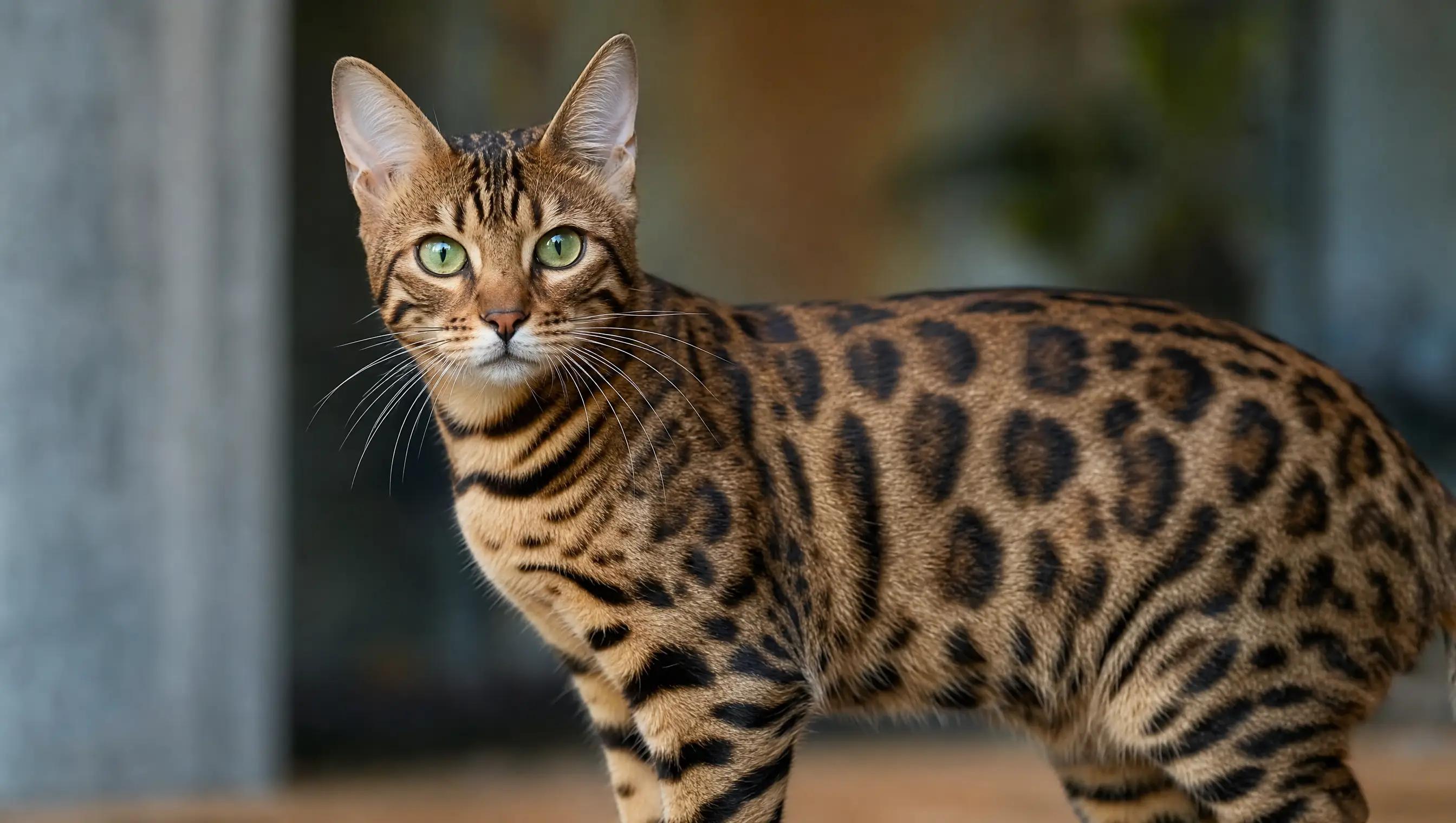
Bengal
A house cat with a wild-cat coat and the energy bill to match.
Vital stats
| Size | Medium–large · long, muscular frame |
| Weight | 4–7 kg · males heavier |
| Life expectancy | 12–16 years |
| Energy | Very high — needs a real outlet |
| Shedding | Low, coat is short and close-lying |
| Coat | Short, dense, spotted or marbled |
| Group | Shorthair |
Breed traits
Friendliness
Care
Mind
Temperament
Bengals are demanding in the way a smart dog is demanding: they need a job, and if you don't give them one they'll invent it, usually involving your countertops. They climb everything, learn to open cupboards and light switches, and many are genuinely fascinated by water — expect a paw in your glass or company in the shower. They bond hard to their people and want to be involved in everything, but they are not cuddle-on-command cats; affection tends to arrive on their terms, between sprints. They're chatty and can be loud when they want something. Put simply, a bored Bengal is a destructive Bengal, and that's the trait that most often lands them in rescue.
Habits & quirks
Water obsession
Many Bengals dunk toys, paw at running taps and join you at the sink or shower — a quirk you rarely see in other breeds.
Vertical living
They treat the top of the fridge, the door frames and the curtain rail as normal terrain; if there's a high point, they're on it.
Little escape artist
Sharp enough to work levers, handles and latches — child locks on cupboards are a fair investment.
Fetch and leash
Trainable to a genuinely high level: fetch, clicker tricks and harness walks all land well with a Bengal.
Care
| Exercise & enrichment | This is the whole job. Daily interactive play, tall climbing structures, puzzle feeders and rotated toys — under-stimulation is the number-one reason Bengals get rehomed. |
| Health screening | The breed carries Bengal PRA-b (progressive retinal atrophy causing blindness) and pyruvate kinase deficiency, both DNA-testable, plus HCM (a heart condition) screened by scan. Ask a breeder for these results directly. |
| Grooming | Easy — the short coat needs little more than a weekly once-over and sheds lightly, so grooming is the least of your Bengal commitments. |
| Household setup | Secure the high-value spaces, give them legitimate places to climb and scratch, and never leave a Bengal alone all day with nothing to do; a second active pet often helps. |
Common questions
Are Bengals part wild cat?
The foundation cats were hybrids of the Asian leopard cat, but a modern pet Bengal is several generations removed (F4 and later) and is a fully domestic cat. Early-generation (F1–F3) Bengals are a different matter and are restricted or banned in some places — check your local laws.
Are Bengals hypoallergenic?
No. They shed little and produce a bit less loose hair, but they still make the Fel d 1 protein that triggers most cat allergies. No breed is truly hypoallergenic.
Do Bengals get along in a normal home?
Yes, if the home meets their energy. They can be great with older kids and other active pets, but they're a poor fit for someone wanting a quiet, low-effort cat — an under-exercised Bengal turns that energy on your furniture.