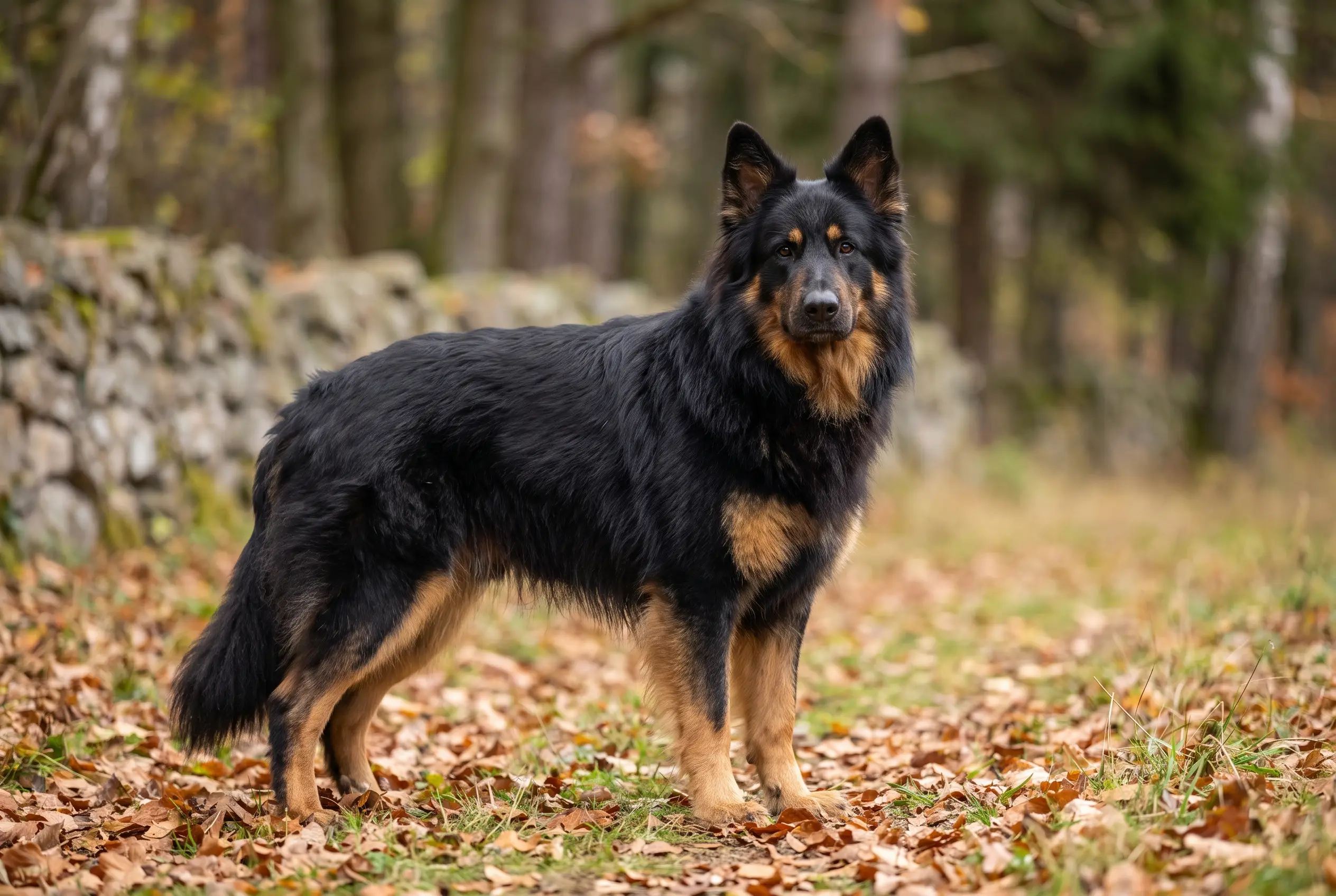
Bohemian Shepherd
Smaller than a German Shepherd, softer to live with, and younger than it looks.
Vital stats
| Size | Medium · 52–55 cm (dogs), 49–52 cm (bitches) |
| Weight | 19–27 kg (dogs), 17–24 kg (bitches) |
| Life expectancy | 12–14 years |
| Energy | Moderate to high — an hour a day, with something to think about |
| Shedding | Moderate to high — long coat over a full undercoat, heaviest twice a year |
| Coat | Long, 5–12 cm, straight to slightly wavy, with a ruff · black to gunmetal with tan markings, nothing else allowed |
| Group | Herding · Sheepdogs, with working trial (FCI №364, Group 1 — provisional) |
| Origin | Chodsko, Czech Republic |
Breed traits
Friendliness
Care
Mind
Temperament
The standard asks for a lively dog with fast but not impetuous reactions: docile, easily trained, attentive, easy to control and amenable, modest and undemanding, fearless, strong-nerved, exceptionally vigilant, with a superb nose. Read that list and notice what is absent. Nothing about hardness, sharpness or a bite. This is a dog that reports the stranger at the gate rather than dealing with him, and both aggression and excessive shyness are disqualifying faults. In a house it attaches closely to everyone in it, does well with the children and dogs it lives with, holds back a beat with visitors and then decides they are acceptable. It will take up almost anything you start — tracking, obedience, agility, canicross, search work, assistance work — and it does not need an experienced handler to get there. The Czech club puts it forward for beginners, which is not a sentence you write often about FCI Group 1.
Habits & quirks
Wears a ruff
The coat runs 5 to 12 cm and stands longest over the neck and chest, where it opens out into a mane. Judges look for it. Owners find it on the sofa, in the car and around the vacuum cleaner.
Announces, then holds
Exceptionally vigilant is the standard's phrase, and it earns it — you will know when someone reaches the gate. What comes next is a dog planted between you and the visitor, watching. Not one going forward.
Works the nose
Scenting ability is written into the standard, and Czech owners lean on it: tracking and mantrailing are the sports the breed shows up in most. A scent game in the garden will hold one far longer than a thrown ball.
Keeps your hours
Modest and undemanding, says the standard, and it holds up. It settles when the house settles and gets up when you do. What it will not accept is being left out of whatever is happening.
Care
| Exercise | An hour a day is the floor, and it should carry something to think about — a track, a retrieve, ten minutes of obedience. An hour on a lead and nothing more leaves a restless dog by evening. It has the stamina for a full day in the hills, and no need for the working-dog timetable a Malinois demands. |
| Grooming | Brush twice a week through the outer coat and the ruff, daily while the undercoat is coming out in spring and autumn. The feathering behind the thighs and hocks and under the tail mats first, so start there. The coat is weatherproof and largely self-cleaning; bathing is rarely the answer. |
| Training | Easy by shepherd standards. Docile, attentive and easy to control are the standard's words and the breed earns them: it offers behaviour, works for praise about as readily as for food, and picks things up in a few repetitions. Being soft, it also needs a light hand — a harsh correction shuts one down instead of sharpening it. |
| Health | A light disease load for a shepherd, on a small and young gene pool, which is the thing to keep an eye on. Czech club breeding rules require hips X-rayed after twelve months with grade C the worst permitted, plus DNA tests for degenerative myelopathy and for the D locus, since dilute coats fall outside a black-and-tan standard. Ask for all three on paper. |
Common questions
How is it different from a German Shepherd?
Start with the tape. FCI standard 364 puts males at 52–55 cm and 19–27 kg; a German Shepherd under standard 166 is 60–65 cm and 30–40 kg. The outline differs too: a level back on a 10:11 body rather than a sloping topline, smaller ears, and a long coat that comes in black-and-tan and nothing else, with a ruff the German breed does not carry. The temperament is where owners land, though — less drive, more give, no protection heritage, and a dog the Czech club is happy to hand a first-time owner. On ancestry, the common line is that the two breeds are unrelated. A 2025 study of historical German Shepherd genomes in PNAS puts it less absolutely: among shepherd breeds established in the mid-to-late twentieth century, the Bohemian Shepherd shared more genetic drift with post-war German Shepherds than with pre-war ones, which is what you would expect of a small population rebuilt in a country full of them.
Is it really a medieval breed?
The tradition is old. The breed is not. The Chods were freeholders who policed the Bohemian–Bavarian border for the Czech crown and held the right to keep large dogs; a long-coated shepherd appears on their banner in Mikoláš Aleš's illustrations for Jirásek's Psohlavci (1884), and Jindřich Šimon Baar wrote about the dogs of Chodsko in the 1920s. The FCI standard cites all of that and then declines to claim more from it, treating the material as support for a long-established Czech sheepdog type rather than proof that today's dogs descend from those. Documented breeding starts in 1984, with the Findejs and Kurz appeal in the cynological press, two answers from around Prostějov, and a litter of six in 1985. Anyone telling you their puppy's line runs back to the fourteenth century is selling the legend, not a pedigree.
Where does it stand with the kennel clubs?
Provisionally, and no further. It has been a Czech national breed since 1985, and the FCI accepted it provisionally on 29 April 2019 under standard No. 364 in Group 1. Provisional means the standard is live and the dogs are entered and judged at international shows, but they are not eligible for the CACIB, so the FCI international beauty champion title stays out of reach until the breed is accepted definitively. The AKC listed it in the Foundation Stock Service in 2019, which is a register rather than recognition. A breeder advertising a 'fully FCI recognised' Chodský pes is running ahead of the paperwork.