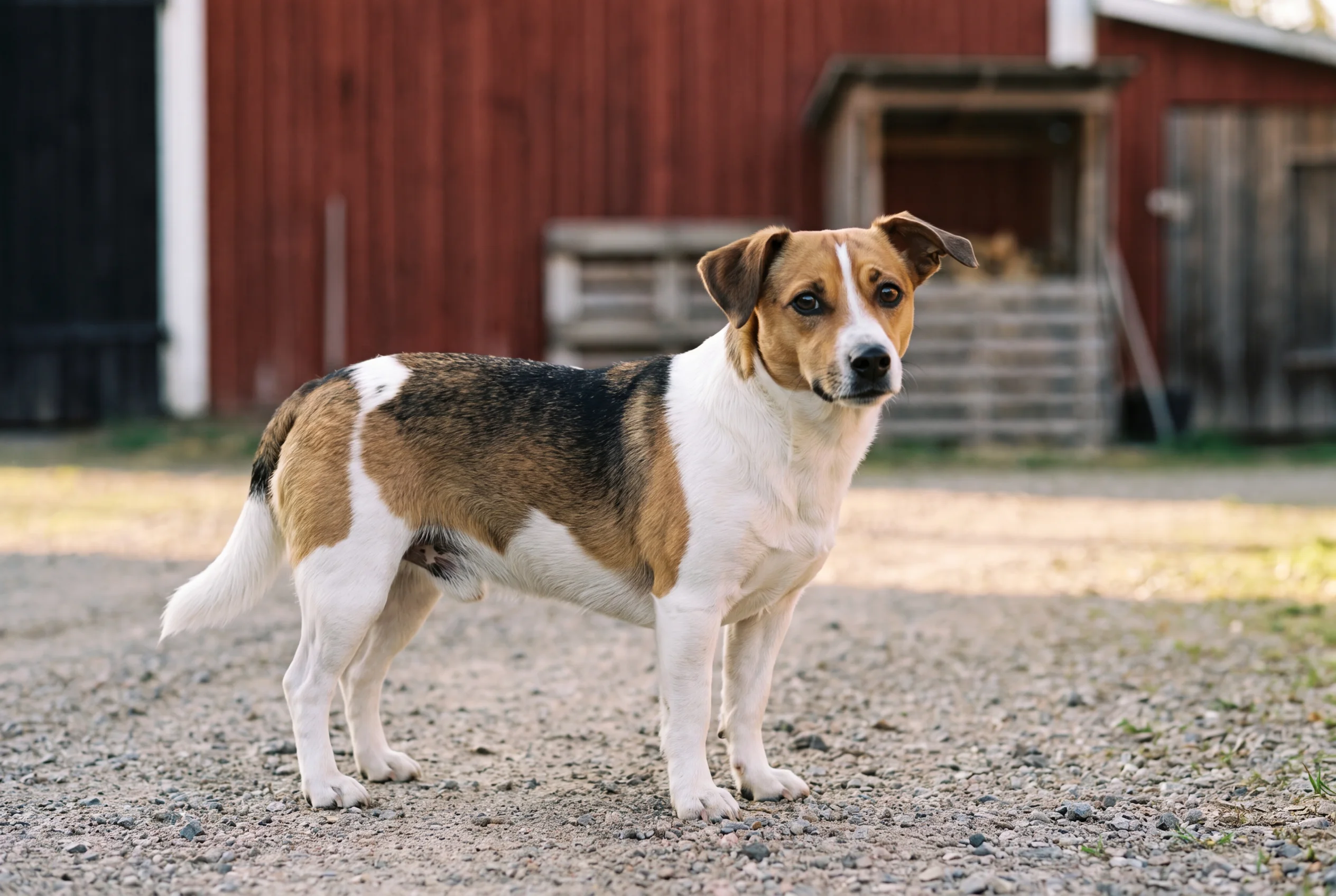
Dansk-Svensk Gårdshund
Two countries claimed the same farm dog, so the name kept both.
Vital stats
| Size | Small · 32–37 cm |
| Weight | 7–12 kg |
| Life expectancy | 12–15 years |
| Energy | High — a small dog on a working dog's schedule |
| Shedding | Moderate — short coat, sheds quietly all year |
| Coat | Hard, short and smooth · white with patches of any colour |
| Group | Working · Farm Dog (FCI №356, Group 2) · AKC |
| Origin | Denmark and Skåne, southern Sweden |
Breed traits
Friendliness
Care
Mind
Temperament
The FCI standard asks for three things: alert, lively, attentive. What that misses is how easy the breed is to live with. A farm dog that snapped at the farmer's children did not get bred from, so what survived is a cheerful, tail-wagging dog that likes people, settles indoors once the day's work is done, and rarely barks for the sake of it. Strangers get a moment's reserve rather than suspicion. The gap with the terriers it resembles is real and worth understanding: a Danish-Swedish Farmdog is softer, quicker to give in, and far more interested in what you want than a Jack Russell of the same size. It still hunts rats, still chases anything that bolts, and still has opinions. It just takes correction without going flat and lets an argument end.
Habits & quirks
Jumps far above its size
Owners talk about fence height first. A 35 cm dog that clears a metre of picket from standing, or lands on a kitchen counter it has been thinking about, is normal rather than exceptional here.
Patrols before it settles
The yard job left a habit of walking the boundary, checking the shed, and announcing anyone who arrives, then dropping it. Report, not siege.
Hunts vermin without being asked
Mice in the wall, a rat behind the compost, moles. It will work a hedge line for an hour and come back muddy and pleased.
Grows up slowly
The standard says the breed is late to develop, and breeders put the adult body nearer three years than two. Expect a puppy brain for longer than a dog this size suggests.
Care
| Exercise | An hour or more, split, with something to think about in it: scent games, a long line in rough ground, agility, a ball thrown into cover. It will happily do more. What it will not do is stay sane on three short lead walks round a block. |
| Grooming | The least of your problems. A rubber mitt once a week keeps the hard short coat in order, it sheds steadily rather than in seasonal drifts, and baths are occasional. Check ears and nails on the same schedule. |
| Training | Reward-based and short, and it will hand you more than you asked for. This is one of the more biddable small breeds and it does well in obedience, agility and nose work. Recall needs proofing against squirrels early, because the prey drive is genuine even if the temperament is soft. |
| Health | A robustly healthy population, helped by a founder base drawn from working farm dogs rather than a show line. Breed clubs test widely for hip and elbow scores, patellar luxation and primary lens luxation, and BAER-test puppies for hearing given the amount of white in the coat. Ask to see all of it. |
Common questions
Is this a Jack Russell?
No, though almost everyone asks. They share the white-and-patched coat, the size and the rat-catching past, and the resemblance is not accidental: the farm dogs behind the breed were pinschers crossed with fox terriers on smallholdings either side of the Öresund. The FCI classifies the Dansk-Svensk Gårdshund in Group 2 with the pinschers and schnauzers, not in the terrier group. In the flesh it is more rectangular, its head is triangular rather than wedge-flat, and its ears fold forward or into a rose where prick ears are a fault. The bigger difference is the character. A Russell is sharp, self-employed and will argue all afternoon. This dog gives in, takes direction and switches off indoors.
Does it need a farm, or will a flat do?
A flat works if the day does. This is not a dog that needs land, it is a dog that needs a job, and plenty live happily in Copenhagen and Stockholm apartments on a diet of long walks, dog sport and nose work. It is quiet indoors by the standards of small dogs and settles once it has been used. Two things break it: being left alone all day, and being under-exercised. If your building has a garden, check the fence, then check it again a foot higher.
How hard is one to find outside Scandinavia?
It depends where you stand. In Sweden it is a top-ten breed with 840 puppies registered in 2024, and Denmark is similar, so a wait there is measured in months. Outside the Nordics the numbers collapse: the United States had a few hundred dogs when the AKC recognised the breed in 2025, and British and continental litters are scarce enough that most people import or join a list. Buy through the national breed club, look at the health testing, and be patient rather than quick.