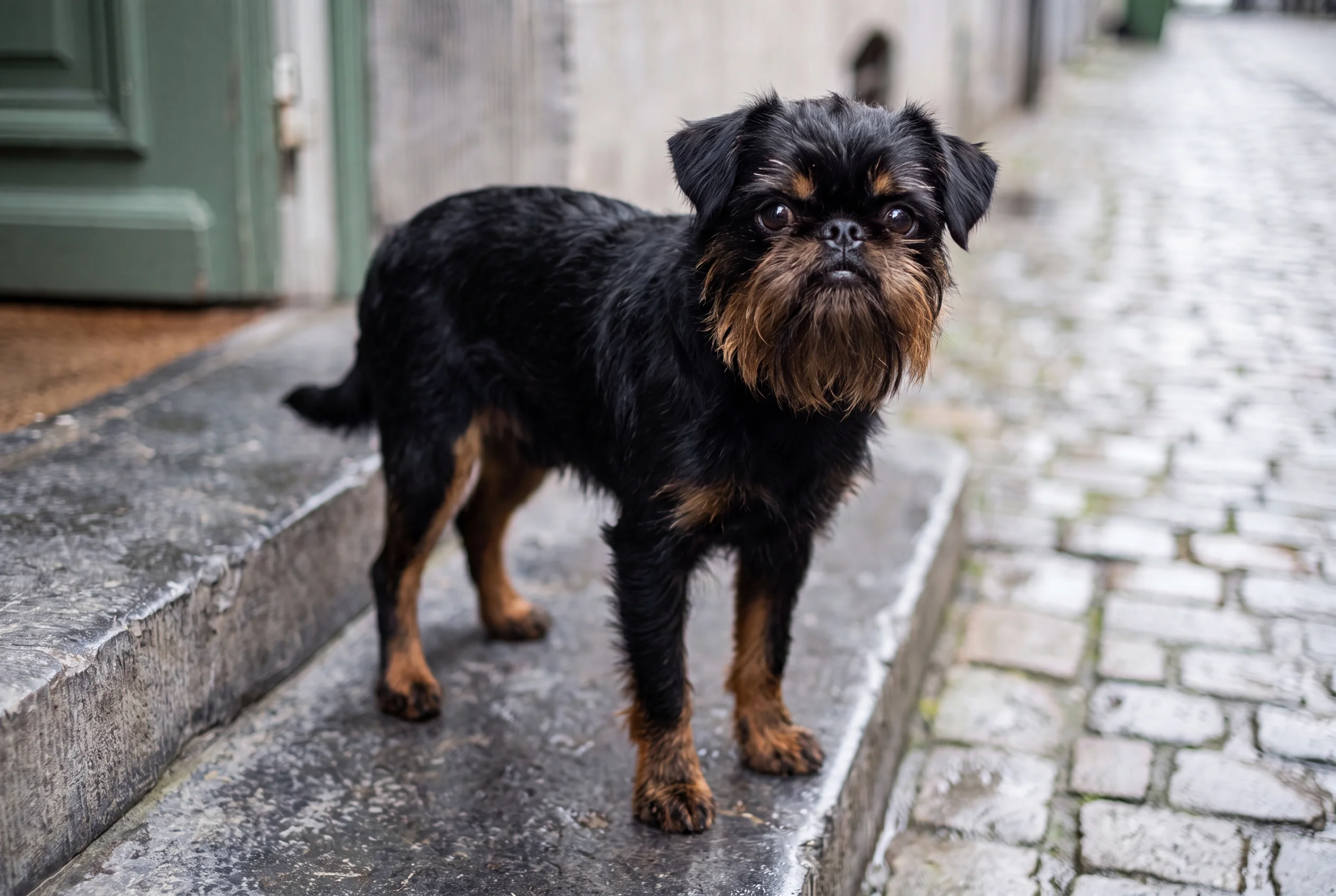
Griffon Belge
Same dog as the Brussels Griffon, in black. In Belgium that makes it a different breed.
Vital stats
| Size | Toy · 18–25 cm |
| Weight | 3.5–6 kg |
| Life expectancy | 12–15 years |
| Energy | Moderate — 30–45 min a day, taken in short walks |
| Shedding | Low — the harsh coat is stripped out rather than dropped |
| Coat | Rough, harsh and slightly wavy, with undercoat · black or black and tan |
| Group | Toy · Companion (FCI №81, Group 9) |
| Origin | Brussels, Belgium |
Breed traits
Friendliness
Care
Mind
Temperament
The FCI standard calls it alert, proud, very attached to its owner and very watchful, neither timid nor aggressive, and that reads accurately in a living room. A Griffon Belge picks one person, follows that person's day and comments on it. Visitors get announced, then studied from a distance before any decision is made. The rat-catching left more behind than the face: there is a hard terrier switch that flips at a moving mouse, a rustling bag, or a dog four times its weight walking past the gate with too much confidence. It is also thin-skinned. Raised voices and heavy corrections shut it down for the rest of the session, and what it then avoids is the exercise, not you.
Habits & quirks
Grumbles more than it barks
Huffs, groans, a rising complaint when the walk is late. Griffon owners learn to tell the noises apart inside a fortnight.
Assigns itself a handler
One person gets chosen, usually in the first month, and acquires a small black escort to the kitchen, the shower and the front door. The rest of the household is staff.
Still works the skirting boards
Stables, mice, a century and a half ago. The instinct outlived the job, and a Griffon Belge will sit and stare at the gap under a cupboard with complete professional focus.
Snores
The short face comes with an audible airway. Soft, even snoring in a sleeping griffon is ordinary. Noise that shows up while the dog is awake and standing still is not, and that line is worth knowing before you need it.
Care
| Grooming | The harsh black coat is hand-stripped, not clipped: two or three full strips a year plus a weekly tidy of the face furnishings. Clippers cut the coarse outer hairs off and leave a soft coat that fades to dull brown-grey within a couple of moults, and getting the texture back takes about a year of stripping. |
| Breathing and heat | Walk in the cool part of the day, use a harness rather than a collar, and stop before the dog wants to. Panting that will not settle, blue-tinged gums or a collapse after five minutes of play means the vet the same day. A griffon that snores while awake should be assessed for airway surgery rather than worked around. |
| Eyes | Large, forward-set and shallow in the socket, so they meet brambles, cat claws and the dog's own hind foot. Check them daily and treat any squint, watering or pawing as urgent: a corneal ulcer in this face can go from irritation to a lost eye inside a week. |
| Training and company | Short reward-based sessions and no correction harsher than being ignored. It is bright, it is stubborn about repetition, and it is genuinely bad at being left: an eight-hour empty house produces a noisy, destructive griffon rather than a bored one. |
Common questions
How is this different from a Brussels Griffon?
By coat and colour, and by nothing else. The FCI runs three Belgian griffons off what is effectively one description of the dog: the Griffon Bruxellois (№80) rough-coated and red, the Griffon Belge (№81) rough-coated and black or black and tan, and the Petit Brabançon (№82) smooth-coated in any of those colours. Same weight range, same square build, same flat face and jutting chin, same character. Belgium allows breeding across all three with the Société Royale Saint-Hubert's permission, and since coat type and colour segregate puppy by puppy, one litter can hold more than one of them. Most of the English-speaking world ignores the split and calls them all Brussels Griffons. Belgium and the FCI do not.
Is the flat face a health problem?
Yes, though less brutally than in the breeds that make the headlines. A UK study that graded 52 Griffon Bruxellois for brachycephalic obstructive airway syndrome put the breed in its moderate band, with between a quarter and half of the dogs completely clear, against 7% of pugs and 10% of French bulldogs. Better company than that is still not a clean bill. Expect snoring, poor heat tolerance and a real chance of airway surgery. The eyes sit forward in shallow sockets, scratch easily, and ulcerate fast. Litters run to four or five puppies and often arrive by caesarean, because the head that makes the face is a head the mother has to pass. Buy from a breeder who will let you listen to both parents breathing at rest, not just look at them standing still.
Can I register one as a Griffon Belge in the United States?
No. The AKC recognises a single breed, the Brussels Griffon, covering both coat types and every colour, and its standard uses 'belge' as the name of a colour rather than a breed. There is no AKC listing for Griffon Belge or Belgian Griffon. So a rough-coated black griffon is an AKC Brussels Griffon in Minneapolis and a Griffon Belge, FCI №81, in Brussels. Same dog either way, different paperwork. Moving one between the two systems is routine, but check which name your pedigree is written under before you enter a show.