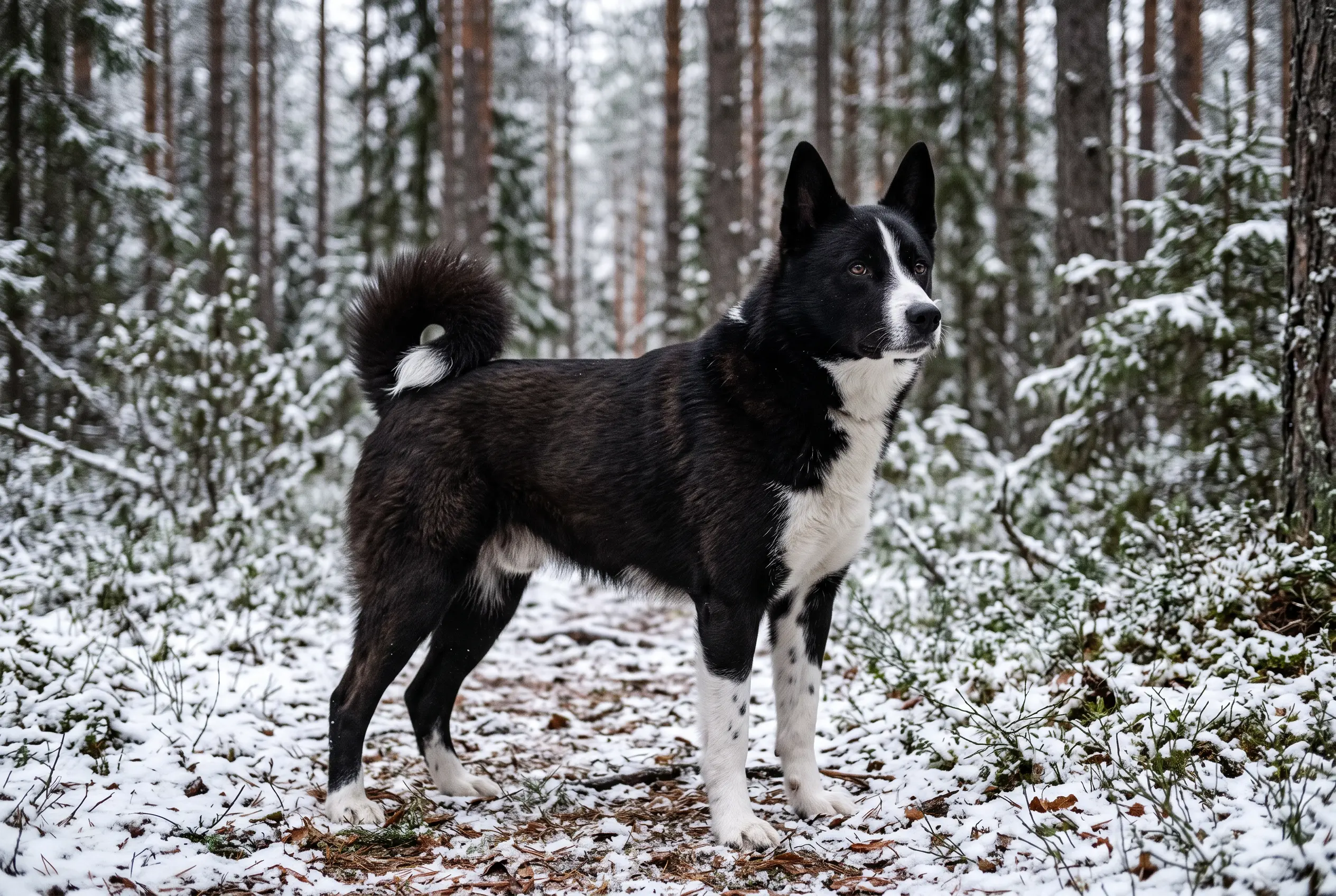
Karelian Bear Dog
Black and white, built for bear, and its standard says a natural bobtail counts the same.
Vital stats
| Size | Medium · 54–60 cm (dogs), 49–55 cm (bitches) |
| Weight | 25–28 kg (dogs), 17–20 kg (bitches) — the standard's ideal weights |
| Life expectancy | 11–13 years — breed literature, not survey data |
| Energy | Very high — a big-game hunting spitz, two hours a day and more |
| Shedding | Heavy, with two seasonal blows |
| Coat | Harsh straight topcoat over a dense undercoat · black with white markings only |
| Group | Hound · Nordic Hunting Dogs (FCI №48, Group 5) |
| Origin | Karelia, Finland |
Breed traits
Friendliness
Care
Mind
Temperament
Read the standard's behaviour clause slowly, because it is unusually honest: eager hunter, very independent yet works co-operatively to game, sharp senses, very good sense of direction, balanced, courageous and persistent, very self-confident, may be territorial towards other males, never aggressive towards people, slightly reserved. Every one of those clauses is a decision about how you will live. The independence means a dog that solves problems without consulting you. The territoriality towards other males is real and physical, and two entire males in one household needs an answer rather than optimism. "Never aggressive towards people" is the part owners confirm. This is not a guard dog that bites, it is a hunting dog that politely ignores visitors. With its own family it is affectionate and undemonstrative. With a strange dog in a park it is a coin toss, and the odds get worse as it matures.
Habits & quirks
Bays big game, does not fight it
The work is to find a bear or an elk, get in front, and hold it with noise until the hunter arrives. The dog has to be brave enough to stand there and sensible enough not to close the distance.
A bobtail is not a fault
The standard permits a natural bobtail and rates it equal to a full tail, which almost no other spitz standard does. Puppies in one litter can be born with either.
Colour is a hard rule
Black with white markings, or nothing. Predominantly white with black markings is a fault, so are wolf-grey hairs and heavy ticking in the white, and any colour outside the standard is a disqualification.
Territorial with other males
The standard says it plainly and owners repeat it. Never towards people, but an adult male meeting another adult male is a situation, not a greeting.
Care
| Exercise | Two hours minimum, and not on a pavement. This is a dog bred to cover forest all day and think while it does it. Skip that and its hobby becomes patrolling and barking. Scentwork, tracking and long off-road walks are the right shape; off-lead freedom in open country is a separate problem, covered below. |
| Grooming | Straightforward for most of the year: a harsh topcoat that sheds dirt, a dense undercoat, a brush once a week. Twice a year the undercoat comes out completely and wants a rake most days for a fortnight. No trimming and no clipping: a wavy coat is a fault, and grooming will not fix one. |
| Training | Independent, quick, and unbothered by your opinion. It learns fast and complies when it agrees. Force-based methods produce a dog that either shuts down or argues, and neither helps. Recall is the hard part and may never be bombproof, because a Karelian on a fresh track has an excellent sense of direction and no intention of using it to come back. Long lines and real fences, not hope. |
| Health | No breed health survey exists. Finnish breeders screen hips and eyes, and the registration base is large enough that you can be choosy. Ask for hip scores on both parents, ask about eye testing, and ask directly about temperament with other dogs, because that is the trait most likely to shape your daily life. |
Common questions
Are Karelian Bear Dogs really used on bears?
Yes, in two opposite ways. In Finland they hunt bear and elk by holding the animal at bay until the hunter arrives. In North America wildlife agencies and the Wind River Bear Institute run the same instinct in reverse: the dogs haze bears that have grown too comfortable around people, so the bear learns to keep away and does not have to be destroyed.
Is it a family dog?
It can be a particular family's dog. The standard's line, never aggressive towards people, holds, and they are affectionate and steady at home. But this is a hunting dog with a heavy prey drive, genuine territoriality towards other male dogs, and a two-hour daily requirement that does not negotiate. It suits an active rural household far better than a flat.
How is it different from a Russo-European Laika?
They come from overlapping stock, both tracing to the black-and-white hunting spitz of Karelia, and photographs of the two get swapped constantly. They are separate breeds with separate registries and separate countries: the Karelian Bear Dog is Finnish, FCI standard 48; the Russo-European Laika is Russian, FCI standard 304. The FCI has never treated them as one breed.