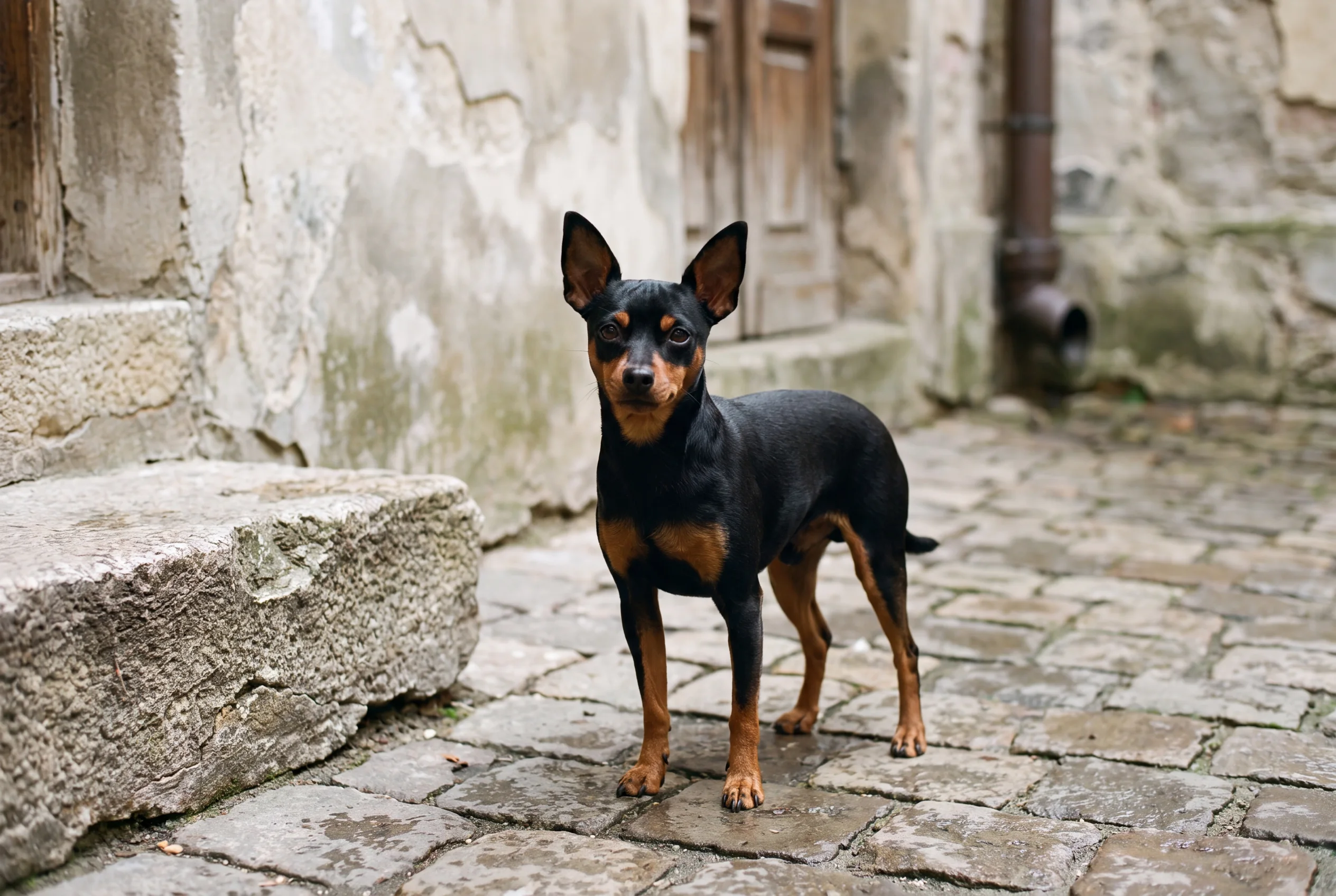
Prague Ratter
Bohemia's palace ratter, rebuilt from one litter in 1982.
Vital stats
| Size | Toy · 21–23 cm (tolerance ±1 cm) |
| Weight | Optimal around 2.6 kg · 1.5–3.5 kg in practice |
| Life expectancy | 12–14 years |
| Energy | Moderate — 30–45 min/day, busy indoors |
| Shedding | Low to moderate |
| Coat | Smooth or moderately long · tan-pointed black, brown, blue or lilac, plus yellow, red and merle |
| Group | Toy · Companion (FCI №363, Group 9) |
| Origin | Bohemia, Czech Republic |
Breed traits
Friendliness
Care
Mind
Temperament
The FCI standard calls it gentle, curious and affectionate, slightly reserved towards strangers and very friendly within the family, and owners describe much the same dog. It is not decorative. It is quick, it notices everything, and the nose that once made it useful on rats is still attached, so mice, insects and anything that scurries across a kitchen floor get chased. Most Prague Ratters pick one person and follow them from room to room. They bark at the door, at the lift, at a bag being set down, which early training keeps in proportion and ignoring never fixes. With visitors they hang back and then thaw. With other small dogs they are usually easy; with large ones they have no sense of scale at all, which is the owner's job to manage rather than the dog's.
Habits & quirks
Still goes after small moving things
The name is a job description and the reflexes came with it. Mice, insects, a crisp packet blown along the pavement: the dog locks on and gives chase. The FCI standard credits the breed's old usefulness to its size, its speed and its sense of smell, and none of the three has been bred out.
Announces the door
It hears the lift before you do and says so. This is a small dog with a sharp, carrying bark and firm views about arrivals. Worth working on early, because a habit at eight weeks is a fixture at two years.
Feels the cold
At around 2.6 kg there is very little dog and a lot of surface, so Czech winters are handled in a coat rather than out of one. Expect it to find the radiator, the sunny square of carpet and the inside of your jumper.
Lives at ankle height
The commonest injuries in dogs this size are domestic ones: stepped on, caught in a closing door, jumped down from a sofa ten times its own height. Households with a ratter learn to shuffle rather than stride.
Care
| Feeding | Portions are measured in grams and mistakes show quickly. Three or four small meals a day suits an adult, and puppies under about four months need them more often, because a stomach this size empties fast and toy-breed puppies can drop their blood sugar between meals. Treats come out of the daily total, not on top of it. |
| Teeth | The standard prefers a full set of teeth, which is a lot to fit in a jaw this narrow. Milk teeth hang on, adult teeth crowd, and plaque hardens into tartar fast. Brush daily from puppyhood and budget for scaling under anaesthetic every year or two. |
| Handling and the home | Lift with a hand under the chest and one under the hindquarters, never by the front legs. Steps or a ramp to the sofa and bed spare the knees. Supervise around toddlers and large dogs, and watch where you put your own feet. |
| Health | Patellar luxation is the one to ask a breeder about, as it is across small breeds; a kneecap that slips causes limping and arthritis, and bad cases end in surgery. The FCI standard disqualifies an open fontanel, so skulls are worth checking too. Beyond that, most vet visits come down to teeth and accidents. Life expectancy is usually given as 12 to 14 years. |
Common questions
How is this different from a Chihuahua?
They are separate breeds with separate FCI standards, and the standards disagree on nearly every point that matters. The Chihuahua's apple-shaped skull is a defining breed characteristic; on a Prague Ratter an apple head is a disqualifying fault, and the muzzle should run from a third to nearly half the length of the head. A Chihuahua is judged on weight alone, 1 to 3 kg, with no height requirement at all, while the Prague Ratter is judged on height, 21 to 23 cm, at an optimal weight of about 2.6 kg. Merle disqualifies a Chihuahua and is a permitted colour in the ratter. The ratter's tail is carried slightly upright and only curves over the back on the move, where the Chihuahua's is carried high and curled. In outline the Prague Ratter sits closer to a Miniature Pinscher, which is roughly what pushed it aside in the 19th century.
Is it fully recognised by the FCI?
Not yet. The FCI accepted the Pražský krysařík on a provisional basis on 29 April 2019 under standard 363, in Group 9, Section 9, alongside the Continental Toy Spaniel and the Russian Toy. Provisional carries real limits: pedigrees carry the FCI logo and the dogs can compete for FCI titles including World Winner, but they cannot be awarded the CACIB. Definitive recognition is a separate later step that the breed has not yet had. Anyone advertising it as fully FCI-recognised is running ahead of the paperwork.
Is a 2.6 kg dog realistic with children?
With older children who have been shown how to pick a dog up and put it down, yes. With toddlers, no, and the reason is arithmetic rather than temperament: a fall off a sofa or a foot in the wrong place does far more damage to a two-kilo dog than the same accident does to a ten-kilo one. Prague Ratters are affectionate and the standard asks for a gentle, friendly dog, but any dog that keeps getting hurt learns to defend itself. In a loud, fast household the breed is a poor fit until things calm down.