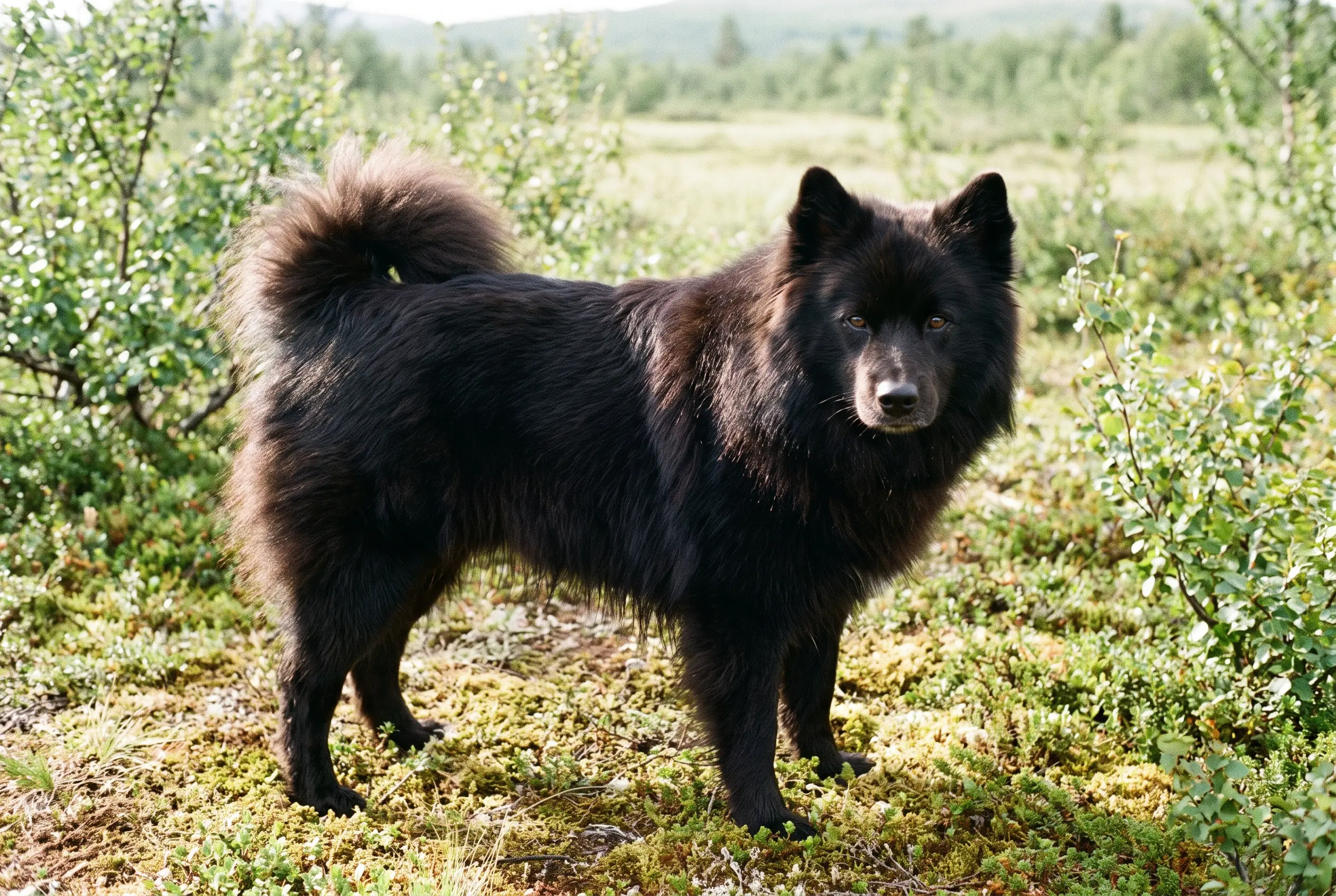
Swedish Lapphund
Sweden's black reindeer dog, with the shortest disqualification list in the group.
Vital stats
| Size | Medium-small · 45–51 cm (dogs), 40–46 cm (bitches) |
| Weight | 16–20 kg (dogs), 14–16 kg (bitches) — breed literature; the standard sets none |
| Life expectancy | 12–15 years — breed literature, not survey data |
| Energy | Moderate to high — 60–90 min/day, plus something to think about |
| Shedding | Heavy, with two seasonal blows |
| Coat | Profuse standing double coat with a ruff · solid black, often bronzing to 'bear-brown' |
| Group | Herding · Nordic Watchdogs and Herders (FCI №135, Group 5) |
| Origin | Lapland, Sweden |
Breed traits
Friendliness
Care
Mind
Temperament
Lively, alert, kind and affectionate is how the standard opens, and then it adds the working words: very receptive, attentive and willing to work, easy to train, full of endurance and toughness. That is a herding dog's record of service, and the herding was reindeer, animals that scatter, kick, and cannot be pushed around. The dog that manages them is watchful, quick to read a situation, and vocal. Swedish Lapphunds bark. It is how the job was done, and it is the trait new owners most often underestimate. With people it is warm and closely attached, sometimes to the point of following you from room to room, and it does badly parked alone in a garden. It is also more sensitive than several of its Nordic neighbours, and heavy-handed training lands badly on it.
Habits & quirks
Black that turns bronze
Solid black is the usual colour, and the standard expects it to bronze into more or less 'bear-brown' shades. White is permitted only on the chest, the feet and the tip of the tail.
The coat stands out, not down
Hair standing straight out from the body over a dense, finely frizzy undercoat, with a ruff round the neck and long bushy furnishings on the tail. It is weather-resistant by design and it never lies flat.
Talks while it works
Reindeer get moved at a distance and with noise. The barking did not appear in the suburbs. It came with the job, and it needs a channel and a stop cue rather than a ban.
Three disqualifying faults
Aggression or extreme shyness, obvious abnormality, and 'untypical'. That last one leaves more to the judge's eye than almost any other standard in Group 5.
Care
| Exercise | An hour to ninety minutes, with mental work folded in. It is not a big dog and it does not need marathon distances, but it is a trained working breed that wants a task, and the standard itself lists obedience, agility, herding and tracking. Left with only a walk, it invents a job, usually a loud one. |
| Grooming | A profuse standing coat over a dense frizzy undercoat: a thorough brush once a week, right down to the skin, then daily work with a rake for a couple of weeks in spring and autumn. It does not mat the way a long silky coat does, and it should not be clipped, because that coat is what keeps the dog both warm and cool. |
| Training | Easy and quick, and sensitive with it. Positive methods, short sessions, plenty of variety. Two things to start on day one: an off-switch, because an attentive dog will stay switched on all evening if you let it, and a stop cue for barking. It suits a first-time owner better than most spitz, as long as that owner enjoys training. |
| Health | The population is small, a few thousand worldwide, so pedigree depth is worth real attention. Swedish breeders screen hips and eyes; ask for both. There is no breed health survey, and the 12–15 years in breed literature does not come from a study. |
Common questions
What is the difference between a Swedish and a Finnish Lapphund?
Two countries, two standards, two registries, FCI 135 and 189, over a shared Sami reindeer-herding job. The Swedish is usually solid black, sometimes bronzing to brown, slightly smaller, with a coat that stands straight out from the body. The Finnish comes in a far wider range of colours and is much the more numerous of the two. The third dog in that family, the Lapponian Herder, is the leggy one whose tail does not curl.
Do they bark a lot?
Yes, and it is worth planning for. Herding reindeer meant moving animals at a distance by voice, and the trait is intact. It responds well to training: teach an 'enough' and give the dog work. But a silent Swedish Lapphund was never the design.
Is it a good family dog?
A very good one, for a household that trains. It is affectionate, sturdy, patient with children, closely bonded to its people and well suited to dog sports. The three honest caveats are the barking, the two heavy moults a year, and how badly it takes being left alone for long stretches.