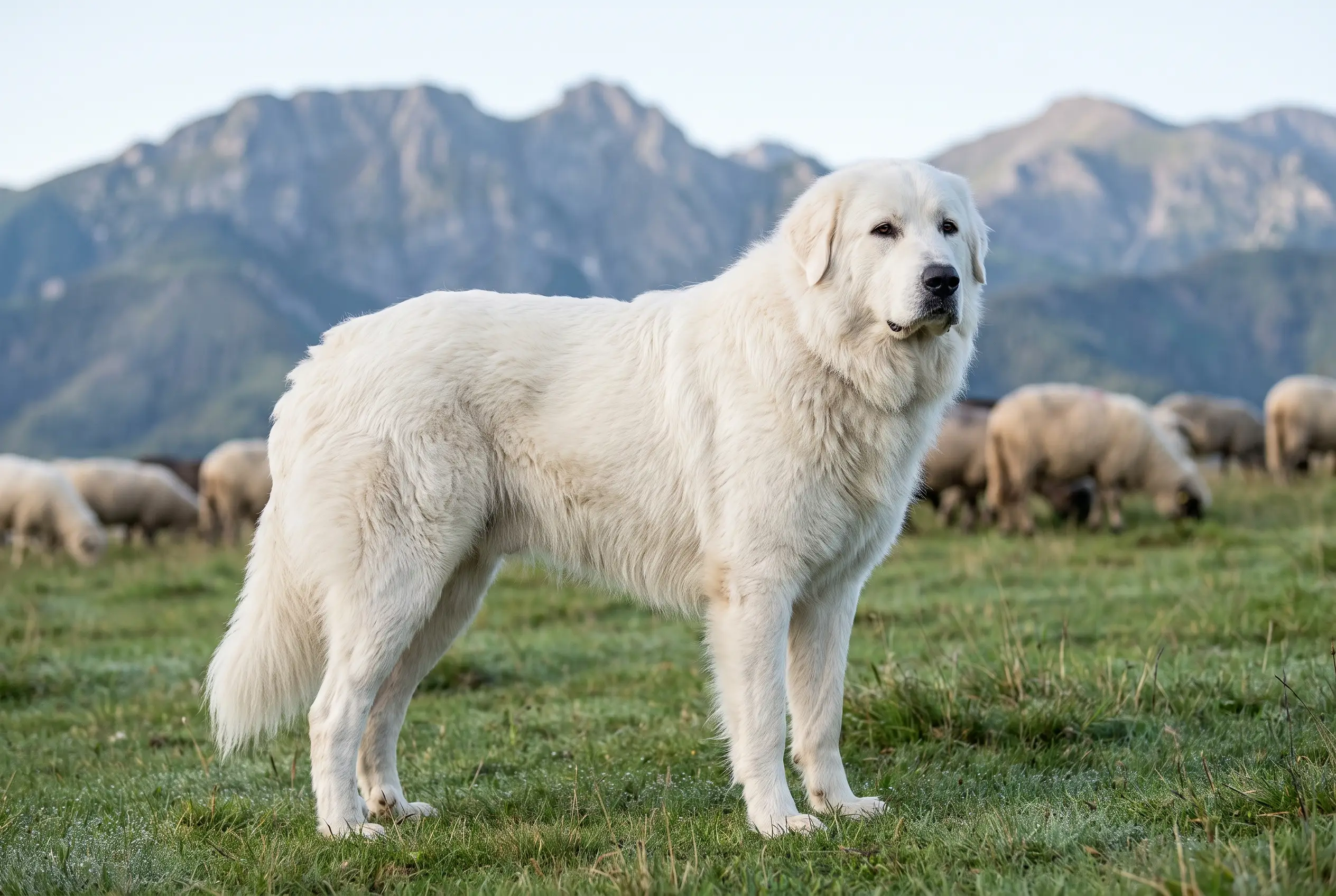
Tatra Shepherd Dog
Filed with the sheepdogs. It has never herded a thing.
Vital stats
| Size | Large · 65–70 cm (dogs), 60–65 cm (bitches) |
| Weight | 35–60 kg · the FCI standard sets no weight |
| Life expectancy | 10–12 years |
| Energy | Moderate — patrol pace, with long stretches of lying still |
| Shedding | Heavy — the undercoat comes out in handfuls each spring |
| Coat | Long, hard outer coat over a profuse undercoat, with a full ruff · uniformly white |
| Group | Herding · Sheepdogs, without working trial (FCI №252, Group 1) |
| Origin | Podhale, Poland |
Breed traits
Friendliness
Care
Mind
Temperament
The standard gives it three words: calm, intelligent and alert. What that describes is a dog that does very little for most of the day and keeps its energy for whatever it decides is a problem. It is not biddable in the retriever sense and was never selected to be — a guardian left on a mountain pasture for a week has to judge a situation on its own, and that judgement does not switch off when the situation is your postman. It attaches hard to its own household, is patient with children it grew up with, and treats every arriving stranger as something to log and clear. Maturity takes two to three years, so a two-year-old is still an adolescent in a 50 kg body, and the guarding instinct tends to arrive late and all at once. Aggression and a nervous character are both disqualifying faults in the ring, and a well-bred one is neither of those. It is a dog with a job already in its head and no particular interest in yours.
Habits & quirks
The night shift
Barking is the tool. A guardian announces itself across a valley so a predator moves on before anything has to happen, and it does this at two, three and four in the morning. On a mountain pasture that is the job. Forty metres from a neighbour's bedroom it is a problem no amount of training removes.
Walks the fence line
It patrols the edge of what it has decided is its ground, on a schedule of its own, and its idea of where the boundary runs is usually more generous than the deeds are.
Lies down and watches
Most of the day goes on lying somewhere with a view of the flock, the yard or the door. The energy level is unremarkable; the attention never really shuts off.
Grows up on its own clock
Body and head both take two to three years. Owners who had an easy puppy often meet the real dog at around eighteen months, when it starts making decisions about visitors.
Care
| Space and fencing | Land, stock, or at the very least a securely fenced plot it can treat as its own. Fencing needs to be tall and solid, because this breed claims territory generously and defends it seriously. A flat is impossible and a suburban garden is close to it. |
| Grooming | Brush the long coat weekly and daily through the spring moult, when the undercoat comes out for weeks. Bathing is rarely needed — the white coat drops dirt by itself. Check the hair between the toes, which the standard asks for and which collects burrs and packed ice. |
| Training | Short sessions from eight weeks, and keep socialising with visitors well past two years. It will do what you ask when it agrees with you, which is a real limit rather than a training failure. Off-lead recall is not reliable in this breed and does not become so; plan around a long line and a closed gate. |
| Health | Sound on the whole. Hips are the screening priority — the American breed club has required OFA hip clearance for its breeding stock since the 1980s, so ask for the certificate. The deep chest also puts it in the bloat risk group: split meals, and know where the nearest out-of-hours vet is before you need one. |
Common questions
Is the Tatra Shepherd Dog a herding dog?
No, and its own standard says so. The FCI lists it in Group 1, Section 1 Sheepdogs, without working trial, but the brief history in that same document calls it "an old, local breed, used primarily for flock guarding rather than herding". A herding dog moves stock on command. This one lives in the middle of the flock and handles whatever turns up, alone, often at night. The group label sells a Border Collie and the dog that arrives makes its own decisions.
How do I tell it from a Slovenský Čuvač or a Kuvasz?
All three are white Carpathian flock guardians, and photographs will not settle the argument — the pedigree will. The Podhalański is Polish, from Podhale on the northern side of the Tatras. The Slovenský Čuvač (FCI №142) is Slovak, from the other side of the same range. The Kuvasz (FCI №54) is Hungarian and came off the plains rather than the high pasture. Height is the cleanest divider on paper: the Kuvasz is the tallest, with males at 71–76 cm, the Podhalański next at 65–70 cm, and the Čuvač the smallest and lightest, males at 62–70 cm and 36–44 kg. The Kuvasz is also the only one of the three the AKC recognises.
Would one be happy in a house with a garden?
Usually not, and the neighbours will notice first. It needs a boundary it can patrol, something to guard, and enough distance from other houses that barking after dark is nobody's business but yours. In a small garden it barks at every car and every passing dog, digs, and gets frustrated, and it meets visitors at the gate with real conviction. People buy it as a handsome white family dog and give it up at around eighteen months, which is roughly when the guarding switches on.