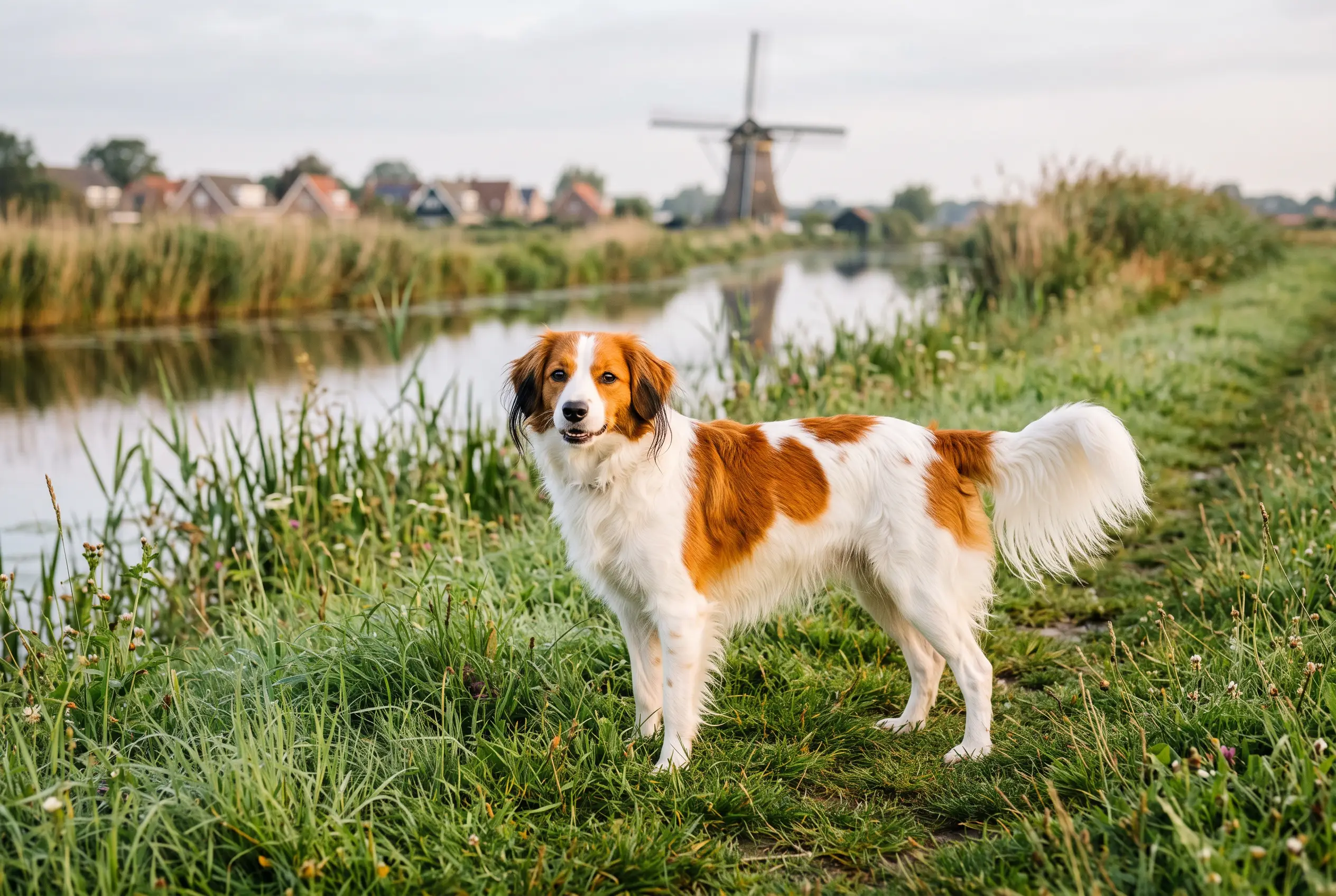
Kooikerhondje
The little Dutch dog that lured ducks for a living.
Vital stats
| Size | Small · 35–42 cm |
| Weight | 9–11 kg |
| Life expectancy | 12–14 years |
| Energy | High — a busy working brain in a small body |
| Shedding | Moderate — heavier in spring and autumn |
| Coat | Medium-length, white with orange-red patches · black ear tips prized |
| Group | Sporting · Flushing Dog (FCI №314, Group 8) |
| Origin | Netherlands |
Breed traits
Friendliness
Care
Mind
Temperament
Cheerful, alert and quick on its feet, the Kooikerhondje is a working dog in a small package. With its own family it is affectionate and playful; with strangers it hangs back and watches, and early socialisation keeps that reserve from hardening into suspicion. It is a sensitive breed — harsh handling shuts it down, and one that was never taught otherwise can be sharp with rough children. Handled lightly, it turns into a fast, willing learner that shines at agility, flyball and nose work.
Habits & quirks
The tail does the talking
The well-feathered white tail waves constantly — it was the lure that drew ducks down the decoy canals, and the standard still treats it as essential equipment.
In and out of view
In the eendenkooi it worked by appearing and vanishing along the reed screens, letting curiosity pull the ducks deeper. It still loves games where it darts out of sight and back.
Vermin patrol
Killing rats and mice around the decoy was part of the job description. Small scurrying things still get its complete attention.
Weighs up the visitor
At the door it stands back and takes a stranger's measure before committing. That reserve is bred in — meet it with introductions, not force.
Care
| Exercise | An hour a day of real movement, with a game or sport built in — agility, flyball and nose work all suit it. A worked Kooiker is a quiet Kooiker. |
| Grooming | Brush the medium-length coat once or twice a week and check the feathering on ears, legs and tail for tangles. It mostly keeps itself clean. |
| Training | Rewards only. It reads tone acutely, and one harsh correction costs more than ten treats buy back. Short, playful sessions get the best out of it. |
| Health | Buy from breeders who test — the breed community screens for von Willebrand's disease type III, ENM (a hereditary necrotising myelopathy), patellar luxation and eye disease. |
Common questions
What does 'Kooikerhondje' mean?
Little dog of the kooiker — the keeper of an eendenkooi, the Dutch duck decoy of curved, screened trap canals. The dog lured ducks in by playing along the screens, its white tail flagging like a fox's brush; between seasons it killed the decoy's vermin. Say it roughly 'COY-ker-hond-yuh'.
Are Kooikerhondjes good with children?
With children who have learned dog manners, yes — it is playful and devoted inside its own family. But it is a sensitive breed and can be sharp if grabbed or teased, so it fits households where children treat the dog with respect, and it should meet plenty of well-behaved children young.
How rare is the breed?
Uncommon rather than vanishing. It came back from a handful of dogs after the Second World War, with Baroness van Hardenbroek van Ammerstol leading the rebuild from the 1940s; the FCI recognised it in 1971 and the AKC in 2018. Numbers are strongest in the Netherlands, with small but active clubs abroad — expect a waiting list.