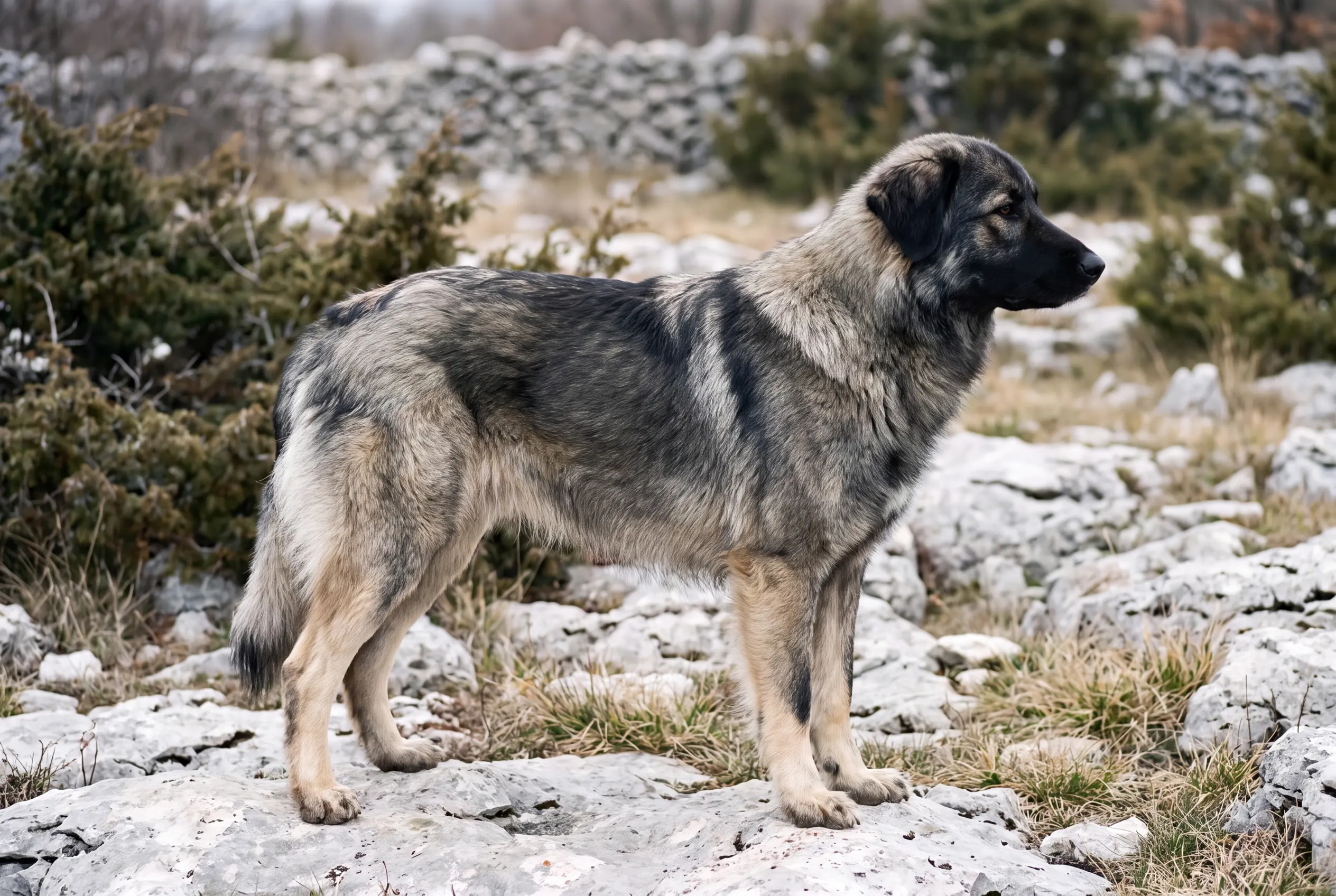
Kraški Ovčar
Iron grey that fades to sand, with no line where it changes.
Vital stats
| Size | Medium-large · 57–63 cm males, 54–60 cm females |
| Weight | 30–42 kg males · 25–37 kg females |
| Life expectancy | 10–12 years |
| Energy | Moderate — a working pace held all day, no sprint in it |
| Shedding | Heavy — long topcoat over an abundant undercoat |
| Coat | Long double coat, topcoat from 10 cm · iron grey shading to light grey or sandy below |
| Group | Working · Mountain Dog (FCI №278, Group 2) |
| Origin | The Karst plateau, Slovenia |
Breed traits
Friendliness
Care
Mind
Temperament
The standard's own description is gentler than most guardian breeds get: good and moderately sharp, courageous but not biting, very devoted to its master, an incorruptible guard, distrustful of strangers, and a pleasant, obedient companion that keeps a strong individuality. Those last two clauses sit together on purpose. This is a guardian that takes instruction more readily than its larger relatives and still reserves the right to reach its own conclusion about a stranger at the gate. Day to day it is watchful without being noisy about it, settles where it can see the approaches, and reads visitors carefully rather than greeting them. Aggressive dogs and overly shy dogs are both disqualified, so neither extreme is the breed. The eye description is worth knowing too: almond-shaped, chestnut or dark brown, calm and firm, and almost melancholic because the eyelids are pigmented black. Owners tend to describe the same look before they ever open a standard.
Habits & quirks
The grey has to fade, never step
Most standards name a colour. This one governs how the colour is allowed to change across the dog. Iron grey darkens over the back and has to give way to light grey or sandy at the belly and limbs with no visible transition, and a definite demarcation between the two shades disqualifies. A dark streak runs down the front of each leg. The effect people describe as a cloak or a saddle is the darker back, though neither word appears in the standard.
A mask that carries past the muzzle
The dark mask does not stop at the nose end. It spreads up over the skull and is bordered at the back of the head by grey, sandy or pale fawn hair overlaid with black. A dog without a mask is marked down for it. Combined with black-pigmented eyelids around a chestnut eye, it gives the breed the grave expression the standard itself calls almost melancholic.
A plateau, not a mountain range
The Karst is limestone country between the Adriatic and the Slovenian interior, scoured by the bora wind and thin on grazing. Flocks there were smaller and the shepherd was rarely far off, which is a different job from holding stock alone on a high summer pasture. The dog that came out of it is built to match: the same guardian temperament in a frame a size down.
Written down in 1689
Baron Janez Vajkart Valvasor described the dogs of the Karst in The Glory of the Duchy of Carniola, which is where the breed's paper trail begins. It is the only native dog breed Slovenia has, and on 24 April 2025 the keeping and breeding of it was entered on the national register of intangible cultural heritage, filed under knowledge of the natural world.
Care
| Exercise | An hour or two a day over ground it can survey, rather than distance for its own sake. The stamina is genuine and the urge to run is not, and a dog given a boundary to keep an eye on will occupy itself with a fair part of the job. Hold a youngster back from forced distance, stairs and jumping until well into its second year, and expect adult judgement to arrive somewhere around two or three. |
| Grooming | The undercoat is the work. Two or three sessions a week keep 10 cm and more of topcoat and a dense undercoat from matting, with particular attention to the mane and ruff on the neck, behind the ears, in the culottes and along the tail. Twice a year the undercoat comes out in quantity and it turns into a daily job for a few weeks. Leave the length alone; it insulates against heat as much as cold. |
| Training and boundaries | Reward-based and started young, while the dog is still small enough to be easy to handle. The standard calls it obedient, and by guardian standards it is, but obedience here means a dog that agrees with you rather than one that defers. Socialise widely through the first two years, teach a calm greeting routine early, and plan on managing introductions for the dog's whole life. Fencing does more than any command: a guardian that decides the line runs elsewhere will go and stand on the line it prefers. |
| Health | Hardy on the whole, with the usual large-breed watch list: ask for hip and elbow scores on both parents and an eye examination. The deep chest brings a gastric torsion risk, so split meals and keep exercise away from them. Check the skin under the coat in spring and autumn. The bigger question is genetic: with fewer than 50 dogs in active breeding, pedigree depth and inbreeding coefficients are a fair thing to ask a breeder about directly. |
Common questions
How is this different from a Šarplaninac?
They were the same breed on paper for nearly thirty years, which is why the confusion persists. The FCI recognised a single Illyrian Shepherd Dog in Stockholm on 2 June 1939 and confirmed it again at Bled in 1948, covering both the Karst dogs and the dogs of the Šar mountains. On 16 March 1968 the central Yugoslav cynological body ended the shared name, calling one the Karst Shepherd Dog and the other the Šarplaninac, and the FCI accepted the Karst breed definitively on 4 February 1969. Today they are separate entries with separate countries of origin: Slovenia for standard 278, North Macedonia and Serbia jointly for standard 41. Size is the first difference in the flesh. Karst males run 57 to 63 cm and 30 to 42 kg against an average of 62 cm and 35 to 45 kg for the Šarplaninac, so the Karst dog is noticeably the smaller of the two. Colour is the cleaner test. The Šarplaninac standard wants a solid single colour and does not permit spotting; the Karst standard requires shading, iron grey over the back fading to light grey or sandy underneath, plus a dark mask over the muzzle and skull. A Karst dog with no gradient is wrong for its breed, and a Šarplaninac with one is wrong for its own.
How rare is it, really?
Rare enough that the numbers are counted rather than estimated in the thousands. The Slovenian breed club puts the living population under 1,000 dogs and the actively breeding population under 50, and it treats the breed as a native population needing protection rather than a secure one. Press coverage citing veterinary administration records has reported figures a little higher, closer to 1,200 dogs with around 1,000 pedigreed, and the club has said it would like to see roughly 2,000 dogs and more than 80 in breeding before calling the breed safe. Take all of these as working figures from the club and the press rather than a published registry return. Practically it means a small number of litters a year, almost all of them in Slovenia, and a wait if you want one.
Is it a manageable dog for a family?
More manageable than the big mountain guardians, and still a guardian. The size helps, the standard's own wording about an obedient companion is honest, and plenty live as family dogs in Slovenia. What does not change is the job description. It is distrustful of strangers by design, it will bark at what it thinks needs barking at, and it decides for itself whether a person crossing the boundary is acceptable. That makes a house with a shared garden, a path along the fence and a steady flow of unfamiliar visitors a hard setting. Give it land it can watch, a fence it respects, early and continued socialisation and an owner who will manage the door for fifteen years, and it does well. Buy it for the looks and you will be surprised by what the looks came attached to.