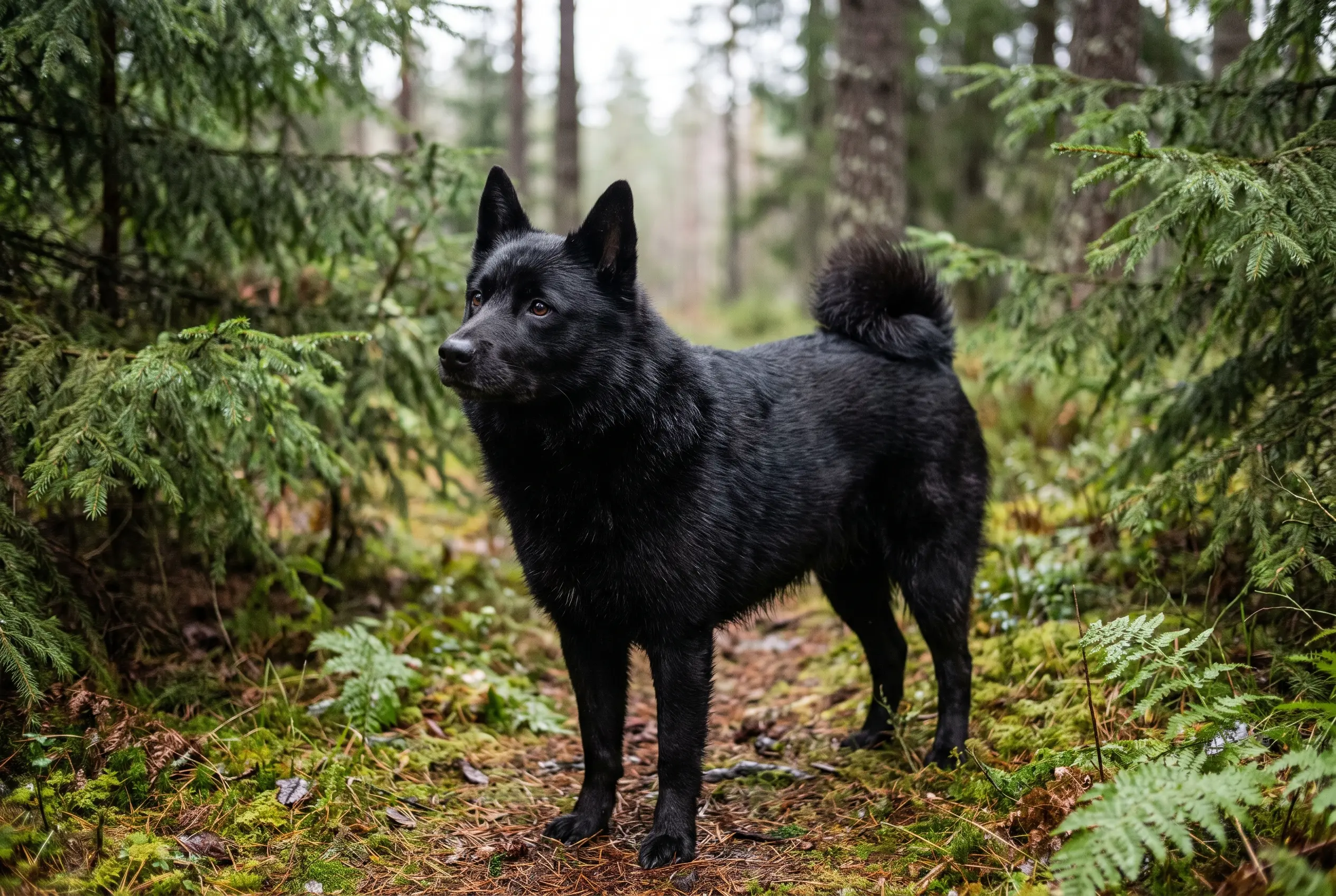
Norwegian Elkhound Black
Not the grey one in black — a smaller, squarer dog with its own standard.
Vital stats
| Size | Medium-small · 46–49 cm (dogs), 43–46 cm (bitches) |
| Weight | 16–20 kg — breed literature; the standard sets none |
| Life expectancy | 12–15 years — breed literature, not survey data |
| Energy | High — an elk-hunting spitz, 1–2 hours a day |
| Shedding | Heavy, with seasonal blows |
| Coat | Dense, rough, close-lying double coat · shining black over a black undercoat |
| Group | Hound · Nordic Hunting Dogs (FCI №268, Group 5) |
| Origin | Norway |
Breed traits
Friendliness
Care
Mind
Temperament
The standard gives you fearless, energetic and brave, and then stops, which is less help than it sounds. What breeders and owners describe is a lighter, quicker, more tractable dog than the grey: a little more willing, a little less stubborn, and every bit as loud. It is affectionate with its own people and alert about everything else, and it was selected for the nerve to stand in front of an animal thirty times its weight and stay there. Barking is the working method and it is not quiet work. The faults list is the real tell on character: stressed, nervous, barking dogs are penalised in the ring, which means the breed's own registry knows precisely which way the failure mode runs.
Habits & quirks
Square, not rectangular
Height at the withers equals the length of the body, and the muzzle equals the skull. The grey Norwegian Elkhound is the bigger, heavier dog; this one is built to turn.
Black to the skin
A shining black topcoat over a soft, woolly undercoat that is also black. A little white on chest and feet is tolerated; white socks and white on the tail are faults, and so is a missing undercoat.
Bays elk
The same job as the grey: range ahead, find the animal, then hold it in place with continuous barking until the hunter walks in. It is loud, and the volume is the point.
The tail sits on the back
Short, thick, tightly curled over the back and never carried to either side. A naturally short tail is a serious fault, the opposite of the Karelian Bear Dog, whose standard rates a bobtail equal to a full tail.
Care
| Exercise | One to two hours daily with real terrain in it. Smaller than the grey and no less driven, it wants distance and something to smell. Cut the hours and you get barking, digging, and a dog that arranges its own hunting. |
| Grooming | Dense and rough on top, soft and woolly underneath, short and close-lying on the head and the front of the legs. A brush once a week most of the year, daily raking through the moults. It sheds a great deal for a dog this size, and it is never trimmed. |
| Training | Reported as the more biddable of the two elkhounds, which is a relative statement — this is still a spitz that hunts out of sight and decides for itself. Reward-based work, short sessions, and a recall built from puppyhood on a long line. Since barking is the working behaviour, teach a reliable 'enough' rather than expecting silence. |
| Health | No breed health survey exists and the population is small, which is the main thing to weigh up. Norwegian breeders screen hips; ask for scores, and ask honest questions about how deep the pedigree really is. The 12–15 years in breed literature has no study behind it. |
Common questions
Is this just a black Norwegian Elkhound?
No. The FCI treats them as two breeds with two standards, 242 for the grey and 268 for the black, and they differ beyond colour. The black is smaller at 46–49 cm against 49–52, squarely built where the grey is slightly longer than tall, lighter in bone, and its undercoat is black rather than the grey's light one.
How rare is it?
Rare outside Norway and Sweden, and not common inside them either. It has no AKC recognition of its own, since the AKC's Norwegian Elkhound is the grey, and most of the world's dogs are in the Nordics. Expect a waiting list, a trip abroad, or both.
Does it bark as much as the grey?
Yes. Barking is the hunting method for both, since the dog holds an elk in place with noise until the hunter arrives, and neither breed was selected to be quiet. Living with one means teaching a stop cue early and accepting that the volume was never a bug.