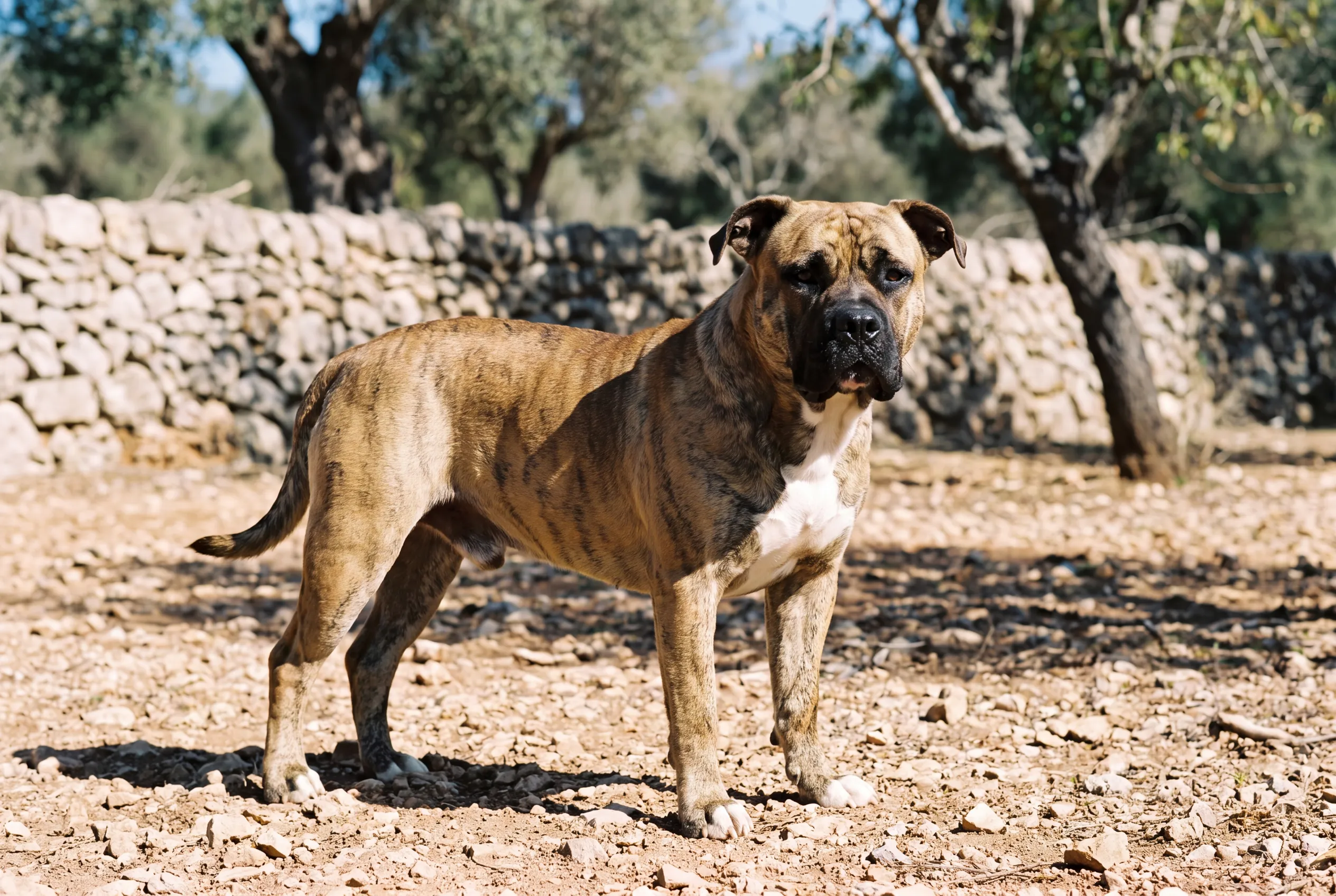
Perro Dogo Mallorquín
Mallorca's bull dog: 38 kg at the top end, with a skull that measures bigger around than its chest.
Vital stats
| Size | Medium · 55–58 cm (males) · 52–55 cm (females) |
| Weight | 35–38 kg (males) · 30–34 kg (females) |
| Life expectancy | 10–12 years |
| Energy | Moderate — short bursts between long rests |
| Shedding | Low — short coat, no undercoat to blow |
| Coat | Short and rough · brindle, fawn or black · white on feet, chest and muzzle up to 30% |
| Group | Working · Mastiff (FCI №249, Group 2) |
| Origin | Mallorca, Balearic Islands, Spain |
Breed traits
Friendliness
Care
Mind
Temperament
The FCI standard opens with the word quiet, and most owners would keep it. A Ca de Bou spends much of the day switched off somewhere with a view of the front door, then gets up at full commitment when something happens. The standard adds that it can be brave when roused and calls it unsurpassed as a watch and guard dog, which is the polite version of the thing you have to plan around. This is a territorial dog with a wide mouth and a low centre of gravity, attached hard to one household and inclined to make its own decisions about who belongs in it. At home it is affectionate, undramatic and slow to escalate. It also does not defer, and at 35 kg a misjudgement costs something. It needs early and continuous socialisation, a handler who is consistent rather than heavy, and honest management around strange dogs, where same-sex tolerance is often thin. People who have kept a guarding molosser before tend to find it steady and easy company. People who have not tend to find out how much dog this is.
Habits & quirks
Off more than on
Most of the day is spent flat out on a cool floor. The switch to full alert is instant, and so is the switch back, which is why owners underestimate how much dog is in the room until something knocks at the door.
Works the shade
The shortened muzzle and the heavy front make it a poor cooler. It will pick tiles over the sofa all summer, and it should. Heat is the thing most likely to hurt it.
Holds the doorway
Guarding here looks like positioning, not patrolling. The dog picks the spot the household passes through, lies down in it, and registers arrivals well before anyone else does.
Leans
Affection arrives as body weight. It parks against a leg and stays there, and at this size that is a decision you get to notice.
Care
| Exercise | Two moderate walks a day plus something to occupy its head. It has no endurance and overheats quickly, so long outings belong to early morning and summer middays belong to the floor. Weight control matters more than distance; a heavy Ca de Bou ruins its own joints. |
| Grooming | A rubber mitt once a week handles the short, harsh coat. Wipe and dry the lip fold and the loose skin over the chewing muscles, especially after meals and swimming, and keep on top of nails and eye rims. Drool is moderate rather than Neapolitan. |
| Training | Start early, keep sessions short, pay well. The breed learns quickly and shuts down under heavy handling, and a 35 kg dog that has decided you are unfair is a real problem. Loose-lead walking, a reliable recall and a settle come before anything showy. Socialise to strange people, dogs and traffic from eight weeks and keep doing it through adolescence. |
| Health | Ask for hip and elbow screening results, cardiac and eye checks, and watch how the parents breathe after exercise rather than at rest. The gene pool came through a bottleneck, so inbreeding coefficients and pedigree depth are fair questions. |
Common questions
Who should actually own one?
Someone who has kept a guarding molosser before, has securely fenced ground, and will spend the first two years on socialisation. At home it is quiet and genuinely affectionate, but it is territorial, physically strong and prone to acting on its own read of a situation, which goes badly with an inexperienced handler. Check the law where you live before anything else. Denmark's 2010 dog act names it among thirteen banned breeds, and while Spain's national potentially-dangerous-dog list does not include it, several autonomous communities have added it to theirs, which brings muzzle, short lead, licence and insurance requirements. Rules differ by country and change, so ask the local authority rather than the breeder.
What health problems does the breed have?
The large-molosser list plus a short-muzzle tax. Hip and elbow dysplasia, cruciate injury and heart conditions are what responsible breeders screen for. The muzzle is far less extreme than a Bulldog's, but it is still shortened, and that shows up as reduced heat tolerance and noisy breathing in some dogs; heatstroke on a Mediterranean summer afternoon is a genuine risk, not a theoretical one. Broad-chested bitches carrying big-headed puppies raise the odds of a caesarean. Life expectancy is usually given as 10–12 years, ordinary for the size. Buy from someone who shows you paperwork and does not treat snoring as breed character.
Was it really a fighting dog?
Yes. Ca de bou means bull dog, and the breed was made in the early eighteenth century for baiting bulls, when British residents of Menorca and Mallorca crossed their baiting and fighting dogs with Iberian mastiffs on the islands. Dog fighting followed. Both were outlawed during the twentieth century, the demand vanished, and by the 1950s the breed was widely considered extinct; today's dogs descend from the 1980s reconstruction. Four decades of breeding for a house-and-yard guard dog sit between that history and the puppy in front of you, and the FCI standard has disqualified aggressive temperament since it was written. The history explains the head. It does not describe the dog.