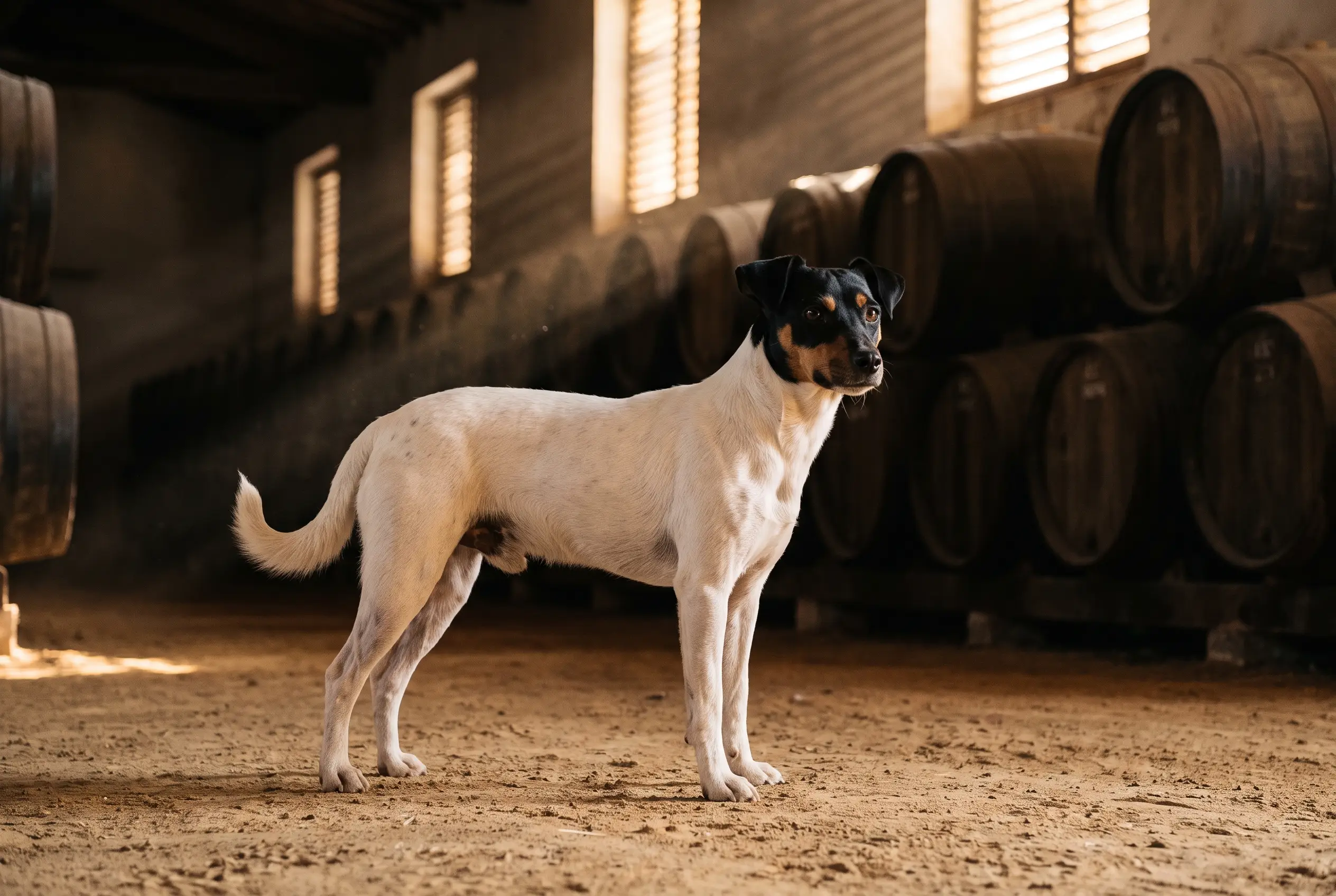
Ratonero Bodeguero Andaluz
The rat catcher of the sherry cellars, painted white so you could see him.
Vital stats
| Size | Small-medium · 35–43 cm |
| Weight | 8–12 kg |
| Life expectancy | 13–15 years |
| Energy | High — a working ratter's engine in a 10 kg dog |
| Shedding | Low to moderate — short hair, all year |
| Coat | Very short and dense · white with a black head and tan points |
| Group | Terrier · Large and medium-sized Terriers (FCI №371, Group 3) |
| Origin | Andalusia, Spain |
Breed traits
Friendliness
Care
Mind
Temperament
The standard asks for a dog that is happy, inquisitive, affectionate, bold and brave, and that is close to what owners describe. A Bodeguero fixes on its household, follows the day from room to room, and treats the children it lives with as company. The working half is not decorative. It hunts by ear and eye as much as by nose, reacts to a scuttle behind the skirting board in about a second, and cannot be talked out of a chase once it has started. Hamsters and rabbits are not safe in the same house, and cats work out only when the dog grew up with them. With visitors it is sociable rather than suspicious, but it announces them first, at volume.
Habits & quirks
Works the skirting boards
The gap under the cupboard, the space behind the washing machine, the line where floor meets wall — all of it gets checked, several times a day. Two centuries of cellar work do not switch off in a flat.
Off the ground without warning
The standard singles out its capacity to turn and jump, and a fit one clears a kitchen counter or a garden wall from standing. Store food and plan fences with that in mind.
A voice for the dark
A cellar dog had to tell the handler where the rat was. Doorbells, birds, passing dogs and the postman all qualify now. Training turns the volume down; nothing switches it off.
Heat-seeker
Bred in Andalusia with almost no coat, it finds the sunny square on the floor, the radiator, or the inside of your duvet, and it has opinions about rain.
Care
| Exercise | An hour a day as a floor, and it should include something to solve rather than only distance covered: scent games, a flirt pole, a searched-through garden. Fences need to be sound at the bottom as well as tall, because it digs and it jumps. |
| Grooming | A rubber mitt once a week covers the coat, and the breed is genuinely clean — the standard says so. The short hair and thin skin cut the other way in weather: it feels cold and wet, and pink skin around a white nose and white ears burns in strong sun. |
| Training | Bright, greedy and quick to join in a game, so the first lessons come easily. The hard parts arrive later: a recall that holds around anything small and moving, and a settle that survives the doorbell. Short reward-based sessions, early socialising with cats and other dogs, and a daily job — an unemployed Bodeguero redecorates. |
| Health | The FCI standard lists no breed-specific disease and the Spanish clubs describe a hardy dog with a long working life. Ask a breeder about patellar luxation and about hearing in the litter, since the breed carries a great deal of white, and stay on top of the teeth — small terrier jaws build tartar fast. |
Common questions
Is this the same dog as the Gos Rater Valencià?
No. They are two separate Spanish ratting terriers with separate FCI standards. The Gos Rater Valencià, or Ratonero Valenciano, comes from the Valencian countryside and was accepted in 2022 as standard No. 370; the Ratonero Bodeguero Andaluz comes from the sherry bodegas around Jerez and was accepted in 2024 as No. 371. Different regions, different standards, and different markings — the Andalusian is the mostly white one with the black head.
Can a Bodeguero live in a flat?
Yes, if you are honest about the exercise and the noise. It is a small dog that folds neatly onto a sofa and the short coat makes almost no mess. But it was bred to work all day and to bark while working, so a flat means an hour of real activity outside, a plan for the doorbell, and neighbours you have thought about.
Why do so many have no tail?
They are born that way. A natural bobtail runs through the breed, and the standard allows for dogs born tailless or with a tail of any length alongside the usual high-set, upright one. It is genetics rather than docking, and a full tail is just as correct.