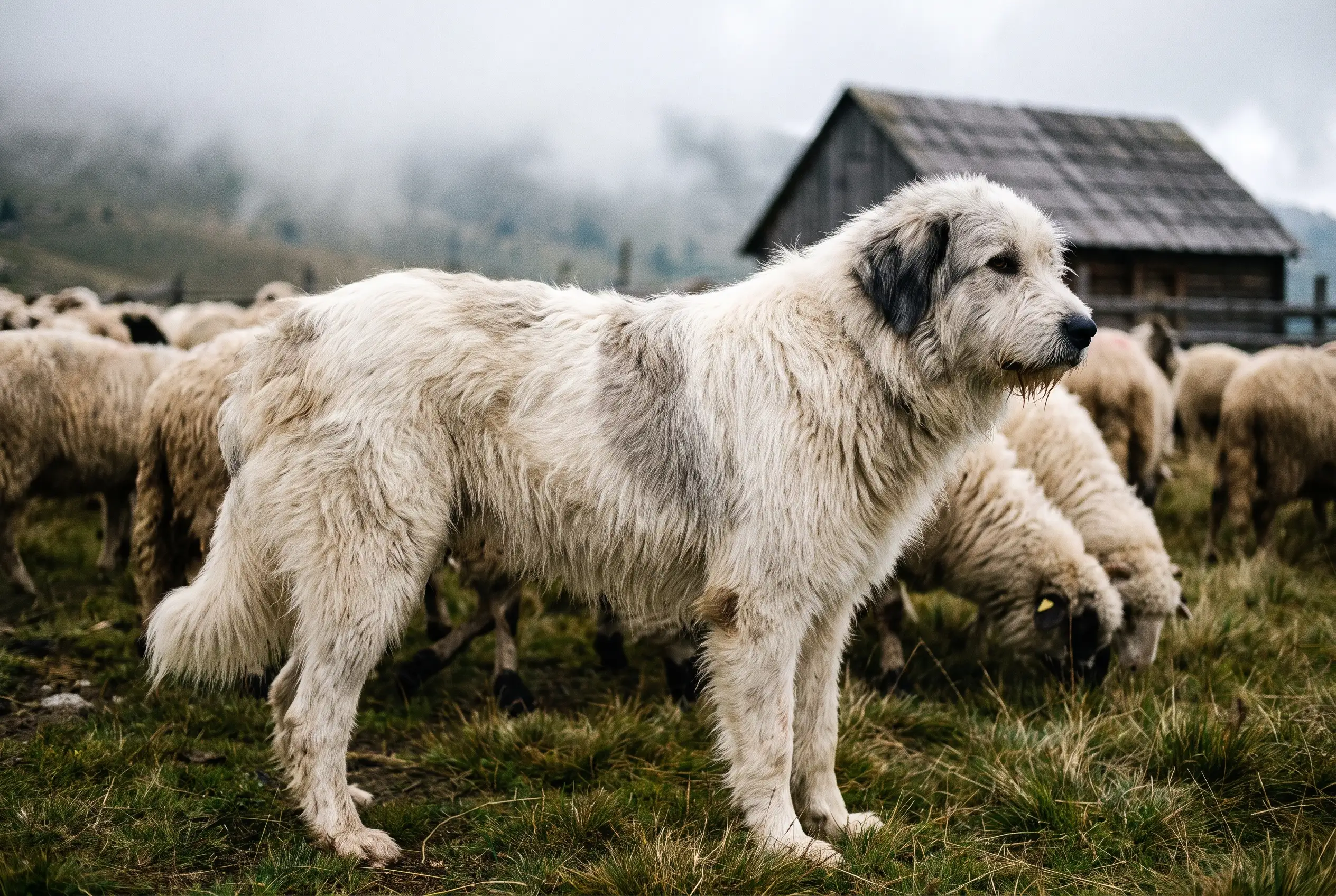
Romanian Mioritic Shepherd Dog
White as the flock, with ear tips the standard calls earrings.
Vital stats
| Size | Very large · from 70 cm and ideally 75 cm (dogs), from 65 cm and ideally 70 cm (bitches) |
| Weight | Not given in the standard — only 'in proportion to the size' |
| Life expectancy | 12–14 years — breed literature, not survey data |
| Energy | Moderate — a guardian's stamina rather than a working dog's speed |
| Shedding | Heavy · 10 cm or more of harsh topcoat over a dense undercoat |
| Coat | Straight, harsh, at least 10 cm · white with well-defined black or grey patches, or solid white or solid grey; ear tips pigmented |
| Group | Herding · Sheepdogs, without working trial (FCI №349, Group 1) |
| Origin | Carpathian Mountains, Romania |
Breed traits
Friendliness
Care
Mind
Temperament
The standard gives it four lines and they are unusually direct: a calm and stable dog; a good herd dog; very courageous and an efficient fighter against possible animal prey, listed as bear, wolf and lynx; wary of strangers. Very few FCI standards name the animals a breed is expected to face. What comes with that is a dog which spends most of its day doing nothing at all, at a scale that makes doing nothing take up a lot of room, and which then acts on its own judgement without a backward glance. It is affectionate and remarkably gentle with its own household, children included, and it treats visitors as a situation to be managed rather than a pleasure. It is slow to mature — two to three years before the adult dog shows up — and slow to change its mind about anything. Owners who describe it as stubborn are describing a guardian working correctly.
Habits & quirks
The standard names its opponents
Bear, wolf and lynx, written into the behaviour section between 'calm and stable' and 'wary of strangers'. It is the plainest statement of purpose in Group 1, and it is the reason everything else about the breed is sized the way it is.
Earrings
The tips of the ears must be pigmented dark grey or black, and the standard's own word for them is earrings. On a solid white dog they are often the only dark thing on it, which is also how a shepherd tells his dog from his sheep at a distance.
The coat has a minimum length
Ten centimetres, straight and harsh, with the undercoat denser, softer and lighter underneath. Under eight centimetres is a severe fault. Most standards cap a coat or describe its texture; setting a floor on the length is rare, and it says the coat is equipment.
A missing tail disqualifies, even a natural one
Docking is forbidden, which is now normal. What is not normal is that a naturally short tail or no tail at all is also a disqualifying fault, so the bobtails that turn up in other guardian breeds are bred away from here rather than tolerated.
Care
| Exercise | Modest by the standards of a big dog, and completely dependent on space. Two unhurried outings and a fenced area it can walk the perimeter of will do more than any amount of structured exercise. It is not built to run alongside a bike and it should not be asked to; the joints of a 70 cm dog that matures at three deserve a slow first two years. |
| Grooming | The real commitment. Ten centimetres and up of harsh hair over a dense undercoat needs a full going-through once a week with a rake and a comb, and daily work while it is dropping in spring and autumn. Mats form behind the ears, in the ruff and in the trousers. A white dog on wet ground also needs its feet and belly dealt with, and clipping the coat off is not the answer — the undercoat is its insulation in both directions. |
| Training | Socialise very early and very widely, because a suspicious 60 kg dog is a different problem from a suspicious spaniel. Teach the practical things while the puppy is still liftable: lead manners, standing to be groomed, being handled by a vet, going through a gate on request. Obedience in the competitive sense is not on the table and chasing it will only frustrate both of you. Solid fencing, and a plan for visitors that does not rely on the dog changing its mind. |
| Health | No breed health survey exists. Treat it as a giant breed and manage it as one: hip and elbow scores on the parents, a slow controlled growth on the right food, bloat awareness with a deep chest, and vigilance about weight, because every extra kilo on a dog this size lands on the joints. Coat and heat are the other practical issue — this is a mountain dog, and a Mioritic in a warm climate needs shade and water rather than a haircut. |
Common questions
How big does a Mioritic actually get?
The standard puts the floor in twice. Males should be at least 70 cm with 75 as the ideal, and a male under 70 cm is a severe fault, but the disqualification does not bite until 68 cm; females run at least 65 with 70 as the ideal, disqualified below 63. Weight is never stated — the standard asks only for proportion — so the 45 to 65 kg you see quoted comes from breeders and owners, not from the FCI.
What is the difference between the Mioritic and the Carpathian?
They are two Romanian guardians from the same mountains that were recognised on the same two dates, and they look nothing alike. The Mioritic is white, or white with well-defined black or grey patches, carries at least 10 cm of coat, and starts at 70 cm in males. The Carpatin is wolf-grey — pale fawn overlaid with black — with a harsh coat of moderate length, and stands 65–73 cm in males. If you can see the dog's outline clearly, it is a Carpatin.
Is it a good family dog?
The standard calls it a marvellous companion and it is not wrong, with conditions attached. Inside its own household it is calm, tolerant and unusually gentle with children, and it does not need much exercise. But it is a guardian at 70 cm and up, it decides for itself about strangers, it barks at night because that is the job, the coat is a weekly commitment, and it needs land with a real fence. Families on a smallholding get a superb dog. Families in a flat get a large, unhappy, loud one.