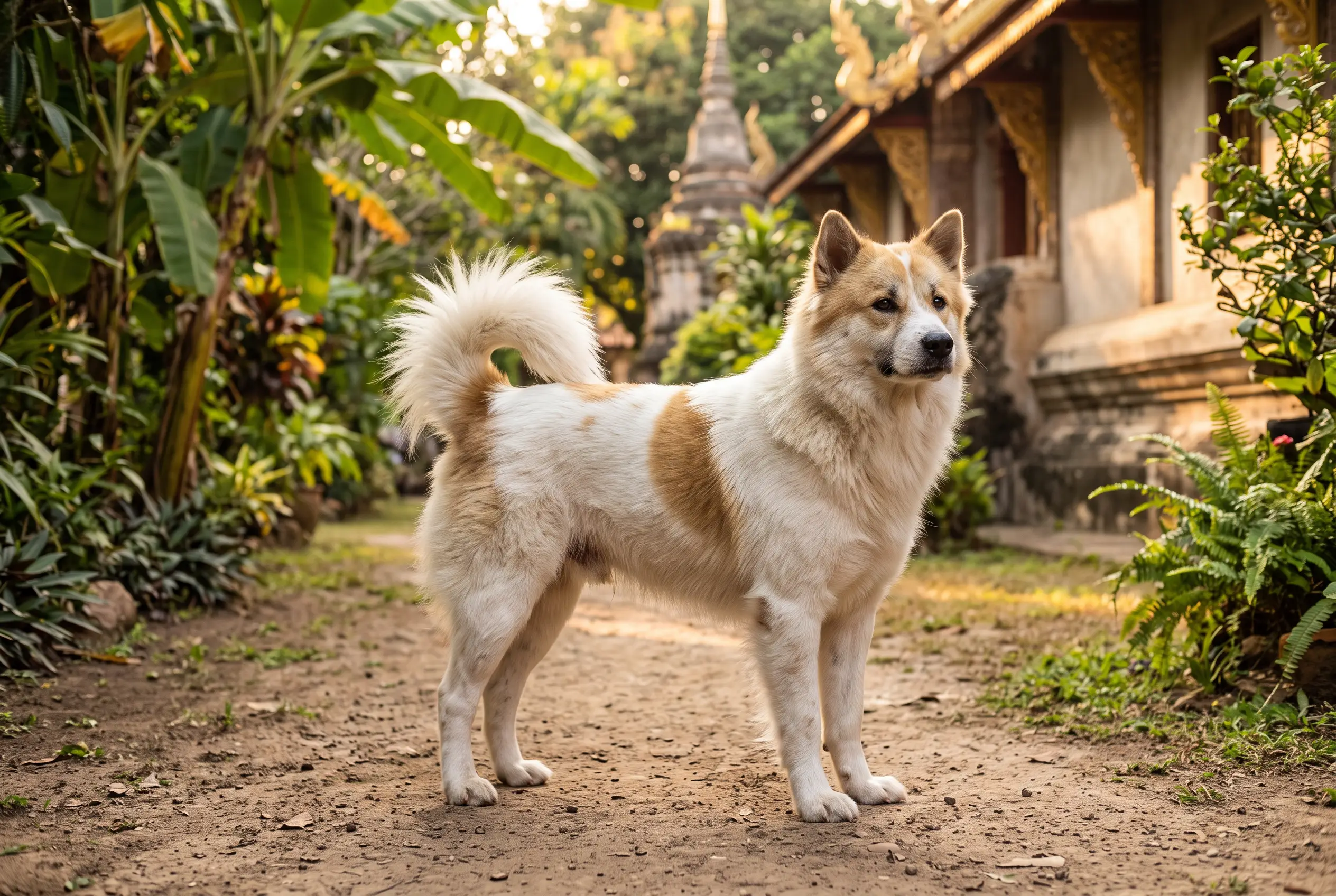
Thai Bangkaew Dog
The temple-born spitz of Phitsanulok: square by rule, white with patches, watchful by standard.
Vital stats
| Size | Medium · 46–55 cm (males), 41–50 cm (females) |
| Weight | Roughly 16–20 kg — breed literature; the standard sets none |
| Life expectancy | 10–14 years — breed literature, not survey data |
| Energy | Moderate — breed literature; the standard names no exercise needs |
| Shedding | Heavy in seasonal moults — expected from the dense undercoat |
| Coat | Double coat with ruff and plumed tail · white with well-defined patches |
| Group | Non-Sporting · Asian Spitzes and related breeds (FCI №358, Group 5) |
| Origin | Phitsanulok province, Thailand |
Breed traits
Friendliness
Care
Mind
Temperament
Alert, intelligent, loyal, watchful and obedient: five words from the standard, which also states outright that the breed is easy to train — praise few spitz standards hand out. The counterweight sits in the same paragraph: it could be slightly aloof towards strangers, and 'watchful' is meant literally, so expect a dog that keeps track of its territory and says so when something changes. Breed literature adds a strong-willed, territorial streak and wariness with unfamiliar dogs; the standard does not mention any of that, so take it as owners' experience rather than the rulebook. Early, patient socialisation keeps the aloofness from hardening, and the disqualification list shows the intent: aggressive or overly shy dogs are out.
Habits & quirks
White with patches, both ways
The colour law is strict in both directions: white with well-defined patches in lemon, red, fawn, tan, grey or solid black is required, an all-white coat is a severe fault, and a solid colour with only slight white markings disqualifies. Symmetrical head markings covering the eyes and ears are preferred, ideally with a white marking around the muzzle.
A square dog
Body length to height at the withers is 1:1, and the standard adds 'never low on legs' — the legs must be slightly longer than the chest is deep. The result is a compact outline that reads square from the side, with males carrying visibly more bone and ruff than females.
Born at a temple
The standard's history traces the breed to Bangkaew village and a cross between a Buddhist abbot's local black-and-white female and a wild dog now extinct. From 1957, selective breeding from single litters produced the generations seen today, and the dogs spread from Phitsanulok to every part of Thailand.
The tail is the flag
A well-feathered plume, thick towards the base, carried in a moderate upward curve over the level back. The standard polices it closely: carried flat on the back or falling to either side is a fault, and a curled or kinked tail — or a natural stub — disqualifies.
Care
| Exercise | The standard files it as a companion dog without working trial and says nothing about exercise, so plan by the build: a square, well-muscled spitz with 'flexible and strong movement' wants a solid daily walk plus play and training, not a marathon. Breed literature rates it moderately active, and a bored, watchful dog spends its energy on the fence line. |
| Grooming | Straight, coarse guard hair over a soft, dense undercoat, with a ruff at the neck and feathering behind the legs: a thorough weekly brush covers normal weeks, daily sessions when the undercoat lets go. There is nothing to sculpt — the standard wants the coat never so long that it hides the body's shape. |
| Training | 'The breed is easy to train' is the standard's own sentence, and obedient is one of its five temperament words. Spend that on early socialisation: the same paragraph allows slight aloofness towards strangers, and breed literature describes a watchdog streak that needs a young start and steady manners around visitors and other dogs. |
| Health | No breed-wide health survey exists, and outside Thailand the population is small and young, so pedigree depth deserves real attention. Treat the 10–14 years in breed literature as a habit of the type rather than study data, ask breeders what they screen for, and note the standard's closing line: only functionally and clinically healthy dogs should be bred. |
Common questions
Is the Thai Bangkaew Dog the same as the Thai Ridgeback?
No. Both are Thai and both sit in FCI Group 5, but the Thai Ridgeback is a smooth-coated primitive-type breed with its own standard (No. 338), while the Bangkaew is a long-coated spitz in Section 5, Asian Spitzes and related breeds, listed as a companion dog. In the ring you could not confuse them — a short or smooth coat disqualifies a Bangkaew outright.
What was the wild dog in its ancestry?
The standard says only that the founding cross involved 'a now extinct wild dog' and leaves it there. Breed lore names the dhole or the golden jackal, but no candidate appears in the standard and none has been verified here. Treat the temple story as history the registry chose to record, not as pedigree data.
Are they good family dogs?
The standard asks for a loyal, obedient, easy-to-train companion, and 'companion dog' is the only job it lists, so the intent is exactly that. The honest caveats: slight aloofness with strangers is written into the standard, breed literature adds a territorial streak and wariness with unfamiliar dogs, the undercoat moults heavily in season, and finding a breeder outside Thailand takes patience.