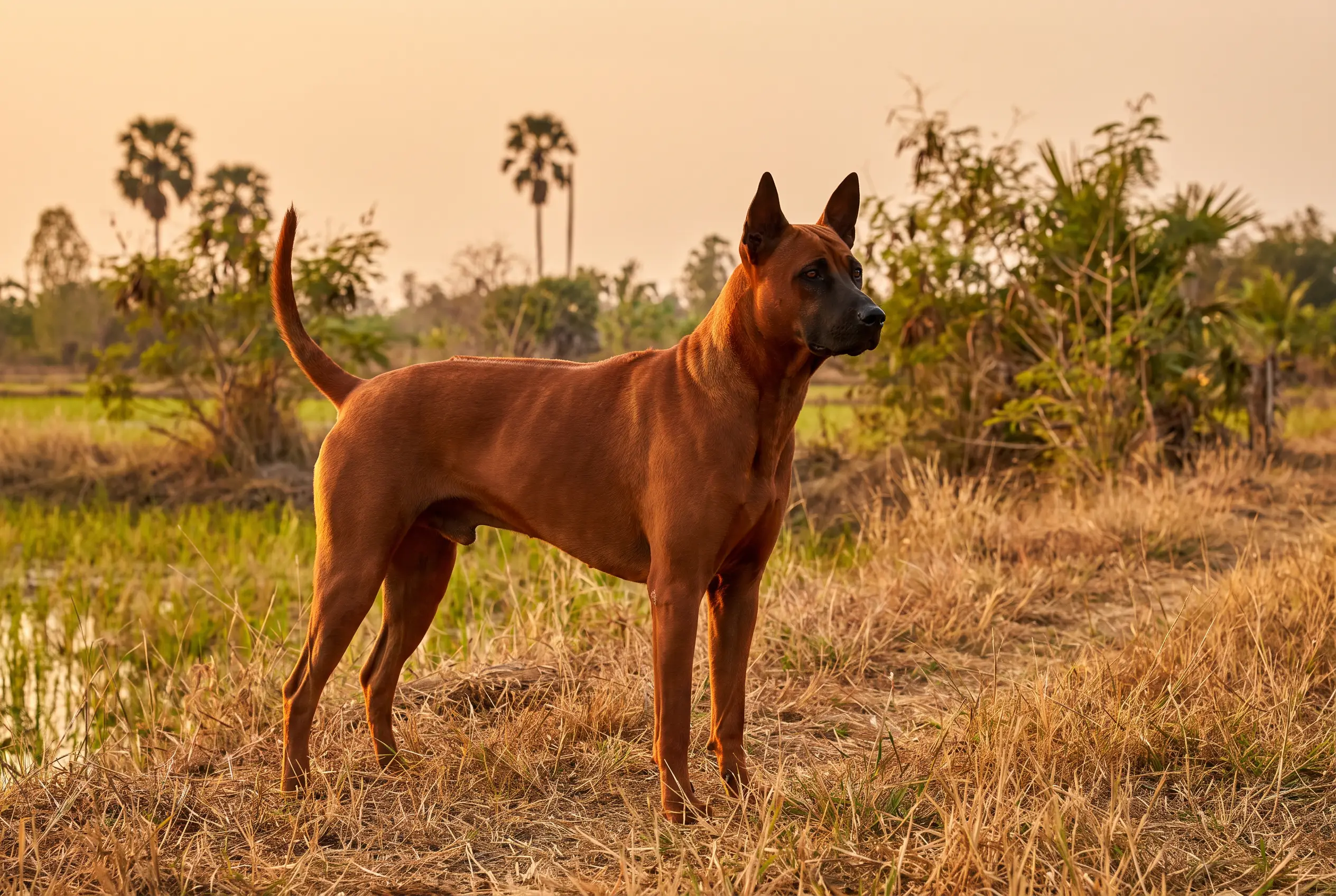
Thai Ridgeback
Thailand's ridged hunter — the other ridgeback, and on paper the older one.
Vital stats
| Size | Medium · 56–61 cm (dogs), 51–56 cm (bitches), ±2.5 cm |
| Weight | 16–34 kg — breed literature; the standard sets none |
| Life expectancy | 14–15 years — breed literature, not survey data |
| Energy | High — an hour a day minimum, and a fence it cannot jump |
| Shedding | Low — short smooth coat, a weekly brush covers it |
| Coat | Short and smooth with a dorsal ridge · solid red, black, blue or isabella |
| Group | Hound · Primitive Type-Hunting Dogs (FCI №338, Group 5) |
| Origin | Eastern Thailand |
Breed traits
Friendliness
Care
Mind
Temperament
The standard's temperament section is eleven words long: tough and active with excellent jumping ability, a loyal family dog. Everything else comes from breed literature, which is unusually consistent — this is a primitive hunter that thinks for itself, saves its affection for its own household, and stands back from strangers rather than greeting them. The prey drive is real: the breed earned its keep hunting, and small running animals still flip that switch, so recall needs early work and a lead near wildlife. The jumping line is not decoration either; plan the garden around a dog the standard itself credits with excellent jumping ability. And the disqualifying faults tell you what breeders select against: aggressive or overly shy dogs are out.
Habits & quirks
The ridge makes the breed
The ridge is hair growing against the rest of the coat, and the standard polices it: any shape or length, but symmetrical either side of the backbone and within the width of the back. Crowns or whirls at its head are acceptable, an unbalanced ridge is a fault, and a dog without a ridge — or with long hair — is disqualified outright.
Solid colours only
Four colours, no patches: red, black, blue and very light fawn, called isabella. A black mask is preferred on reds; in blues the nose turns bluish and amber eyes are permitted. The standard even reaches inside the mouth: a black marking on the tongue is preferable.
A born jumper
The one physical talent named in the standard's temperament line is excellent jumping ability. Take it at face value. This is a tucked-up, well-muscled hunter that treats an ordinary garden fence as a suggestion.
Wrinkles on demand
The standard writes the expression into the head: the forehead wrinkles when the dog is attentive. With the pricked triangular ears tipped forward, you can read attention off this dog from across the garden.
Care
| Exercise | At least an hour a day, per breed literature, and more suits a dog built to hunt in heat. Free running needs a fenced space it cannot jump out of, and on walks the lead matters — the prey drive does not switch off because you asked. |
| Grooming | One of the cheapest coats in the catalogue: a brush once a week, a little more in shedding season, ears checked every few weeks. The skin is soft, fine and tight with no dewlap, so a quick once-over after outdoor work takes seconds. |
| Training | An independent mind from a breed that hunted for itself, not on command. Short sessions, real rewards and early, broad socialisation — the reserve with strangers should stay reserve, and the standard disqualifies both aggression and excessive shyness. First-dog households will find easier breeds. |
| Health | Ask about dermoid sinus before anything else: a congenital tube in the skin along the neck or spine, linked to the ridge and shared with the Rhodesian Ridgeback, which in severe cases can reach the ligaments or spinal cord and is treated surgically. Have a vet check puppies for it. Hip dysplasia screening is worth asking for too; the 14–15 years in breed literature is generous for the size, but it is literature, not a survey. |
Common questions
Is the Thai Ridgeback related to the Rhodesian Ridgeback?
Only by hairstyle. The Thai breed is the older documented of the two — the FCI standard cites Thai archaeological documents from about 360 years ago — and it grew up in isolated eastern Thailand, hunting, escorting carts and watching homes. The Rhodesian was assembled in southern Africa in the late 1800s. The FCI does not even file them together: the Thai sits with the primitive hunting dogs in Group 5, the Rhodesian with the scent hounds in Group 6. What they share is the backwards-growing ridge and, less happily, the dermoid sinus that travels with it.
Are Thai Ridgebacks good family dogs?
The standard calls it a loyal family dog, and with its own household it is exactly that. The honest caveats come from what it was: a self-reliant hunter that stands back from strangers, chases what runs, jumps what stands still, and needs an owner comfortable setting rules for an independent dog. Breed literature steers first-time owners elsewhere, with reason.
What is a dermoid sinus?
A birth defect that follows ridged breeds: a narrow tube of skin running inwards from the surface, usually along the neck or spine, which in severe cases reaches the ligaments or the spinal cord. It can become infected, and the treatment is surgical removal. It is the first health question to put to a Thai Ridgeback breeder — ask how litters are checked and what has turned up in the line.