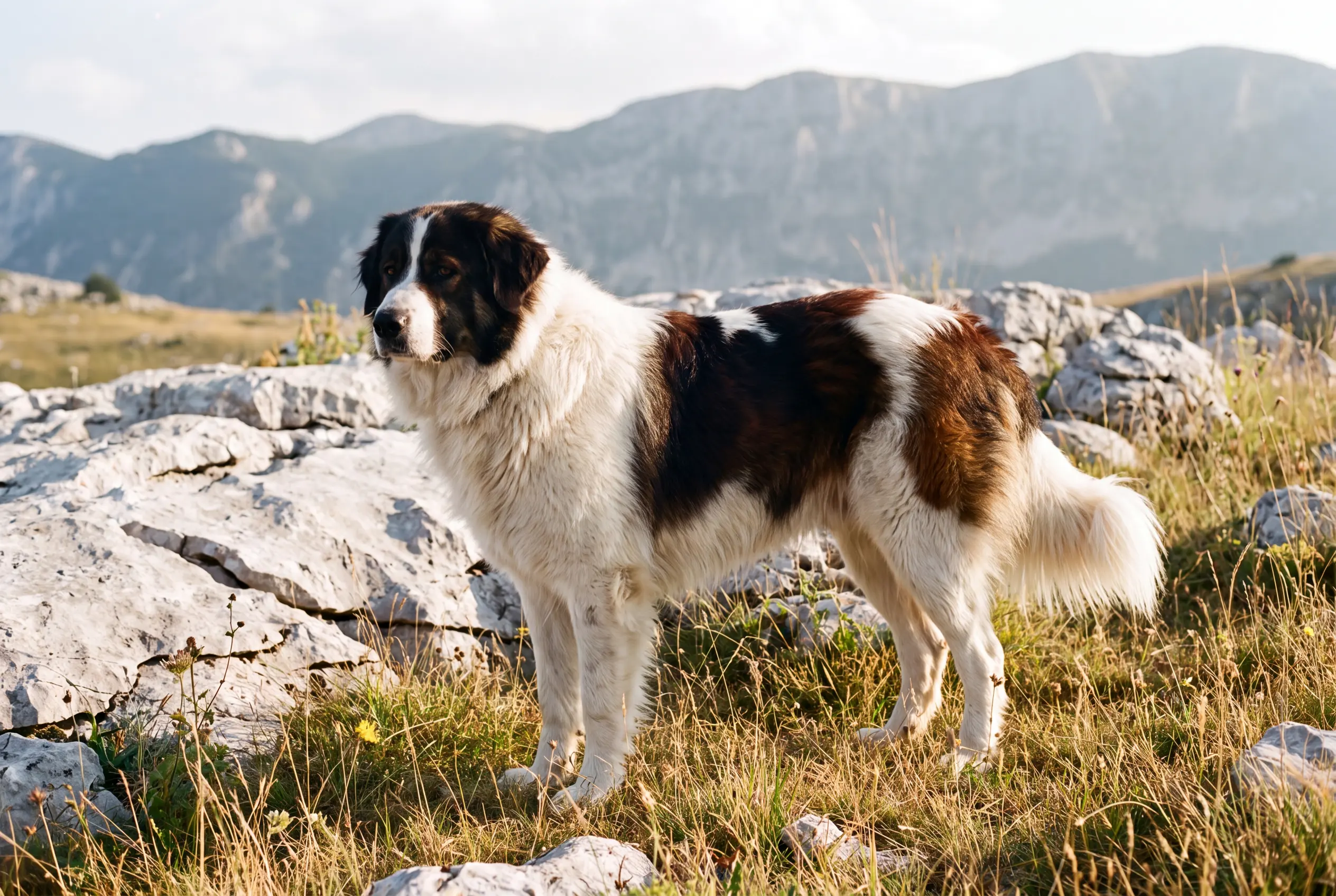
Tornjak
Named after the sheep pen, and put back together from the dogs that were left.
Vital stats
| Size | Large · 65–70 cm males, 60–65 cm females (±2 cm) |
| Weight | Not set by the standard · commonly 35–45 kg males, 30–40 kg females |
| Life expectancy | 12–14 years |
| Energy | Moderate — a long working trot rather than a sprint |
| Shedding | Heavy — long topcoat over a woolly winter undercoat |
| Coat | Long, thick, coarse · parti-coloured, usually white with distinct patches |
| Group | Working · Mountain Dog (FCI №355, Group 2) |
| Origin | The Dinaric Alps of Bosnia and Herzegovina and Croatia |
Breed traits
Friendliness
Care
Mind
Temperament
The FCI standard is warmer about this breed than flock-guardian standards usually allow themselves to be: steady, friendly, courageous, obedient, intelligent, full of dignity and self-confidence, devoted to his master and very calm in his presence. It goes further and says he learns quickly, holds it in memory a long time, and is easy to train. Read that against other livestock guardians rather than against a retriever. The same paragraph has him fierce in guarding what has been entrusted to him, impossible to bribe, and suspicious of strangers, and none of that is decoration. This is a dog bred to be out with the stock overnight with no handler in sight, deciding for itself what counts as a threat, and nothing about moving into a garden hands that judgement back. Day to day you get a dog that is quiet and undemonstrative indoors, physically affectionate with its own people, and switched on the moment an unfamiliar face appears at the gate. It is more biddable than most of its type. It is still a guardian, and it will always have an opinion about who is allowed in.
Habits & quirks
The tail goes up
Long, set at medium height and very mobile. It hangs when the dog is relaxed and comes up over the level of the back as soon as it moves, which the standard flags as characteristic of the breed. It is richly coated with a distinct plume, and a poorly coated tail counts as a fault.
The patches are the rule, not the accident
As a rule the Tornjak is parti-coloured with distinct markings of solid colour, usually on a white ground. Some dogs carry a black mantle with white around the neck, head and legs; some are nearly white with only small patches. Solid-coloured dogs and untypical distribution of colour are both disqualifying, and a dark mask is a fault.
Covers ground at a trot
The standard calls it a trotter and asks for long-reaching, supple movement with strong drive from behind and a firm back line. The frame backs that up: almost square, well angulated, bone that is neither light nor coarse. It is built to keep walking a boundary all day and to put itself between things, not to chase anything down.
Herds as well as guards
The utilization line reads herding and protection of livestock, then farmyard guard dog, which is a broader job than most guardian standards claim. The name points the same way. Tor means the sheep pen, so the dog is named after the enclosure it belonged to rather than the animals inside it.
Care
| Exercise | An hour or two of proper walking a day, ideally on ground rather than pavement, plus somewhere it can patrol. It settles well once the day's rounds are done and it is not a running partner, but a Tornjak with nothing to watch over and nowhere to walk gets loud and inventive. Fencing matters more than mileage. |
| Grooming | A weekly brush through the long coarse topcoat, daily when the woolly winter undercoat comes out. The standard says the hair should not part along the back, which tells you how dense it is meant to be. The mane, the breeches and the back of the hind pasterns are where mats start, and the plumed tail needs its own pass. The face and the front of the legs stay short and look after themselves, and this is a dry-mouthed breed, so no towel duty. |
| Training and visitors | Start early, while the dog is still liftable. The standard's line about being easy to train is fair by guardian standards, and reward-based work goes a long way, but none of it removes the instinct to challenge an arrival. Teach a place command, a settled greeting routine and solid lead manners in the first year, socialise widely through the first two, then keep managing introductions at the gate for the rest of the dog's life. Barking at night is normal for the breed and worth thinking about before you commit. |
| Health | Generally a hardy breed with few reported problems, which is what you would expect from stock selected on the mountain. Ask for hip and elbow scores on both parents and an eye check: the standard lists entropion and ectropion as disqualifying faults, not merely serious ones. The deep chest carries a real gastric torsion risk, so split meals and keep exercise away from them. The gene pool is the thing worth real attention, because the breed was rebuilt from a limited foundation in the 1970s, so ask about pedigree depth and inbreeding coefficients rather than taking papers at face value. |
Common questions
Does a Tornjak suit a home with no livestock?
It can, more readily than most livestock guardians, and it is still not a general-purpose family dog. The guarding does not need sheep to switch on. With no stock to mind, the dog adopts the house, the garden and the people in it and works those instead, which makes a shared stairwell, a garden backing onto a footpath, or a steady flow of unfamiliar visitors the hardest setting you could pick. In its favour, the standard's claim about trainability broadly holds up, and the breed is calm and undramatic indoors once it has had its walk. Against it: a long coat that moults heavily, a bark used freely and at volume, and an adult that will not simply defer to you about who may come in. It works with secure fencing, ground to walk on, neighbours who are not within earshot of every night's barking, and an owner willing to manage arrivals for a decade. Anyone hoping for a big friendly dog that greets guests should look at a different breed first.
Why does this breed carry two country names?
Because that is how the FCI registered it. Standard No. 355 is headed Tornjak, with the full title Bosnian and Herzegovinian – Croatian Shepherd Dog, and the origin line reads Bosnia and Herzegovina and Croatia. The FCI's nomenclature lists the breed under both countries rather than either one alone. The standard's history section explains why: the surviving dogs the breed was rebuilt from were spread across the mountains of both countries and the valleys around them, and the salvage work started in both places at roughly the same time, around 1972. Older local names stay in use on both sides, among them Bosanski Ovčar and Hrvatski pas planinac. In practice most people simply call the dog a Tornjak, which is the name the FCI puts first.
How do you tell a Tornjak from a Šarplaninac?
Colour is the quickest test, and the two breeds sit at opposite ends of it. The Tornjak has to be parti-coloured, normally a white ground with well-defined patches, and a solid-coloured dog is disqualified; the Šarplaninac is bred in self colours, where heavy white markings are the thing that gets marked down. Coat and outline help too. The Tornjak carries a long, coarse topcoat with a pronounced mane, breeches and a plumed tail that lifts above the back on the move, over a body that is almost square with moderate bone. The Šarplaninac is the heavier, lower-slung and more thickset of the two. They are separate breeds with separate standards and separate homelands, not regional versions of one dog, and the FCI numbers them apart.