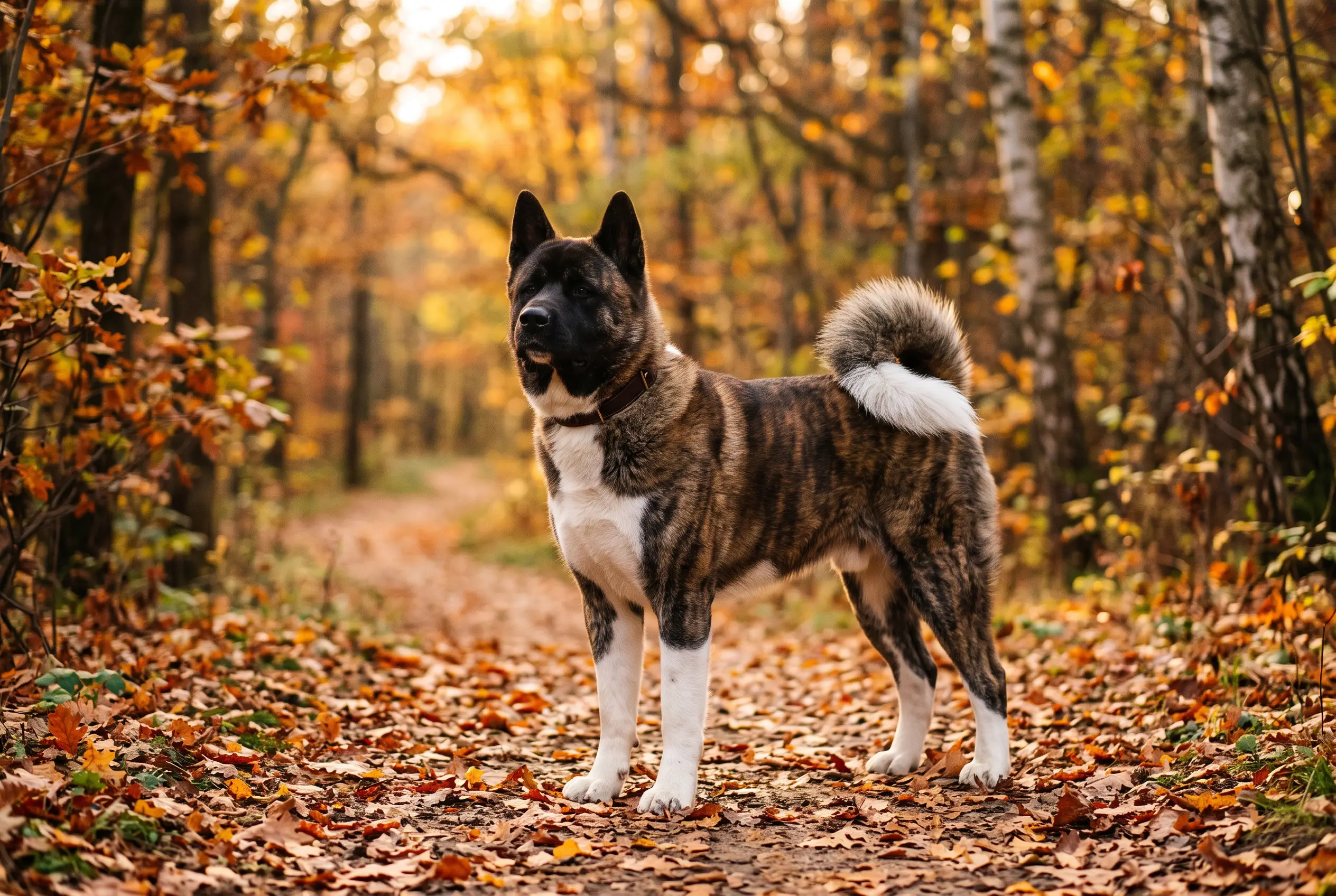
American Akita
The Akita that left Japan and came back twice the dog.
Vital stats
| Size | Large · 61–71 cm |
| Weight | 32–59 kg |
| Life expectancy | 10–13 years |
| Energy | Moderate — daily walks, not marathons |
| Shedding | Heavy in bursts — two undercoat blows a year |
| Coat | Thick double coat · all colours, usually with a black mask |
| Group | Working · Asian Spitz (FCI №344, Group 5) |
| Origin | United States, from Japanese lines |
Breed traits
Friendliness
Care
Mind
Temperament
The American Akita is calm, self-possessed and territorial — a guardian by temperament, not by training. With its family it is loyal and surprisingly playful; with strangers it is reserved and watchful, and it rarely barks without a reason. It thinks for itself, which reads as stubbornness in obedience class, and it has little patience for other dogs of the same sex. Firm, fair handling and broad socialisation from puppyhood are what keep all that power good-natured.
Habits & quirks
The silent type
It watches the street from its spot by the window and says nothing — until something actually needs saying.
One family, whole heart
Affection is for the inner circle. Guests get polite tolerance, delivery drivers get a stare.
Cat rules
It grooms itself, keeps clean, and takes offence at undignified handling — owners compare it to a very large cat.
Chooses its friends
Same-sex dogs are rivals until proven otherwise; early, well-managed introductions decide how wide its circle gets.
Care
| Socialisation | Start in puppyhood and keep going: people, dogs, places. A guardian this strong must learn early what normal looks like. |
| Exercise | A long daily walk or two and something to think about. It would rather patrol the garden than chase a ball for an hour. |
| Grooming | Weekly brushing most of the year, daily when the undercoat blows. The coat needs no trimming. |
| Health | Screen lines for hip dysplasia and eye disease; the breed also carries a known risk of autoimmune skin conditions and bloat. |
Common questions
What is the difference between an American Akita and an Akita?
One ancestor, two breeds since the FCI split them in 1999. The Japanese Akita is lighter and fox-like, restricted to red, sesame, brindle and white with urajiro markings; the American Akita is heavier, broader in the head, usually wears a black mask, and comes in every colour including pinto. Temperament differs less than looks — both are independent guardians.
Are American Akitas dangerous?
They are powerful, territorial dogs with strong guarding instincts and little tolerance for same-sex dogs — in the wrong hands that is a real risk. Well bred, well socialised and well managed, they are steady, quiet companions. They need an experienced owner, and some countries regulate ownership, so check local rules.
Are they good with children?
With the children of their own family, generally patient and protective, especially when raised together. They are big, strong and intolerant of rough handling, so small-child households need supervision and dog-savvy kids. Visiting children's play can be misread as a threat — manage introductions.