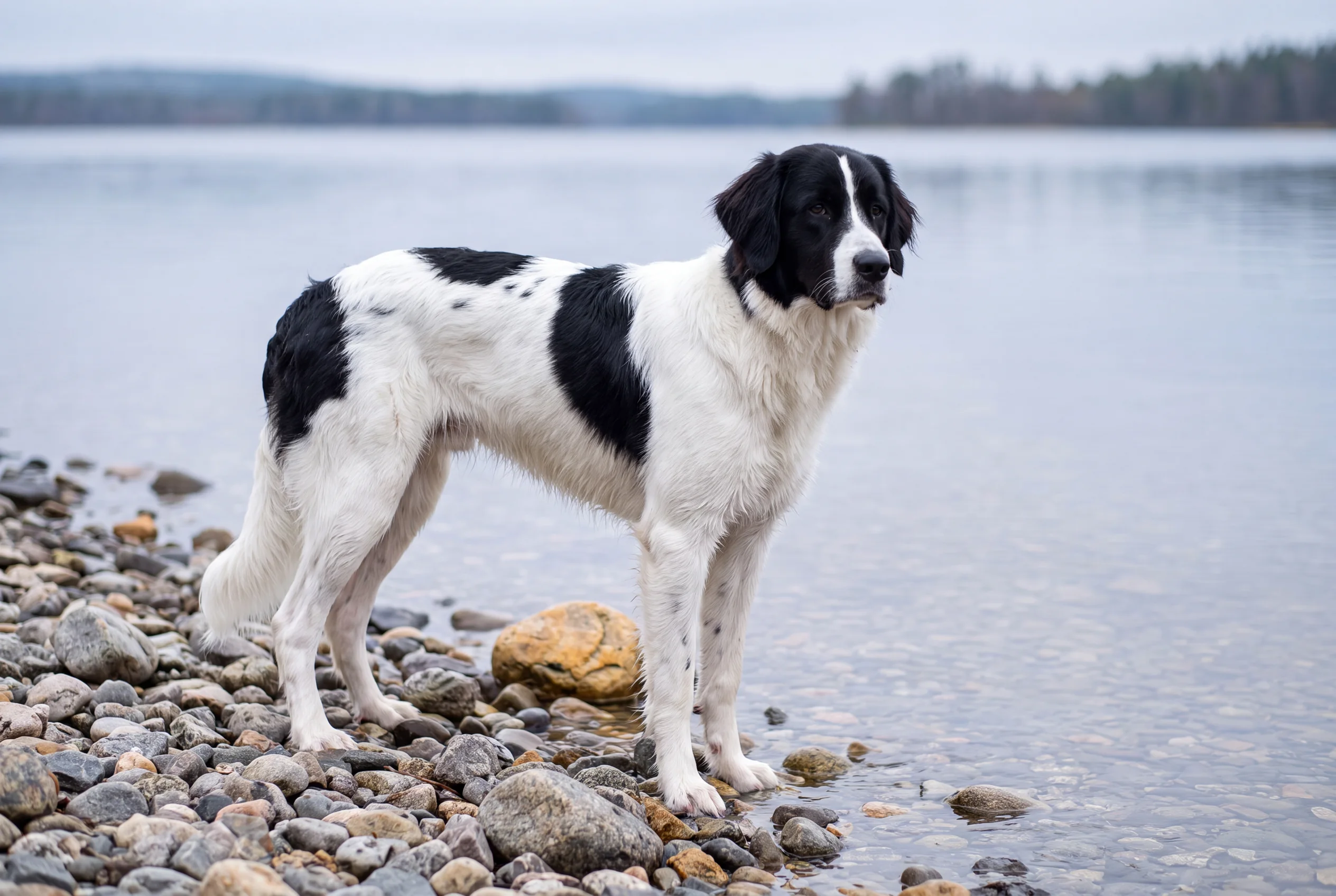
Landseer
A breed in continental Europe, a coat colour everywhere else.
Vital stats
| Size | Giant · 67–80 cm |
| Weight | 50–70 kg |
| Life expectancy | 10–12 years |
| Energy | Moderate — an hour a day, more where there is water |
| Shedding | Heavy, with seasonal moults |
| Coat | Long soft double coat · white with black patches, black head, white blaze |
| Group | Working · Mountain Dog (FCI №226, Group 2) |
| Origin | Germany and Switzerland |
Breed traits
Friendliness
Care
Mind
Temperament
The FCI standard is thin on character. It asks for a friendly expression, lists guard dog and companion as the breed's work, and disqualifies dogs that are aggressive or overly shy. Owners fill in the rest, and what they describe is a large dog that guards by standing there rather than by making noise: watchful at the door, quiet about it, and willing to be handled by children who have not yet learned to be careful. It was bred for water and it still reads that way, happiest on a long walk that ends at a lake. The German and Swiss lines were selected for a lighter, leggier dog than the Newfoundland, and the temperament came with a little more spring in it — a Landseer will keep going past the point where its black cousin lies down.
Habits & quirks
Goes to the water
Webbed feet, a coat built for cold lakes, and no interest in your plans for a dry walk. Give a Landseer a shoreline and it will be in up to the chest before you have finished the sentence.
Starts the same conversation
Every walk includes a stranger saying "lovely Newfoundland". Continental owners have a short version of the answer ready, and it never quite fits on a lead tag.
Guards by presence
It notices the doorbell and it goes to look, but the barking usually stops there. Most of the deterrent is that there is 65 kg of dog in the hallway.
Grows for a long time
Giant breeds finish late, and this one is still filling out through its second year. Skeletons that heavy need the growing done slowly.
Care
| Exercise | About an hour a day of unhurried walking, plus swimming as often as you can manage. Skip forced running and long stairs until the growth plates have closed. |
| Grooming | The long coat is softer and less oily than the Newfoundland's, which makes it easier to brush and quicker to soak. Two or three sessions a week, daily through the moults, and dry the chest and armpits properly after swimming. |
| Health | Hips and elbows first, as with any dog this size, and ask about the heart. Landseers also carry a COL6A1 variant that causes a muscular dystrophy, identified in 2015 and testable, so ask breeders whether the parents were screened. |
| Heat | A double coat made for cold water is a poor fit for a warm afternoon. Walk early, keep shade and water within reach, and let it lie on a tiled floor in summer rather than pushing on. |
Common questions
Is this just a black-and-white Newfoundland?
It depends entirely on which registry you ask. The AKC and the UK Kennel Club say yes: their Landseer is a Newfoundland of black-and-white colouring, judged against the Newfoundland standard, and neither club recognises any separate breed. The FCI says no: Landseer (European Continental Type) is its own breed, standard 226, recognised definitively in 1960 and judged against a standard that asks for a taller dog with longer legs, a less massive head and a thinner undercoat than the Newfoundland. Both answers are correct inside their own system. A black-and-white puppy from Newfoundland parents is a Landseer-coloured Newfoundland wherever you live; a Landseer ECT is a distinct breed in FCI countries and an unregistrable dog in the United States.
How big does one actually get?
The standard asks for 72–80 cm at the withers in males and 67–72 cm in bitches, which puts a male's shoulder at roughly hip height on an adult. Weight commonly runs 50–70 kg, higher in males. That size sets the household terms: a car it can get into, floors it will not slide on, an insurance quote worth checking before you commit, and the knowledge that a dog this heavy may need help onto its feet in its last years.
Can I get one outside continental Europe?
Not easily, and not with papers everywhere. Breeding is concentrated in Germany, Switzerland, the Netherlands, Belgium and Italy, with FCI-registered litters in small numbers. In the United States the breed has no AKC recognition at all, not even Foundation Stock Service status, so an imported Landseer ECT cannot be registered or shown there as its own breed. Expect an import, a waiting list, and a fair amount of paperwork.