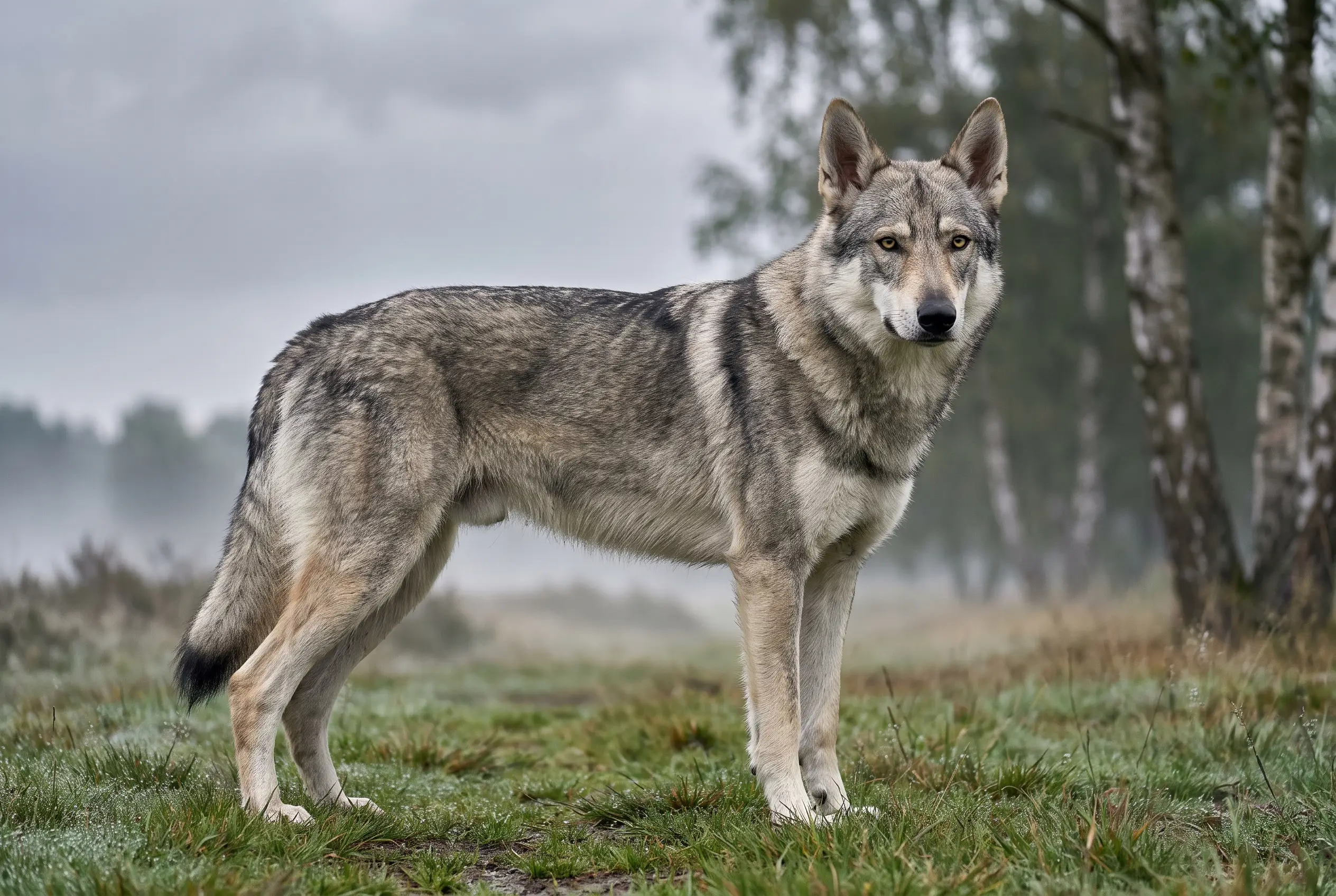
Saarloos Wolfdog
A wolf crossed into a German Shepherd, and the working dog never arrived.
Vital stats
| Size | Large · 65–75 cm (males), 60–70 cm (females) |
| Weight | 30–45 kg |
| Life expectancy | 10–12 years |
| Energy | High — long daily movement, and space it can use |
| Shedding | High — dense double coat, twice-yearly moults |
| Coat | Harsh double coat, thicker in winter · wolf-grey, forest-brown or white |
| Group | Herding · Sheepdogs, without working trial (FCI №311, Group 1) |
| Origin | Netherlands |
Breed traits
Friendliness
Care
Mind
Temperament
The FCI standard is unusually blunt about what this dog is. It asks for a dog devoted to its owner, reserved with strangers and not seeking contact, and it names "his reserve and wolf-like wish to flee in unknown situations" as qualities to be kept rather than bred out. It goes further and warns strangers off: a forced approach can trigger an overwhelming urge to leave, and a dog on a lead, unable to leave, may look nervous instead. That is the animal in one paragraph. There is no guarding instinct here and very little aggression — the response to pressure is distance. With its own people a Saarloos is affectionate, closely bonded and strongly pack-minded, which is the other half of the problem: it copes badly on its own, and hours alone come back as howling, digging and escape attempts. It needs room, movement and company at the same time, most days, for a decade. Very few pet homes can supply all three, and most people drawn to the wolf look should buy something else.
Habits & quirks
Leaves rather than argues
An unfamiliar person, a dropped bin lid, a vet's waiting room: the first move is backwards. Handlers learn to let the dog take its own time and to stop strangers reaching in.
Howls more than it barks
The alarm bark most owners expect barely exists. What comes instead is a long howl, usually in the evening, usually joined by any other Saarloos within earshot.
Reads the household as a pack
It tracks where everyone is, follows from room to room, and settles once the group is accounted for. A member missing for hours unsettles it.
Works on the fence
Given a boundary it will test the bottom of it. Dig-proofed fencing at least 1.8 m high is standard advice from the breed clubs, and it is cheaper than the third time the dog is found two villages away.
Care
| Exercise | Hours outdoors, most of it at a walk or a trot over ground the dog can range across. It is not a sprinting sport dog and it is not a garden dog either; what it wants is distance, varied terrain and time. Off-lead freedom needs somewhere genuinely safe, because recall competes with a strong urge to move away from anything alarming. |
| Grooming | Brush weekly through the year and daily during the two moults, when the undercoat comes away in sheets. The harsh outer coat needs no trimming and sheds mud on its own; bathing is rarely necessary and strips the coat if overdone. |
| Training | Socialise hard before twelve weeks — the standard's own guidance — and keep it up for life. Force, correction and repetition all backfire; this dog shuts down or withdraws instead of arguing. Build behaviours with food and patience, expect slow progress, and treat a reliable recall as a long project rather than a puppy-class outcome. |
| Health | Two DNA tests decide whether a litter is worth considering. Pituitary dwarfism sits on an LHX3 mutation carried by 31% of 239 clinically healthy Saarloos wolfdogs in Voorbij's Utrecht study, and degenerative myelopathy runs in the breed as well. Ask for both results on both parents, plus hip scores and an eye examination. |
Common questions
How is it different from a Czechoslovakian Wolfdog?
Different experiment, different country, different dog. The Saarloos came out of one Dutch breeder's private project from 1935, aimed at a hardier German Shepherd and ending in a companion breed. The Czechoslovakian Wolfdog (FCI №332) was a military programme begun in 1955 under Karel Hartl, crossing working German Shepherds with Carpathian wolves to make a border-patrol dog, and it kept far more drive: Czechoslovakian Wolfdogs compete in tracking and protection sports, where Saarloos entries are rare. Side by side, the Saarloos is bigger-framed and more retiring, the Czechoslovakian smaller, harder and much more likely to engage with a problem instead of leaving it.
Is a Saarloos Wolfdog legal to own?
It depends on where you live, and the rules are usually written around wolf content rather than breed names. Across most of Europe it is an ordinary pedigree dog — the Netherlands, its home country, registers it like any other breed. In Great Britain, wolf-dog hybrids fall under the Dangerous Wild Animals Act 1976, but licensing guidance applies to animals close to the wolf, so dogs several generations removed are treated as dogs. The United States is where it gets difficult: wolfdog rules there are set state by state and often county by county, FCI recognition counts for nothing, some states ban wolfdogs outright and others require permits. Landlords and insurers add rules of their own. Check your own jurisdiction before you buy a puppy, and get the answer in writing.
Can a Saarloos Wolfdog be a family pet?
For almost everybody, no. It is gentle with its own household and useless as a guard, so danger is not the issue — the mismatch is everything else. It wants acres, hours of company and no surprises, it will not reliably greet your visitors, it can panic in a busy street, and it holds a grudge against a training method it dislikes for months. It is a poor first dog, a poor apartment dog, and a poor choice for a house with young children and their friends coming and going. The homes it works in tend to be rural, quiet, already experienced with primitive breeds, and organised around the dog rather than the other way round.