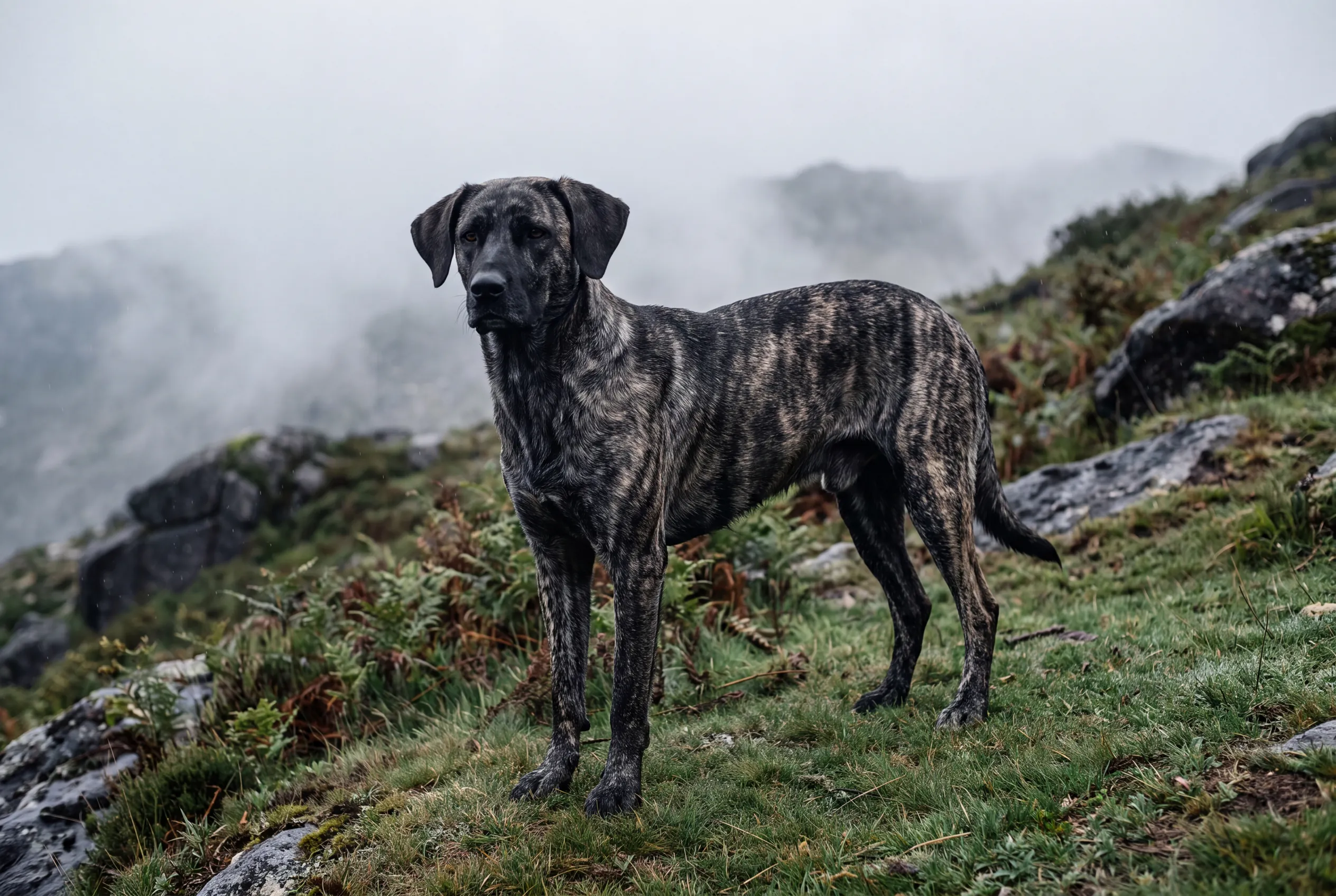
Cão de Castro Laboreiro
Named for a village, coloured after the mountain.
Vital stats
| Size | Large · 55–64 cm |
| Weight | 25–40 kg |
| Life expectancy | 11–14 years |
| Energy | Moderate — a patroller rather than a runner |
| Shedding | Low to moderate — short coat, no undercoat |
| Coat | Short, flat and harsh · brindle in the shades called cor do monte |
| Group | Working · Mountain Dog (FCI №170, Group 2) |
| Origin | Castro Laboreiro, Melgaço, northern Portugal |
Breed traits
Friendliness
Care
Mind
Temperament
The standard calls it a loyal and docile companion to its family, then a few lines later notes that it can show some hostility without being quarrelsome. Both halves hold. At home it is quiet, undemonstrative and closely attached to the people it lives with, usually with one it treats as its own. Outside it works: it walks the boundary of whatever has been handed to it, checks anything that has changed since the last round, and says so. It does not warm to visitors and should not be asked to. What the standard refuses to allow is nerves — shyness and distrustfulness are both listed as faults, and a Castro Laboreiro that shrinks from a stranger instead of reading one is wrong for the breed. Shown plenty of the world early and handled with patience, it settles into something steady. Left to form its own opinions about people, or handled heavily, it does not, because the job it was bred for was deciding alone on a mountain with nobody to ask.
Habits & quirks
The bark that climbs
Very few standards describe a breed's voice. This one does: an alarm bark that starts deep, rises through a low pitch and ends in drawn-out high notes. It carries across a valley, which was the point, and it carries across a terrace of flats, which is the problem.
Patrols at a walk
The standard's normal gaits are a walk and an easy amble trot, and it adds that the dog will only go faster when a strong reason urges it to. A guardian that spends the night covering ground does not spend energy it might need later.
Decides on its own
It was bred to be right about a stranger with no handler within a kilometre, so it assesses first and looks to you second, if at all. That is the trait people admire in a field and struggle with at a front door.
Keeps its circle small
Affection goes to the household and stays there. It follows its people from room to room, leans rather than fusses, and treats a visitor as a thing to be monitored until told otherwise.
Care
| Exercise | An hour or two of unhurried walking a day, ideally over ground it can come to think of as its own. It is not a running or agility dog and will not thank you for drills. What it does need is space to patrol and a fence that ends the argument. |
| Grooming | The coat is short, about 5 cm, thick and harsh to the touch, with no undercoat underneath it. A brush once a week covers it, and shedding is modest for a dog this size. The missing undercoat is worth remembering in cold wet weather: it is less insulated than it looks. |
| Training | Reward-based, early and social. Take it to towns, markets, vets and other dogs from the first weeks, because a guardian's default setting is suspicion and the only thing that widens it is exposure. It learns quickly but sees no reason to repeat a thing it has already done. Heavy handling closes it down for good. |
| Health | Generally hardy, and there is little published health data because the population is too small to generate any. Ask breeders for hip screening and go through the pedigree yourself: with a gene pool this narrow, how closely bred a litter is matters more than any single test result. |
Common questions
What does cor do monte actually mean?
Mountain colour, and it is a specific thing rather than a poetic one. The standard describes a brindle coat built on a grey base and overlaid with lighter and darker black striping, with individual hairs carrying three colours that run anywhere from pine-nut through reddish to mahogany. The striping is graded across the dog: darkest on the head, back and shoulders, medium over the body, croup and thighs, lightest on the belly and the lower legs. Wolf colour is the most common version and the one the breed is best known for; the mountain shade is the most prized, and the standard records that breeders in Castro Laboreiro regard it as an ethnic trait of their dogs. A small white spot on the chest is allowed and nothing else is. The nose has to be black — any other colour disqualifies.
Can it live in a home with no livestock and no land?
Sometimes, but the odds are against it and you should be honest about which case you are. A Castro Laboreiro without something to guard will guard what it has, which is your house, your garden and the people in it, and it will use that bark to do the job. Neighbours in a terrace or a block will hear all of it. The dog also needs a boundary it can walk and a household that accepts a dog which is polite to guests rather than pleased by them. People who make it work generally have a garden with a real fence, time for a long daily walk, a trainer who understands guardian breeds, and no expectation of an off-lead park dog. People who wanted a large, handsome, easygoing family dog and were charmed by the coat usually find out within a year that they picked wrong.
How is it different from the Serra da Estrela dog?
They are separate Portuguese mountain breeds from different corners of the north, and the coat sorts them out fastest. The Castro Laboreiro has one colour scheme, the brindled cor do monte, on a short flat coat with no undercoat. The Estrela comes in fawn, wolf grey and brindle, in a long or short variety, and carries a proper double coat. Build differs too: the Castro Laboreiro is the lighter and longer-framed of the two, built to cover ground rather than to block it. Numbers differ most of all. The Estrela is in the AKC's Foundation Stock Service and has breeders across Europe and North America; the Castro Laboreiro is not in that programme, is barely bred outside Portugal, and a serious search usually means a Portuguese waiting list.