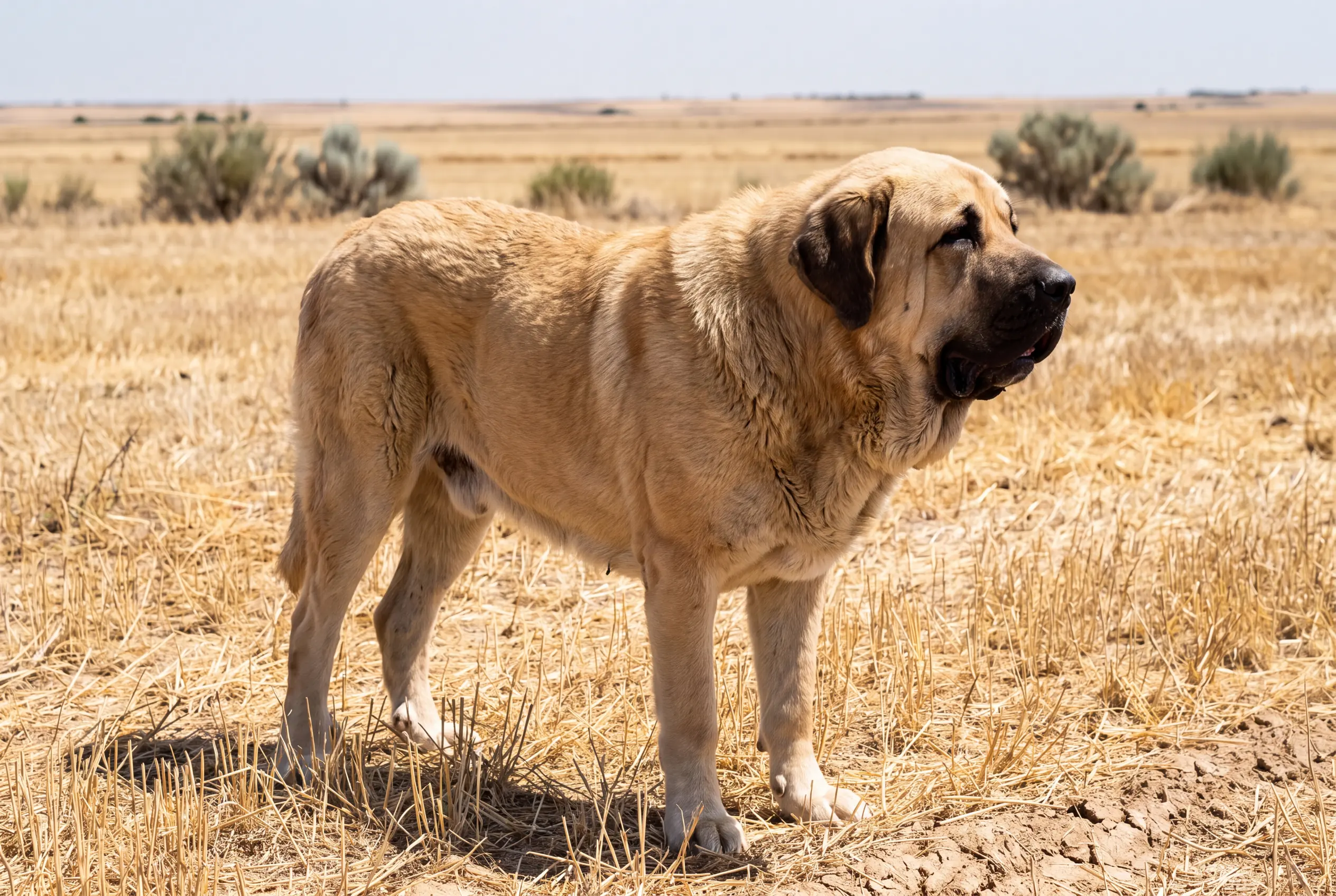
Mastín Español
The drove-road guardian of Castile: a minimum height, and no maximum.
Vital stats
| Size | Giant · minimum 77 cm males, 72 cm females · no upper limit |
| Weight | Not set by the standard · commonly 70–100 kg males, 55–80 kg females |
| Life expectancy | 10–12 years |
| Energy | Low — it saves everything for the one thing it is for |
| Shedding | Heavy — dense coat, two seasonal drops |
| Coat | Dense, smooth, medium length · colour open, self colours most admired |
| Group | Working · Mountain Dog (FCI №91, Group 2) |
| Origin | Castile and the Spanish drove roads |
Breed traits
Friendliness
Care
Mind
Temperament
The FCI standard calls it rustic, affectionate, kind and noble, and then very determined when facing dangerous animals and in front of strangers. The line that tells you most is the one about self-restraint: a dog sure of himself, the standard says, determining his strength because he is aware of his enormous power. That rationing is real. A settled Mastín spends most of the day lying where it can see the ways in, gets up slowly, and spends nothing on anything it has already judged harmless. Affection goes to its own people and takes the form of leaning on them. Everyone else gets watched. What it will not do is defer. This is a dog bred to make the call at night, out of sight of the shepherd, with nobody to ask, and it does not start asking now. Adult judgement takes two to three years to arrive, so you live with an enormous, opinionated adolescent for a long stretch first.
Habits & quirks
The throat is the design
Thick, loose, elastic skin, a lower lip with slack mucous membranes, and a double dewlap the standard wants amply developed. A wolf goes for the throat, and loose skin gives it nothing solid to hold. Shepherds put the same idea in iron: the carlanca, a spiked collar worn in wolf country. That is history and working kit, not something a dog at home has any use for.
You hear it long before you see it
The bark is written into the general appearance clause, not left to chance: raucous, low pitched and deep, very sonorous, audible from a considerable distance. Warning a predator off before anything happened was most of the job, and the volume has not gone anywhere.
Walks, does not chase
The croup sits level with the withers and the chest girths about a third more than the dog stands, which is a frame for putting yourself between things and covering ground at a walk. The preferred gait is a trot, and ambling is marked as a fault. Nothing in the build says sprint.
Still doing the work
The standard uses the present tense: he accompanies numerous herds, sedentary or wandering, fulfilling his ancestral task. Spain holds the largest wolf population in western Europe, and across the north and west the mastiffs still go out with the flocks for the reason they always did.
Care
| Exercise | Less than the size suggests. An hour of steady walking split across the day suits an adult, on ground rather than pavement. Growth is the real constraint: keep a young one off stairs, jumps and forced distance well past its first birthday, because it will put on the weight of a grown labrador in a few months and the joints are still open underneath it. |
| Grooming | The coat is the easy part. A weekly brush handles the dense smooth hair, more often through the two seasonal drops, and the longer hair on the tail is worth a check. The face is the work. Water sits in the loose lips and comes back out across the floor, food collects in the folds, and the dewlap stays damp unless someone dries it. Keep a towel by the water bowl and expect to use it. |
| Training and visitors | All of it has to be done before the dog is bigger than you, which arrives sooner than most people plan for. Teach lead manners, a place command and a settled greeting routine at 25 kg, not at 85. Reward-based work goes fine and force does not, and there is no version of physically overruling an adult. Socialise widely through the first two years, then keep managing introductions for the rest of the dog's life. |
| Health | Hips and elbows first, on both parents, plus a cardiac check and a proper look at eyelids: the standard lists excessive entropion and ectropion among its serious faults, which tells you the breed has form there. A chest this deep carries a real gastric torsion risk, so split meals, keep exercise away from them and learn the signs. Feed a giant-breed growth diet and resist pushing weight onto a puppy. |
Common questions
Does a Mastín Español belong in a home with no livestock?
For most households, no, and it is worth being plain about why. The guarding does not need sheep to switch on: with no flock the dog adopts your family and your boundary and works those instead, which makes shared stairwells, gardens backing onto footpaths and a steady flow of unfamiliar visitors the hardest possible setting. Then there is the size. This is a dog with a minimum height and no maximum, commonly 70 to 100 kg, that drools, sheds, barks at a volume built to carry across a valley, and does not finish maturing until three. It can live well with secure fencing, an owner who will manage every introduction for a decade, neighbours far enough off, and no illusions about who is stronger. People who have kept large guardian breeds before and want this one specifically do fine. Anyone hoping for a big gentle family dog should look elsewhere first.
How is it different from the Mastín del Pirineo?
Colour is the quickest answer. The Pyrenean Mastiff has to be white-based with a well-defined mask and clearly outlined patches, and a solid white dog with no mask is a disqualifying fault; the Spanish Mastiff's standard says colour is indifferent and lists self colours like fawn, red, black and wolf grey as the ones most admired. Size is not the difference people expect, because both standards set the same floor: 77 cm for males, 72 cm for females, no ceiling. Beyond that, the Spanish is the longer-bodied and heavier-skinned of the two, with the more developed dewlap, while the Pyrenean carries a plumed tail with a definite hook at the tip. The histories separate them as well. The Pyrenean worked the mountains of Aragón against wolf and bear; the Spanish worked the long transhumance routes with the Merino flocks.
How big does one actually get?
Bigger than the paper numbers. The standard sets 77 cm at the withers for males and 72 cm for females as a minimum, then says outright that these should be amply exceeded, with males over 80 cm and females over 75 cm, and that the largest dogs are preferred where the proportions hold. Weight is not in the standard at all. Working males commonly run 70 to 100 kg and females 55 to 80 kg, and dogs at the top of that range are not unusual. Treat published figures carefully, since the breed is defined by a floor rather than a range and the numbers quoted around it vary a lot from source to source. Plan the car, the doorways, the vet bills and the food budget for the upper end.