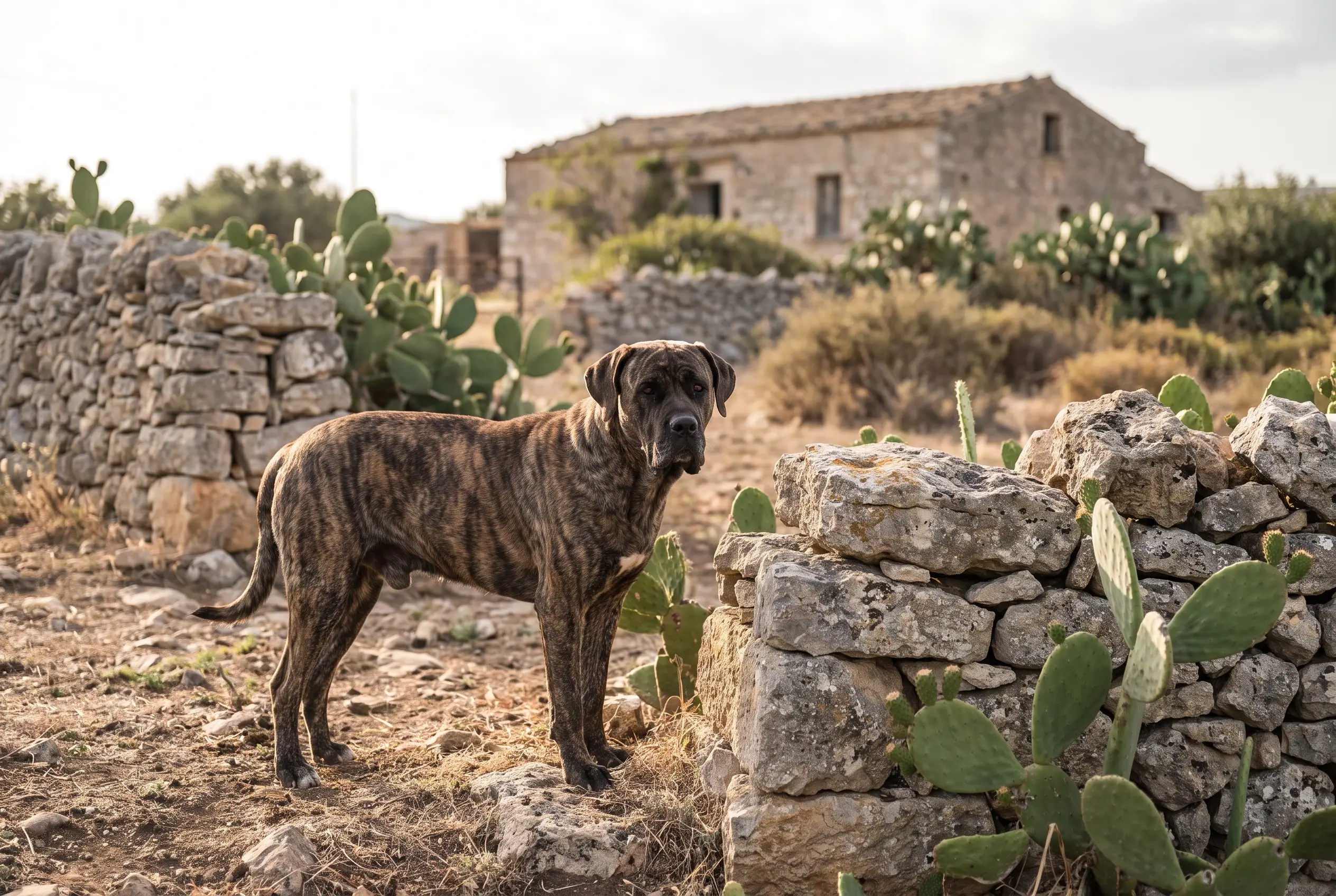
Sicilian Mastiff
Sicily's farm-and-flock guardian — athletic, self-reliant, serious about its ground.
Vital stats
| Size | Medium-large · ~58–70 cm (not tightly standardised) |
| Weight | ~30–45 kg (approximate) |
| Life expectancy | Around 10–12 years (limited data) |
| Energy | Moderate — a working guardian, not a runner |
| Shedding | Low — short coat, minimal grooming |
| Coat | Short · brindle, fawn or black |
| Group | Working · Molossian guardian (ENCI RSR · FCI 903, Group 2) |
Breed traits
Friendliness
Care
Mind
Temperament
The Mastino Siciliano is a territorial, self-reliant guardian, steady and deeply bonded with the people and animals it knows. With strangers it is wary and serious, watching first and warming slowly if at all. It guards by its own judgement rather than waiting for a command, so it wants space, a real job and clear, secure boundaries. It is not a dog for a first-time owner or a flat; without room and a purpose it becomes hard to manage.
Habits & quirks
Guards by its own judgement
It reads its ground and decides for itself when something is wrong, rather than waiting to be told.
Bonded to its own
With family and stock it is steady and close, and that trust is the whole basis of how it works.
Slow with strangers
New people are met with distance and a long look, not a wagging welcome.
Built to work, not to race
Athletic and functional rather than heavy, it patrols and holds ground more than it sprints.
Care
| Space and a job | It needs room and a real guarding purpose; penned in a flat with nothing to watch, it grows frustrated. |
| Secure boundaries | Give it firm, well-fenced ground it can call its own, so its territory is clear to both of you. |
| Grooming | The short coat asks for little — an occasional brush and the usual checks are enough. |
| Handling | Early, consistent socialisation and calm, experienced handling matter; this is not a beginner's breed. |
Common questions
Is the Mastino Siciliano a recognised breed?
Yes. ENCI, Italy's national kennel club, recognises it as a native breed and has entered it in its supplementary register (RSR), with an official standard under FCI classification 903, Group 2. Recognition is recent and provisional, so detailed published figures are still limited.
Is it the same as the Neapolitan Mastiff?
No. Both are Italian molossers, but the Sicilian is more athletic and far less heavy and wrinkled, built as a working farm guardian rather than a show-type mastiff.
Is it a good family or apartment dog?
It bonds deeply with its own family, but it is a wary, independent guardian that needs space, a job and secure boundaries. It suits an experienced rural home far more than a flat or a first-time owner.