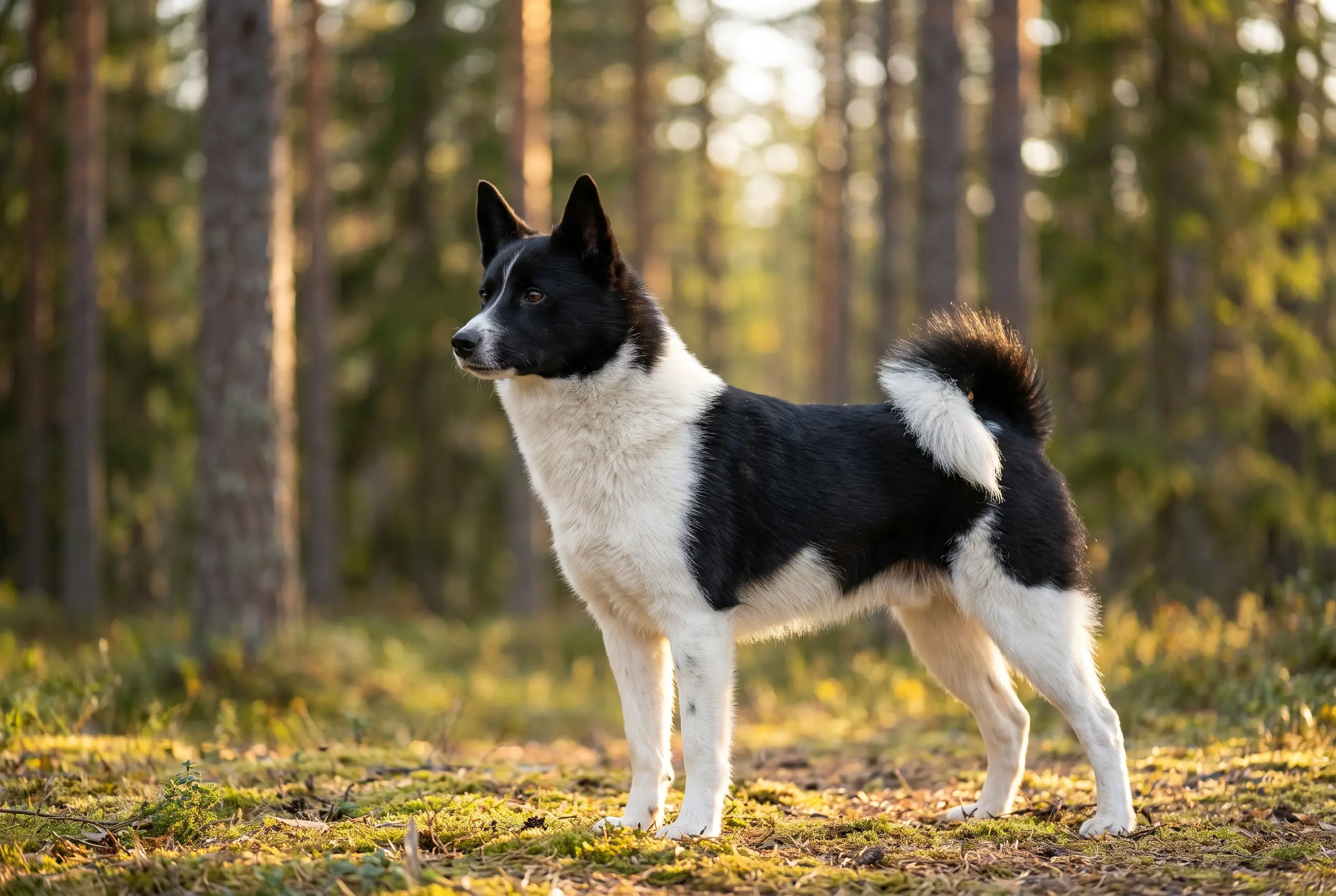
Russian-European Laika
Russia's compact black-and-white treeing spitz, and the one laika whose standard throws a bobtail out of the ring.
Vital stats
| Size | Medium · 52–58 cm (dogs), 48–54 cm (bitches) |
| Weight | 18–23 kg — breed literature; the standard sets none |
| Life expectancy | 12–14 years — breed literature, not survey data |
| Energy | Very high — a treeing spitz still in active work; two hours a day is the floor |
| Shedding | Heavy, with two seasonal blows |
| Coat | Harsh straight topcoat over a thick woolly undercoat · black with white or white with black |
| Group | Hound · Nordic Hunting Dogs (FCI №304, Group 5) |
| Origin | European Russia |
Breed traits
Friendliness
Care
Mind
Temperament
The standard spends one line on character: steady, evenly-tempered, with a very well developed sense of scent and detection of game. Everything else in the breed's reputation follows from how that scenting talent gets used. This is a dog selected since the 1940s to fire up at the flick of a squirrel's tail and then to bark, precisely and persistently, at the tree that holds it. At home that translates into a sharp, quick, watchful dog with a low threshold for excitement and a loud opinion about anything that crosses the garden. Breeder and owner reports call it the most owner-attached of the three Russian laikas, quicker to work with a handler than its bigger Siberian cousins, though that is a claim about laikas, not about lapdogs. Strangers get announced rather than welcomed. Small pets read as game, and early socialising softens that without deleting it. It is a hunting dog first; the affection is real, and it arrives on the dog's terms.
Habits & quirks
Barks at the tree, not at you
The working pattern is treeing: find a squirrel, a marten or a capercaillie, hold it up a tree, and bark until the hunter walks in. The bark is the report — where the dog is, and that the game is still there. A silent laika is out of a job.
Black and white, either way round
The most typical colours are black with white or white with black, and the standard also accepts solid black and solid white. Any other colour disqualifies, and tan markings on the head and legs count as a severe fault.
A bobtail is a disqualification
The tail must curl or sickle-curl against the back, thigh or buttocks, and a natural stumpy tail puts the dog out of the ring, along with sabre and otter tails. Finland's Karelian Bear Dog, its closest relative, rates a natural bobtail equal to a full tail. Same forests, opposite rule.
Assembled in 1947, on the record
Most spitz standards gesture at ancient origins. This one lists its ingredients: offspring of Arkhangelsk, Komi, Karelia and Votiatsk laikas, united into one breed in 1947 and given a standard in 1952. The modern type came from selective breeding afterwards, and the standard says so plainly.
Care
| Exercise | Two hours a day, and forest beats pavement by a wide margin. This is a working hunting breed with live field trials behind it, not one that retired into the show ring. Scentwork, tracking and long walks off the beaten path are the right shape; off-lead freedom is a calculated risk, because one squirrel across the trail settles the recall debate. Under-exercised, it patrols and barks, and the neighbours will let you know. |
| Grooming | A harsh, straight topcoat over a thick, woolly undercoat, with a collar at the neck, side-whiskers on the cheekbones and trousers behind. A weekly brush covers most of the year; twice a year the undercoat lets go completely and wants a rake most days for a fortnight. No clipping and no trimming: the collar and whiskers are breed type, not styling. |
| Training | Quicker to take direction than most of the Nordic hunting section, and closely bonded to one handler — relative praise, since drive still outranks obedience the moment something scrambles up a trunk. Short positive sessions, a long line through adolescence, and a stop cue for barking taught before the barking rewards itself. Punishing the voice confuses the dog, because the voice is what the breed is for. |
| Health | No breed health survey exists, and most of the population lives in Russia, where screening records are hard to check from abroad. The breed carries a hardy reputation and no documented signature disease, which is not the same thing as evidence. Ask for hip and eye results on both parents, and treat the 12–14 years in breed literature as an estimate rather than a measurement. |
Common questions
How is it different from the Karelian Bear Dog?
They grew from overlapping black-and-white hunting spitz stock in Karelia, and photographs of the two are mistaken for each other constantly. The registries are clear: the Karelian Bear Dog is Finnish, FCI standard 48; the Russian-European Laika is Russian, FCI standard 304. The standards then split on detail. The Karelian must be black with white markings, and a mostly white dog is a fault; the Laika treats white with black, solid black and solid white as equally legitimate. And the tail rule inverts: the Karelian rates a natural bobtail equal to a full tail, while for the Laika a bobtail is a disqualification.
Which of the three Russian laikas is this one?
The smallest and the black-and-white one, from the forests of European Russia, with squirrel and other small fur at the heart of its working tradition. The West Siberian (FCI №306) stands taller, runs to grey, red and sable shades, and carries the big-game reputation; the East Siberian (FCI №305) is the largest of the three. If the dog in front of you is compact, sharp-faced and piebald black and white, it is this one.
Do they bark a lot?
Yes, by design and by name: 'laika' comes from the Russian verb for barking. The working method is to hold game up a tree with voice until the hunter arrives, so the bark sits deep in the wiring. It channels well into work and answers to a trained stop cue, but a quiet Russian-European Laika in a flat was never on offer.