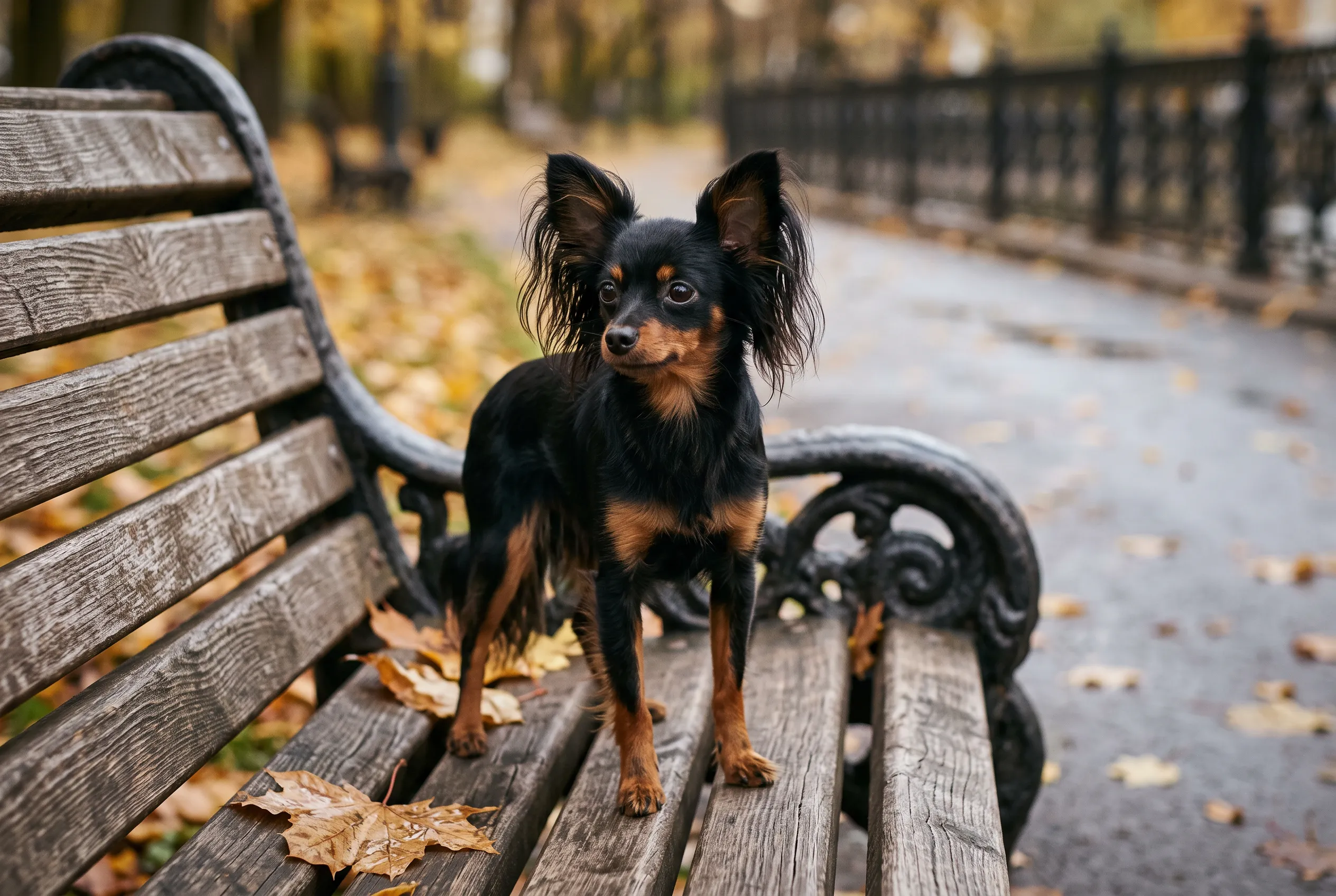
Russkiy Toy
Rebuilt in Moscow from dogs with no papers, and no longer a terrier.
Vital stats
| Size | Toy · 22–27 cm |
| Weight | 1.5–3 kg |
| Life expectancy | 12–14 years |
| Energy | Moderate — 30–45 min a day, plus indoor games |
| Shedding | Low — light and year-round in both coats |
| Coat | Smooth or long-haired · black, brown, blue or lilac with tan; red, fawn or cream |
| Group | Toy · Companion (FCI №352, Group 9) · AKC |
| Origin | Moscow, Russia |
Breed traits
Friendliness
Care
Mind
Temperament
The FCI standard gives it in one line: active, very cheerful, neither cowardly nor aggressive. The last part earns its place, because the two ways a toy dog goes wrong are shrinking from everything and snapping first, and the standard disqualifies both. A well-bred Russkiy Toy is nosy about the world, wants to be in whatever room the household is using, and attaches to one person hard enough to follow them from room to room. It is alert and it will announce the door. It also believes it is the size of a labrador, which is charming at home and a genuine hazard in a park. Training goes easily. The usual complaint about the breed is not stubbornness but that nobody troubled to teach it anything, on the grounds that it only weighs two kilos.
Habits & quirks
Goes up, forgets the way down
Sofa backs, window sills, the arm of a chair, your shoulder. Most vet visits for this breed start with a fall from furniture or from someone's arms, not with anything that happened outdoors.
Picks one person
The standard's phrase is strongly devoted to its owner. In practice that is a dog that relocates whenever you do and settles against a leg rather than on a bed across the room.
Works as a doorbell
Big erect ears on a curious dog catch everything in the stairwell. It is an easy habit to shape in the first months and a hard one to undo once it has been funny for half a year.
Hunts for the warm spot
Thin skin, fine bone, and no undercoat at all on the smooth variety. It will be under the blanket or inside the jumper, and it needs a coat for a northern European winter.
Care
| Exercise | Thirty to forty-five minutes of real walking a day, on a harness rather than a collar, plus games indoors. It has more stamina than the size suggests, and a bored Russkiy Toy gets loud. |
| Grooming | The smooth coat wants a rubber mitt once a week. The long coat wants a comb twice a week, with attention to the ear fringe and the feathering behind the legs, which mat where nobody looks. Neither variety is clipped: a trimmed coat is a disqualifying fault in the standard. |
| Health | Ask the breeder about patellar luxation, eyes, and the fontanel, which the standard disqualifies if it is still open after nine months. Baby teeth that refuse to fall out around six to nine months usually need extracting, and daily brushing after that is not optional in a jaw this crowded. Very small puppies can drop into hypoglycaemia between meals, so they eat little and often until they have grown into their weight. |
| Training | The same syllabus as a 30 kg dog, in a smaller room: lead manners, recall, being handled by a vet, staying quiet when someone knocks. It learns quickly and enjoys the work. Picking the dog up to carry it past everything it finds difficult is how people end up with one that bites the groomer. |
Common questions
Smooth-haired or long-haired?
The standard describes the same dog twice and both varieties compete for the same titles, so this is a question about coat and grooming. The smooth coat is short, close-lying and shiny, and takes a rubber mitt once a week. The long coat runs 3 to 5 cm on the body with feathering behind the legs and a fringe on the ears that, in an adult, should hide the outer edge and the tip completely. That fringe is not there at eight weeks and can take a year or more to fill in, so do not judge a long-haired puppy's ears the day you meet it. Litters can hold both, and two smooth-haired parents can still produce long-haired puppies, which is exactly how the variety started in 1958.
Is it a good dog for a house with small children?
Usually not, and the reason is physics rather than temperament. An adult weighs 1.5 to 3 kg on fine bone. A toddler who trips over one, sits on one, or drops one from chest height can break a leg, and the falls happen fast enough that supervision does not always help. A small dog that has learned hands are dangerous will growl and then bite, because nothing quieter worked. With calm children of eight or so upwards, taught to let the dog come to them and to leave it alone when it is on the floor, it makes a good family dog. With a two-year-old in the house, the honest answer is to wait a few years or pick something sturdier.
Is the Russkiy Toy a terrier?
No, though it was called one for fifty years and plenty of breeders still write it that way. It descends from the English Toy Terrier, and the Soviet-era breed was registered as the Russian Toy Terrier and the Moscow Longhaired Toy Terrier. By the time the FCI recognised it, decades of separate breeding had made it something else, and it went into Group 9 with the companion and toy dogs rather than Group 3 with the terriers. None of the working terrier wiring survived: no earth-dog drive, no serious digging, no appetite for a fight. What is left is a companion dog with an alarm bark.