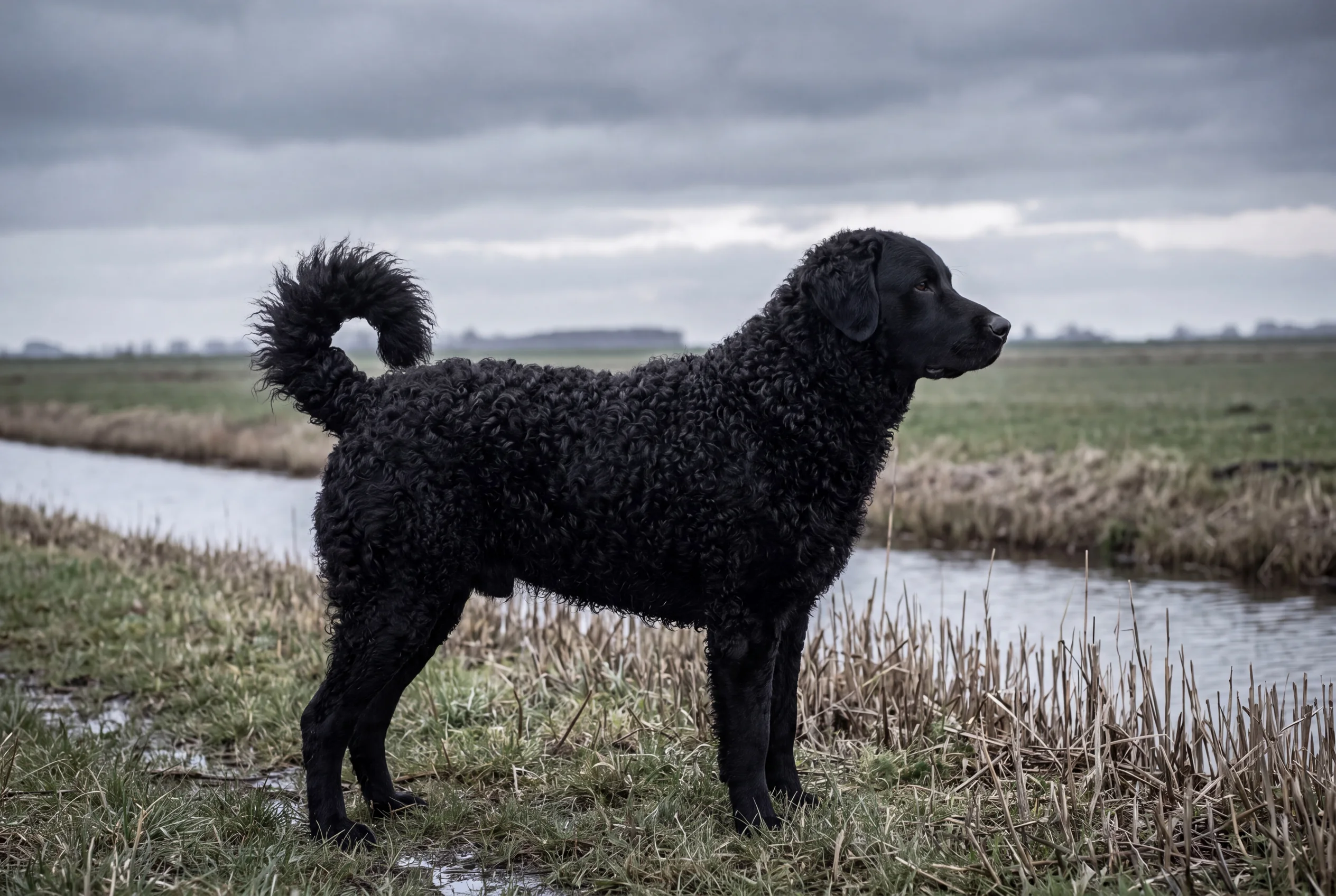
Wetterhoun
Friesland's otter dog: greasy curls, a spiral tail, a mind of its own.
Vital stats
| Size | Medium-large · 55–59 cm |
| Weight | 28–34 kg |
| Life expectancy | 12–13 years — Dutch sources put the average nearer 10–11 |
| Energy | Moderate to high — a working water dog that switches off indoors |
| Shedding | Moderate — two moults a year and little in between |
| Coat | Dense greasy curls · solid black or solid brown with white on chest and toes; patches, ticking and roan allowed |
| Group | Sporting · Water Dog (FCI №221, Group 8) |
| Origin | Friesland, Netherlands |
Breed traits
Friendliness
Care
Mind
Temperament
The FCI standard opens the character section with the words self-willed by nature, and it means them. At home a Wetterhoun is affectionate with its own family and easy to have around, usually flat in a corner with one ear up. Strangers get held at a distance until it has made up its mind, and the standard is careful to draw the line: reserved at first, never fearful. Guarding the yard sits in the standard next to hunting, so it registers who comes to the gate, though Dutch breed sources describe it as alert rather than noisy. It is also keen on vermin in and around the house. It understands what you have asked and then decides whether now is the moment, which people who want instant obedience find maddening. Wait out the long look and you get a calm, level-headed dog that means what it does.
Habits & quirks
The coat does the work
Dense curls in firm bundles, coarse and oily to the touch, so a Wetterhoun climbs out of a canal and shakes most of the water straight off. Strip the grease out with shampoo and the waterproofing goes with it, which is why breeders bathe as little as they can get away with.
The tail rolls up
Long and rolled into a spiral carried over or alongside the croup. The Raad van Beheer's breed page calls it his sieraad, his ornament, and it stays curled whether or not the dog is pleased about anything.
Straight into the water
Otter and polecat were hunted in cold ditches and reed beds, and the breed has never lost the habit. Any walk that passes open water is a swim as far as the dog is concerned.
Keeps the yard
Watching the property and killing vermin around it were part of the job, not a side effect of it. A Wetterhoun clocks a visitor, says so once, and then waits to see how you handle it.
Care
| Exercise | An hour or more of real work a day: swimming, long lines, retrieves, scent games. It is not a restless dog and settles well indoors, but a bored Wetterhoun picks its own project in the garden. |
| Grooming | Undemanding. Comb the curls through during the two seasonal moults and check the ears, which lie flat against the head and trap damp after every swim. Bathe rarely: the oil that waterproofs the coat takes weeks to come back. |
| Training | Short, consistent, and worth the dog's while. It learns fast and then negotiates, so settle what the rules are before the puppy does. Reward-based work gets you somewhere; heavy handling gets you a dog that plants its feet. Socialise early and widely so the natural reserve stays reserve. |
| Health | Buy only from breeders who test. The breed carries a nonsense mutation in the RAG1 gene causing a severe combined immunodeficiency that kills affected puppies before four months; it was described in Frisian Water Dogs in 2011, there is a DNA test, and Dutch breeding rules require it alongside hip screening. A 2010 analysis measured inbreeding at 32% or more across all generations, which is why the Dutch club runs an outcross programme using the West Siberian Laika. |
Common questions
Is a Wetterhoun a Labrador with curls?
No, and that expectation is where most of the disappointment starts. They share Group 8 and a love of water, and the resemblance ends there. The FCI standard's first words on Wetterhoun character are self-willed by nature, and the breed's other historical job was guarding the yard. It is genuinely affectionate with its own people and quiet in the house, but it keeps strangers at arm's length, it weighs a request before answering it, and it has no interest in pleasing for its own sake. Plenty of people find that restful to live with. It suits an owner who negotiates rather than commands and who is content with a dog that greets visitors politely instead of joyfully. If you want a retriever's eagerness, buy a retriever.
What do 'Wetterhoun' and 'Otterhoun' mean?
Wetterhoun is Frisian for water dog. Otterhoun, the older Dutch name, is the job: hunting otter and polecat in the ditches and lakes of Friesland, close-quarters work against an animal that fights back in cold water. The Raad van Beheer lists mole catching, cart pulling and yard guarding among the breed's other former uses. Say it roughly 'VET-er-hoon'.
How hard is a Wetterhoun to find?
Hard. The FCI standard's own figure puts the world population at about a thousand dogs, most of them in the Netherlands, and breed sources put annual births at something like a hundred puppies across all of it. The Dutch breed club, the NVSW, runs the puppy list and enforces the health testing, so getting one usually means a wait rather than a search. Outside the Netherlands the breed is spread very thin: the first litter bred in the UK made BBC News in 2023.