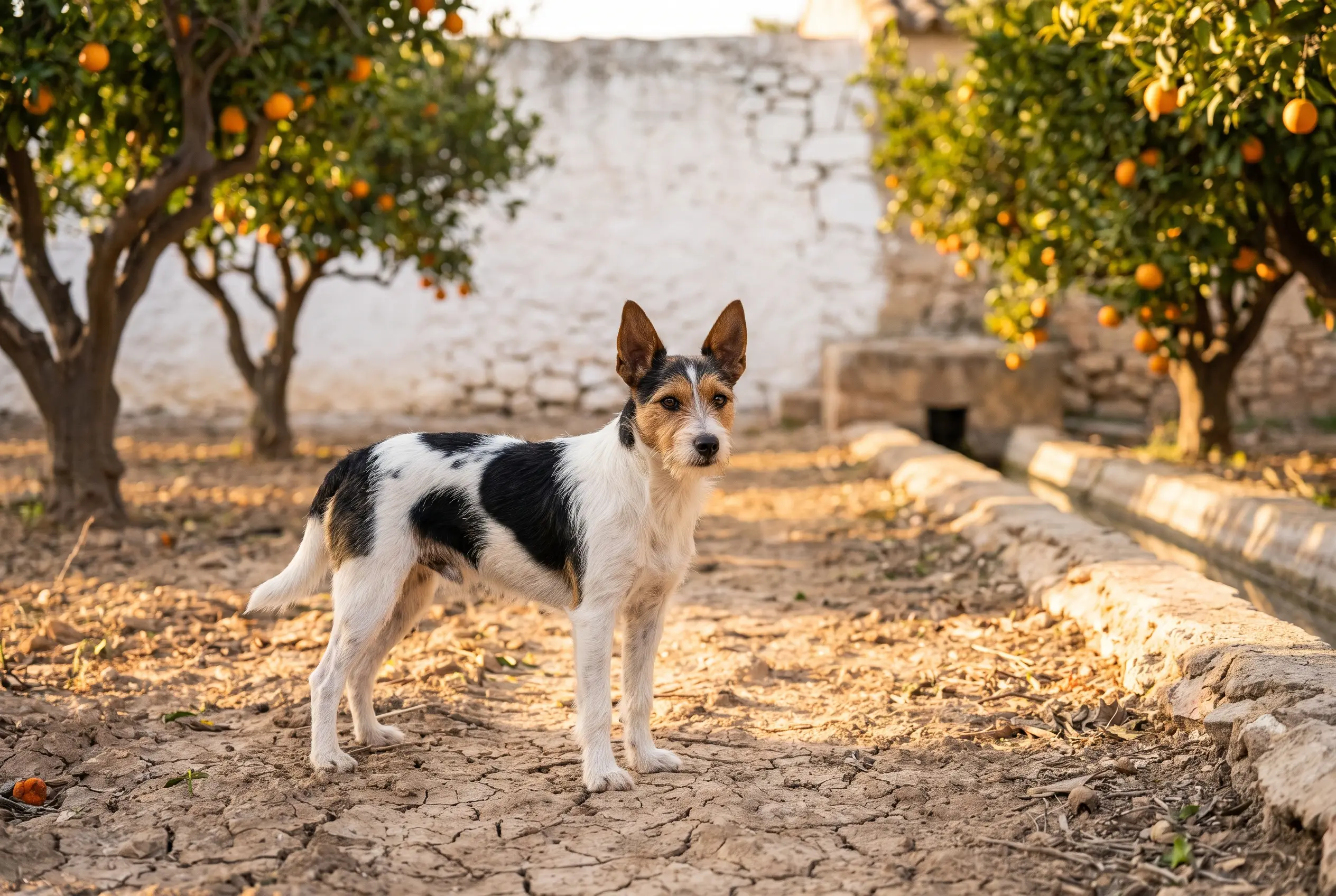
Gos Rater Valencià
The rat-catcher of Valencia's orange groves and irrigation ditches.
Vital stats
| Size | Small · 30–40 cm (males, ideal 36) · 29–38 cm (females, ideal 33) |
| Weight | 4–8 kg |
| Life expectancy | No published breed data · small terriers of this build usually reach their early teens |
| Energy | High — a working ratter's day packed into 6 kg |
| Shedding | Low to moderate — fine coat, no more than 2 cm, no undercoat to blow |
| Coat | Fine and short · usually tricolour black and tan with white; also black and tan, white and black, white and cinnamon, brown and tan, or solid cinnamon or black |
| Group | Terrier · Large and medium-sized terriers (FCI №370, Group 3) |
| Origin | Valencian Community, Spain |
Breed traits
Friendliness
Care
Mind
Temperament
The standard's own words are lively, cheerful and somewhat restless, which is a fair account of a dog bred to spend its day hunting things in ditches. At home it is affectionate and loyal, reserved with people it doesn't know, and brave out of proportion to its weight — after quarry and at the gate alike. It learns fast, and that cuts both ways: house rules stick quickly, and so does the discovery that barking brings everyone running. Aggression and extreme timidity are both disqualifying in the ring, and a well-bred one is neither. It is simply busy, and loud about visitors.
Habits & quirks
The doorbell with legs
The standard names avisador, the announcer, as part of the job. A van in the street, a step on the stairs, a cat on the wall: all of it gets reported.
Works the wet ground
Old ratters go straight for water — acequia banks, drains, anywhere a rat would live. Expect digging, and expect it to listen at a hole for a long while before it commits.
Jumps out of its weight class
The standard singles out its long jump and a footfall so light the dog barely seems to touch the ground. Garden fences that look tall enough often aren't.
Never quite off duty
Indoors it patrols, checks the windows and resettles somewhere it can see the door. A day with no job in it becomes a day of loud opinions.
Care
| Exercise | About an hour a day, split, with something to hunt in it: a scent trail, a dig box, a ball lost in long grass. A walk on its own leaves the head untouched. |
| Grooming | The coat is fine and under 2 cm, so a rubber mitt once a week covers it. The standard describes the skin as very fine and tight to the body, which means brambles cut it easily and cold weather gets through it. Check the dog over after rough ground. |
| Training | It learns fast and does best on short reward-based sessions. Start recall around small animals early, because the prey drive is the whole reason the breed exists, and teach an off-switch for barking before the habit hardens. |
| Health | No health survey has been published for the breed — the registered population is small and, in studbook terms, young. Ask breeders for patella and eye checks, standard for small terriers, and ask how closely the parents are related. |
Common questions
Is this the same dog as the Ratonero Bodeguero Andaluz?
No. Two separate breeds with separate standards: the Valencian is FCI No. 370, the Bodeguero is No. 371, accepted two years later in September 2024. Both are small Spanish ratting terriers with old British terrier behind them, which is why they were lumped together for years. The Bodeguero comes from the sherry bodegas around Jerez, stands taller at roughly 35–43 cm, and is mostly white with black and tan patches. The Valencian is smaller and usually carries its colour over most of the body.
Do they bark a lot?
Yes, and the FCI standard says so almost before it says anything else: announcing strangers is listed as part of the breed's work. A stop cue helps, and enough exercise removes the boredom barking, but a quiet Gos Rater Valencià is not what anyone was breeding for.
Can you get one outside Spain?
Rarely. Nearly the whole population sits in the Valencian Community, and only a few hundred were registered in Spain in the first decade after national recognition. Provisional FCI status means dogs can be entered in any member country's studbook and shown at international shows, though not for the CACIB, so the breed is only beginning to travel.