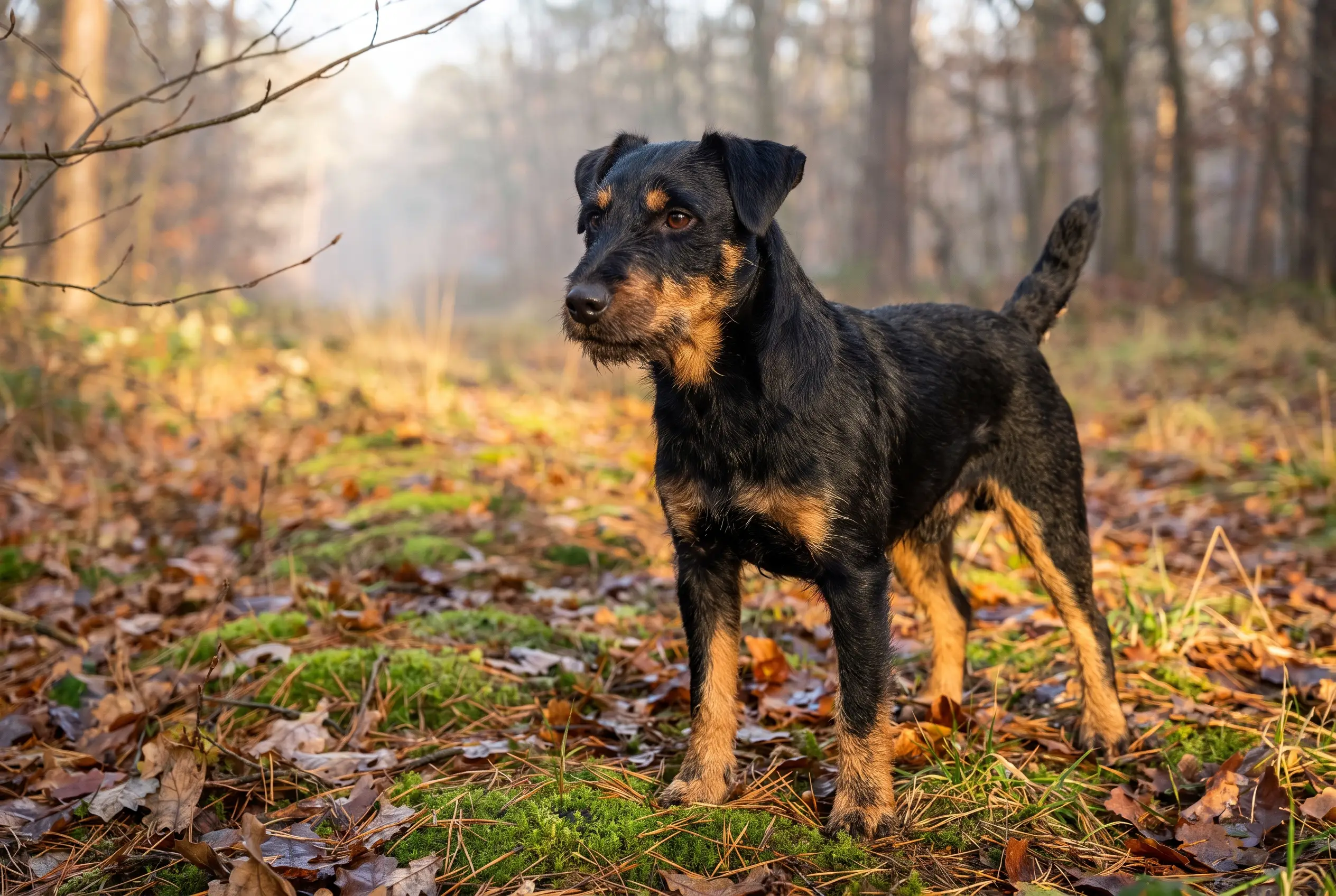
Deutscher Jagdterrier
Small, black and tan, and bred to go down a badger's hole.
Vital stats
| Size | Small · 33–40 cm |
| Weight | 7.5–10 kg |
| Life expectancy | 12–15 years |
| Energy | Very high — a working hunting dog before anything else |
| Shedding | Low to moderate — short, hard coat |
| Coat | Rough or smooth, always harsh and dense · black, dark brown or greyish-black with tan markings |
| Group | Terrier · Large and medium-sized Terriers, with working trial (FCI №103, Group 3) |
| Origin | Germany |
Breed traits
Friendliness
Care
Mind
Temperament
The FCI standard asks for a dog that is courageous and hard, takes pleasure in work, enduring, reliable, sociable and trainable, neither shy nor aggressive. Breeders have held that line for a century by refusing a breeding permit to any dog that has not passed a hunting test. What arrives in a house is a small dog with a very large engine: bonded to its own people, sharp with strange dogs, loud on a scent, and willing to meet a badger underground in the dark. Hunters find it straightforward to live with. Someone who wants a small companion finds it relentless. It is a poor first dog, a poor apartment dog, and a poor choice for anyone who cannot give it a job — say that out loud before falling for the puppy photos. Left without work it makes its own: digging, barking, opening gates, and hunting whatever the household keeps in a cage.
Habits & quirks
Goes in
Below ground on fox and badger, in a tunnel too tight to turn around in. The standard builds the dog to the hole: chest circumference only 10–12 cm more than the height at the withers.
Gives tongue
It was selected to bark hard at the quarry so the hunter can locate it under a metre of soil. The volume arrives in the suburbs unchanged.
Everything small reads as quarry
Cats, rabbits, chickens, the neighbour's small dog. Raised alongside the family cat, many tolerate that one cat and no other. Outdoors, nothing small is safe off a lead.
Renovates the garden
Digging is the job, not a bad habit. A Jagdterrier with nothing to do will excavate the lawn, the flower beds and the line under the fence, in that order.
Care
| Exercise | Count on a couple of hours of real work a day: field work, tracking, drag lines, scent games, water. Lead walks barely register on this dog. |
| Grooming | The easy part. The smooth coat needs a rubber brush now and then; the rough coat wants tidying by hand a few times a year. After a working day, go over ears, eyes, feet and skin for cuts, thorns and ticks. |
| Training | Start at eight weeks and keep going. Heavy socialisation with people and dogs, and a recall built long before the prey drive matures. It answers pressure with more pressure, so consistency and reward beat force every time. |
| Health | A hardy breed with one problem worth insisting on: primary lens luxation, which is common enough here that both parents should have a clear ADAMTS17 DNA result. Ask to see them. Working injuries — bites, torn ears, eye damage — are the other running cost. |
Common questions
Is a Deutscher Jagdterrier a good family dog?
For most families, no. It is a hunting dog bred and licensed on working ability, with prey drive, hardness and stamina that a normal pet home cannot absorb. In a hunting or working-dog household it can be an excellent family member: loyal, clean, easy to feed, small enough to live anywhere. Without that outlet it becomes noisy, destructive and dangerous to small pets, and rescues see the results regularly.
How is it different from a Fox Terrier or a Jack Russell?
It comes from Fox Terrier stock, deliberately taken in the opposite direction. The founders left the Fox Terrier club in the 1920s because they wanted performance rather than show points, and the German club still requires a passed hunting test before a dog may be bred. The result is heavier-boned than a Jack Russell, calmer at rest than a Fox Terrier, and considerably harder on quarry than either.
Smooth coat or rough coat — what's the difference?
Both are correct under FCI standard 103, which asks for dense hair that is either hard and rough or coarse and smooth. Rough-coated dogs carry more furnishing on the face and legs and want occasional hand-tidying; smooth-coated dogs need almost nothing. Soft, woolly or thin hair is a severe fault in either variety. Colour is the same for both: black, dark brown or greyish-black with clearly marked tan on the eyebrows, muzzle, chest, legs and tail base.