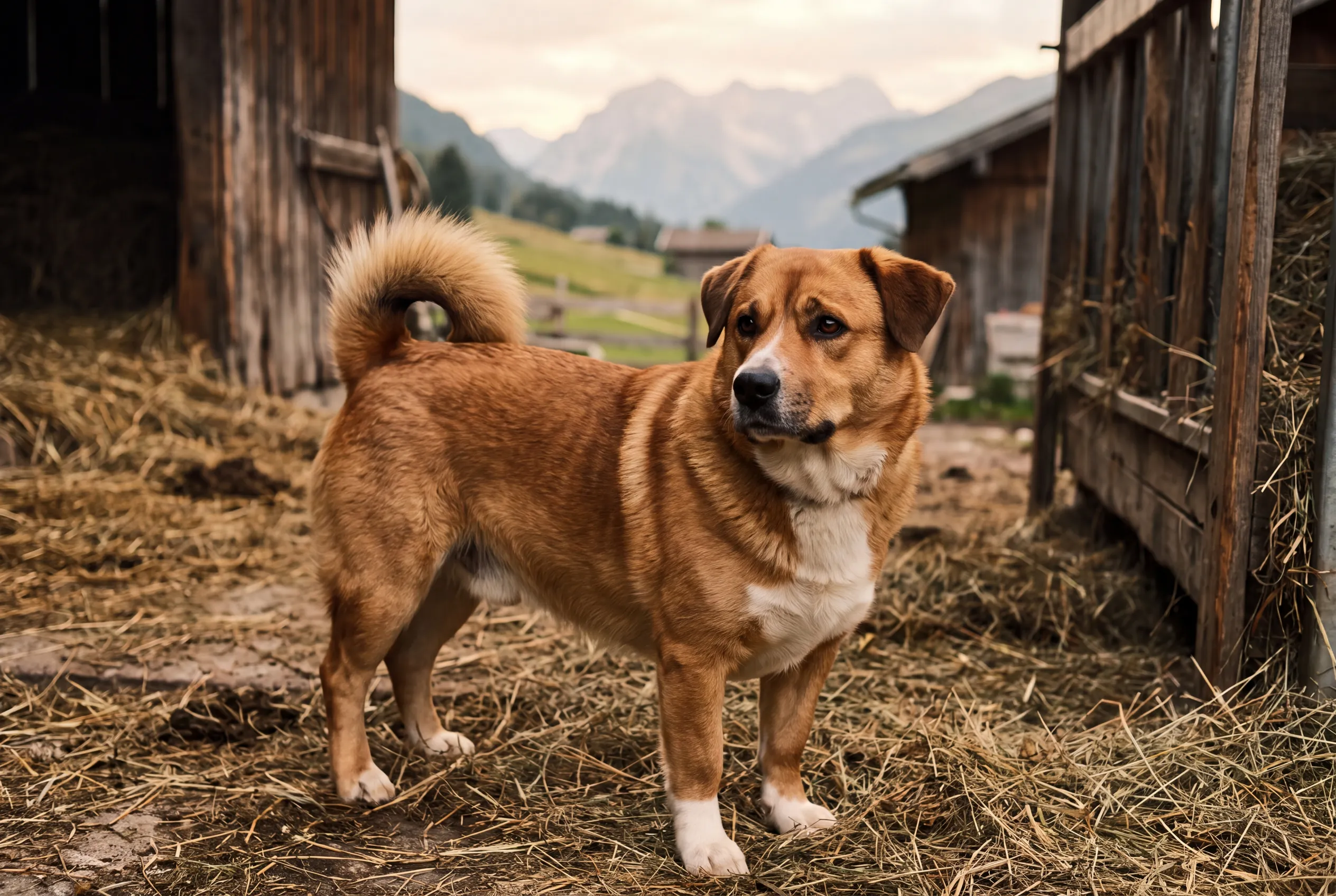
Österreichischer Pinscher
Austria's farmyard pinscher, rebuilt from one surviving stud dog.
Vital stats
| Size | Medium · 42–50 cm (males 44–50, females 42–48) |
| Weight | 12–18 kg |
| Life expectancy | 12–14 years |
| Energy | Moderate to high — a working farm day, not an athlete's |
| Shedding | Moderate — thick undercoat, heavier twice a year |
| Coat | Short to medium double coat · russet gold, brownish yellow, stag red or black-and-tan, usually with white markings |
| Group | Working · Pinscher (FCI №64, Group 2) |
| Origin | Austria |
Breed traits
Friendliness
Care
Mind
Temperament
The FCI standard calls the Austrian Pinscher an incorruptible guard, and that is the line to plan around. It is assertive, lively and playful, openly affectionate with the people it knows, and permanently interested in the edges of whatever it has decided is home. Strangers get announced, loudly and early; the voice is deeper than the size suggests. Farmers wanted precisely that and nobody has bred it back out. The hunting instinct runs the other way — the standard calls it only slightly developed — so this is not a dog that disappears over a hedge after a hare, and it tends to stay in sight on walks. What it does need is somebody else deciding who counts as welcome. Left to work that out alone, it settles on suspicion, and gets sharp with visiting dogs as readily as with visiting people.
Habits & quirks
The gate is the job
Every trip outside includes a lap of the boundary. Guarding the yard was the whole point of the breed, and the dog still treats the fence line as a route that needs walking.
Announces before it checks
The bark comes first and the assessment second. A delivery van gets the same volume as an intruder, and the difference has to be taught rather than assumed.
Long body, short legs
Built 9 to 10, height to length, it moves with a low ground-covering trot rather than a sprint. It will walk all day and rarely looks like it is hurrying.
Stays in sight
With so little hunting drive, it hangs back within eyeshot on a walk instead of casting ahead. Owners who came from a terrier find the recall almost restful.
Care
| Exercise | About an hour outdoors a day, ideally with ground to cover and something to keep an eye on. Long walks, farm chores and scent games suit it far better than repetitive drills. |
| Grooming | A weekly brush handles the thick short-to-medium double coat, stepped up when the undercoat drops in spring and autumn. It stays clean, needs baths rarely, and asks nothing beyond nails and teeth. |
| Training | Start on visitors, doorbells and other dogs from the first week home. This is a confident dog that will make its own call about a stranger if nobody makes it first, and reward-based work on a quiet settle is worth more than any obedience title. |
| Health | Generally hardy, with no breed-specific disorder well documented. The real question is the gene pool: ask breeders about the depth of the pedigree, how much Landpinscher blood is behind the litter, and for hip and eye screening. |
Common questions
Does an Austrian Pinscher bark a lot, and can it live in a flat?
Yes, it barks, and a flat is a poor match. The breed was kept to guard a yard, the FCI standard calls it an incorruptible guard, and the barking is the guarding — it fires at footsteps in the stairwell, at the neighbour's door, at anything crossing the territory. Training teaches it what deserves a report and shortens the outburst; nothing switches it off. In a house with a garden and neighbours at some distance that is a feature. In a shared building it is a complaint waiting to happen, and no amount of exercise changes that.
How is it different from the German Pinscher?
Different dogs with different jobs. The German Pinscher is a sleek, leggy ratter with a short single coat, a real prey drive and 45–50 cm of athlete. The Austrian is stocky and set lower, built 9 to 10 in height to length, and carries a thick double coat with white markings on the muzzle, chest and feet. Its hunting instinct is slight by standard, and the guarding is the strong end. They sit in the same FCI section and nowhere near the same house.
How hard is one to find?
Hard. The breed came through the 1970s on a single registered stud dog and has stayed small ever since, with litters falling mainly in Austria and Germany and a handful elsewhere. Germany's VDH logged nothing at all in most years before 2018. Expect to work through the Austrian breed club, expect a waiting list, and expect the breeder to ask whether you have a garden long before you get to ask about price.