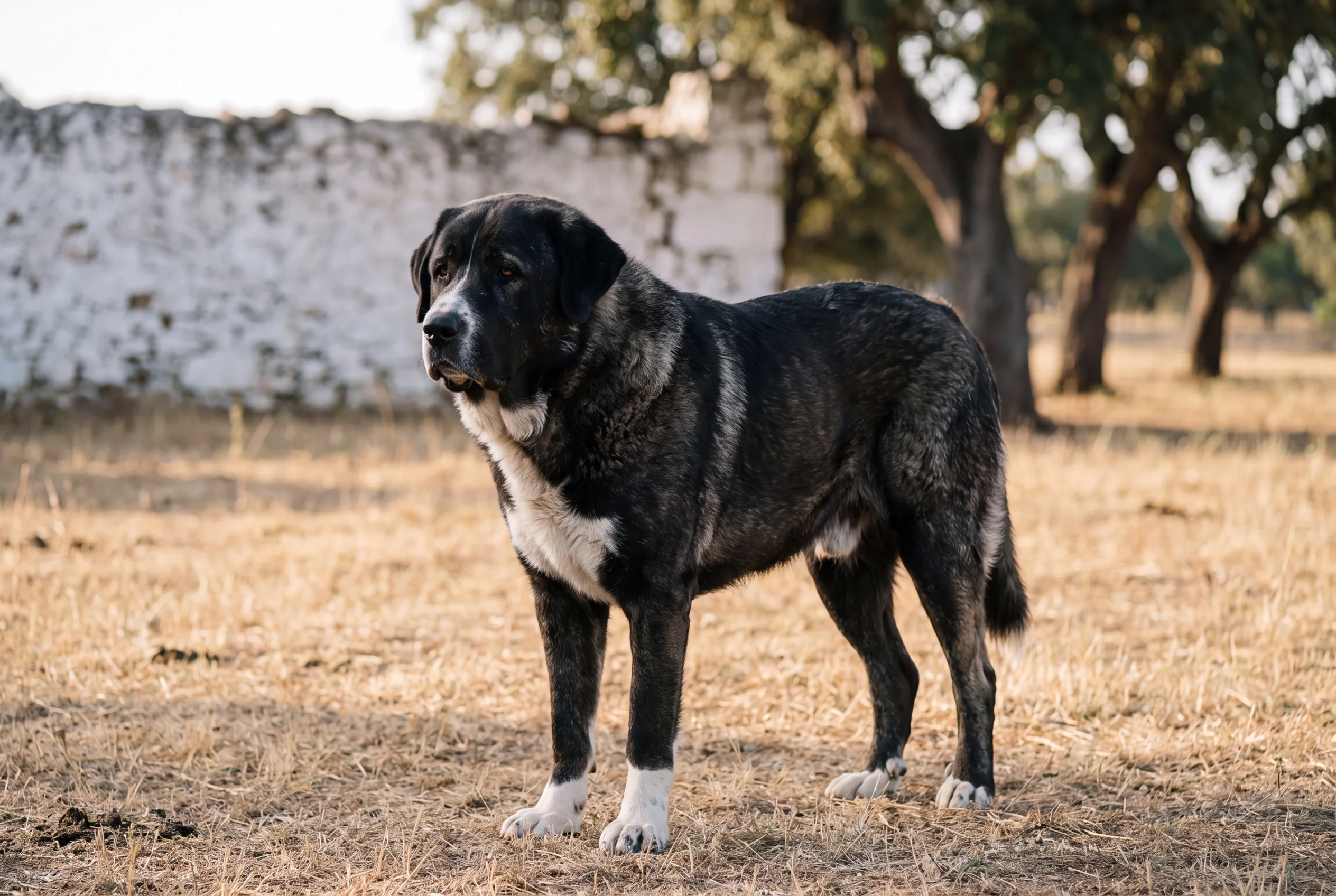
Rafeiro do Alentejo
Sleeps through the Alentejo afternoon, works the whole night.
Vital stats
| Size | Large · 64–74 cm · males 66–74, females 64–70 |
| Weight | 35–60 kg · males 45–60, females 35–50 |
| Life expectancy | 12–14 years |
| Energy | Low to moderate — works the night, idles by day |
| Shedding | Moderate to heavy — thick, dense, evenly spread coat |
| Coat | Short or medium · black, wolf grey, fawn or yellow, always with white |
| Group | Working · Mountain Dog (FCI №96, Group 2) |
| Origin | Alentejo, southern Portugal |
Breed traits
Friendliness
Care
Mind
Temperament
The standard's own line does most of the work: an excellent farm and estate watch dog, more vigilant at night, very serious when guarding territory or any other property entrusted to it. Serious is the operative word. This is not a noisy dog or an excitable one. It watches an arrival, reaches a conclusion, and acts on it, and it does not check with anyone first. At home it is calm to the point of inert, steady with children it has grown up around, and physically undemanding for its size. With strangers it closes, and adult males can be difficult with other dogs and with visitors who mistake stillness for softness. The standard is exact about where the line sits. The expression should be calm and confident, neither aggressive nor shy, and both aggression and marked shyness are disqualifying faults. A correct Rafeiro is not looking for a fight. It is simply certain that it decides who comes through the gate.
Habits & quirks
Takes the night shift
Very few standards describe when a breed works. This one does, listing the dog as more vigilant at night. Owners describe the same pattern: long stretches of the day spent flat out in the shade, then a dog that gets up at dusk and walks the boundary until morning. It is a livestock guardian's schedule, set by when predators move, and it survives intact in dogs that have never seen a sheep.
Works loose, not at heel
It was never a driving or herding dog. Its job was to take a whole property and decide its own routes around it, which is why the standard puts guarding territory ahead of following anyone. Day to day that reads as a dog with a wide sense of what belongs to it and a recall that arrives when it suits. Fencing does the work here that a lead does in other breeds.
Rolls rather than trots
The standard asks for a gait that is heavy, slow, a roll without exaggeration. Almost no other breed is required to move slowly. The chest is drawn slightly shallower than half the height at the withers and the frame is longer than tall, and the whole build is set up to cover ground all night without spending anything it might need later.
The white is compulsory
Colour is one of the easier ways to name this breed. Black, wolf grey, fawn or yellow, brindled or plain, and always with white markings, or the whole thing inverted into a white dog carrying patches of those colours. Both readings are correct and both are common, so two Rafeiros in the same litter can look like opposite dogs.
Care
| Exercise | An hour or two of unhurried walking a day, split rather than done in one push. It is not a running, cycling or agility dog and the standard's slow rolling gait is the reason. What matters more than distance is ground it can patrol: a securely fenced area it treats as its own does more for this breed than any amount of structured exercise. Keep young dogs off long forced walks and stairs while the joints are still closing. |
| Grooming | The coat is thick, straight and dense, spread evenly right down between the toes, in a short or a medium length with medium preferred. A weekly brush handles it outside the moults, more often when the undercoat lifts. The dewlap and the folded ears are worth a look each week, since both trap moisture. Long, wiry or wavy hair is a fault, so a Rafeiro should never need a coat trimmed. |
| Training and boundaries | Socialise early, widely and for years, not months. Reward-based work suits it and force does not, because a 60 kg dog that has learned to argue is not a problem you settle by hand. Teach a place command and a fixed routine for visitors before you need either, and manage introductions outside the gate rather than inside it. Expect a dog that learns fast and then declines to repeat itself. |
| Health | Hips and elbows first, on both parents, and a breeder who offers the results rather than waits to be asked. Gastric torsion is the other risk that comes with a deep-chested dog of this weight, so split meals and learn the signs. Published health data for the breed is thin because the population is small, which makes pedigree depth worth reading as carefully as any single test result. |
Common questions
Does a Rafeiro work in a home with no land?
Usually not, and this is one of the breeds where the honest answer is closer to no than to it depends. The guarding drive does not need livestock to switch on; without a property to hold it appoints your home and the people in it, and then works that boundary on its own schedule, which includes the night. A flat with a shared entrance and a stream of unfamiliar people through it is the worst setting available. What it actually needs is a securely fenced area it can treat as its own, an owner who will manage every introduction for the dog's whole life, and neighbours far enough off to live with a deep bark at three in the morning. A house with a real garden and a committed owner can work. A first-time owner who wanted a large, calm, easygoing family dog has picked the wrong breed, and the calm is the part that misleads people, because it is the calm of a dog that is off duty rather than a dog that is soft.
What does the nocturnal habit mean in practice?
It means the dog you meet at four in the afternoon is not the dog your neighbours hear at two in the morning. A Rafeiro asleep in the sun looks like the least demanding large dog you could own. After dark the same animal is up, moving on a circuit, and answering things that pass the fence. The barking is deep, it carries, and it is doing exactly what the breed was kept for, so training it away is not really on offer. What can be managed is where the dog spends the night and how much it can see and hear from there. Owners who bring the dog inside overnight generally get a quieter animal; owners who leave it out on a boundary with a road behind it generally do not. Decide which of those you are before you take a puppy, not after the first complaint.
How rare is it, and can you find one outside Portugal?
It is genuinely scarce and almost all of it sits in Portugal. The breed came within a few dogs of disappearing in the early 1980s and has been rebuilt since, but that recovery ran on a narrow base and the numbers stayed modest. Outside Iberia the picture is thinner again. The American Kennel Club records the breed in its Foundation Stock Service, a holding programme for rare breeds that is not full recognition and does not carry conformation eligibility, and the United Kennel Club recognises it among its guardian dogs. Elsewhere in Europe, litters are occasional and usually traced back to Portuguese lines. A serious search means learning some Portuguese, waiting, and travelling. Anyone offering one quickly, locally and cheaply is selling a large crossbreed.