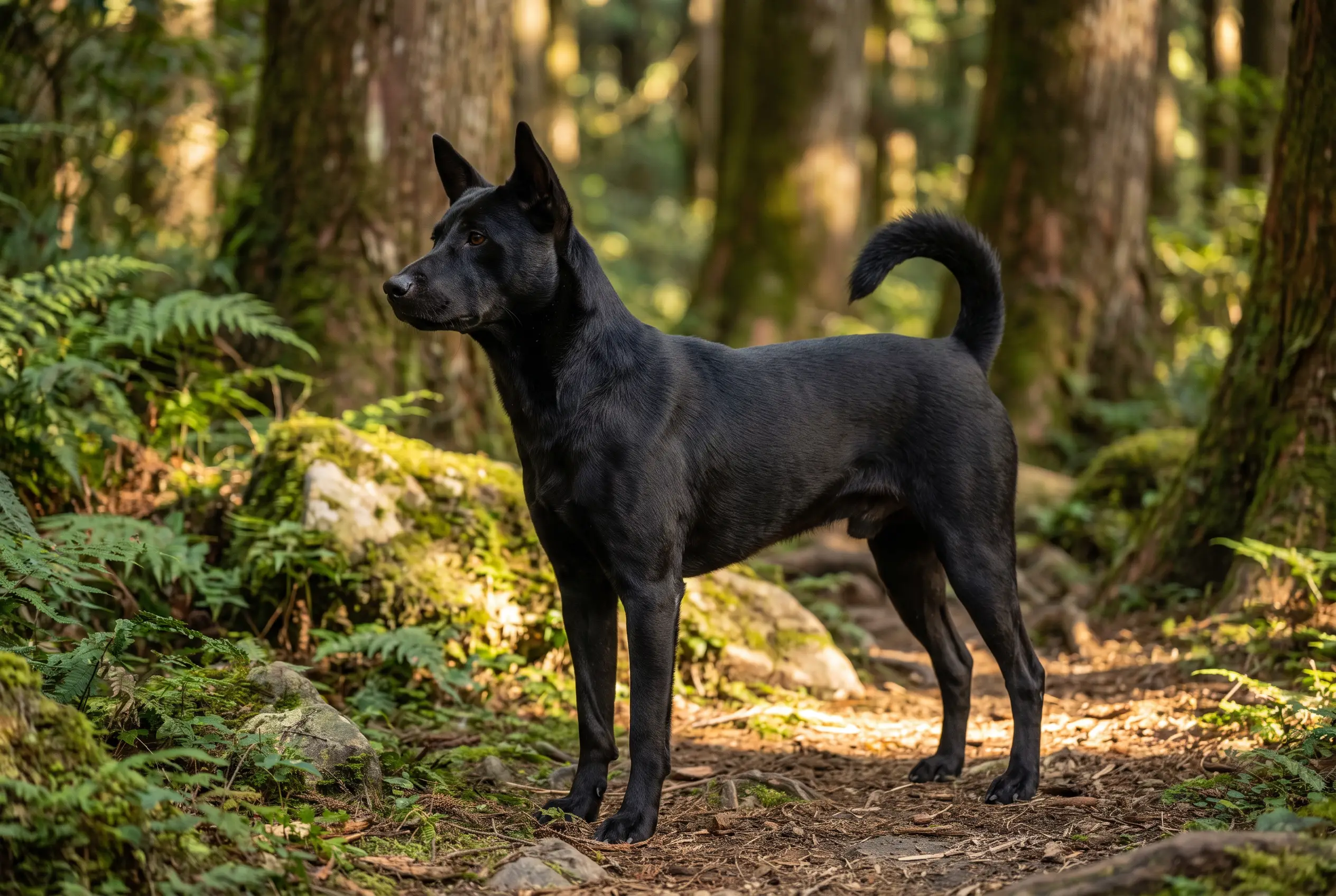
Taiwan Dog
Taiwan's native mountain hunter: triangular head, sickle tail, one master.
Vital stats
| Size | Medium · 48–53 cm (dogs), 43–48 cm (bitches) |
| Weight | 12–18 kg — dogs 14–18 kg, bitches 12–16 kg, set in the standard |
| Life expectancy | 12–15 years — breed literature, not survey data |
| Energy | High — a hunting and watch breed; 1–2 hrs/day |
| Shedding | Low to moderate — breed literature; the standard is silent |
| Coat | Short and hard, lying tight · 1.5–3 cm · black, brindle, fawn, white, or white with any of the three |
| Group | Non-Sporting · Primitive type – Hunting Dogs (FCI №348, Group 5) |
| Origin | Taiwan |
Breed traits
Friendliness
Care
Mind
Temperament
Extremely faithful to his master, keen in sense, alert in movement, bold and fearless: the standard's behaviour clause, word for word, and 'his master' is singular on purpose. This is a one-family dog from a line of one-hunter dogs, and breed literature is consistent that the devotion does not extend to strangers — expect reserve at the door and a serious watch dog, which is what the standard's utilization line asks for anyway: hunting dog, watch dog, companion dog. The body backs the temperament. It is nearly square, dry and sinewy, with a gait the standard wants 'agile enough to easily turn 180 degrees quickly'; a dog with those reflexes and a hunter's senses needs work for both, and small fleeing animals will read as game. Early, wide socialisation matters more here than in most breeds: shyness is a listed fault, and 'aggressive or overly shy' disqualifies.
Habits & quirks
One master, in writing
The behaviour clause names a single figure — 'extremely faithful to his master'. Households do fine, but by reputation the breed picks its person and treats everyone else as scenery.
Turns on a coin
The gait section asks for a powerful, reaching stride and a dog 'agile enough to easily turn 180 degrees quickly'. That is a mountain hunter's requirement, and you will see it in any garden.
Seven colours, no long coats
Black, brindle, fawn, white, and white with black, fawn or brindle. The coat itself is short and hard, 1.5–3 cm by the standard, and hair over 4.5 cm is a disqualifying fault.
Counted in 1980
Scholars from National Taiwan University, Gifu University and Nagoya University surveyed twenty-nine indigenous communities in 1980 and confirmed the native dog as a descendant of South Asian hunting dogs — the study the standard itself cites as the breed's paper trail.
Care
| Exercise | An hour or two a day with real content. This is a hunting and watch breed built to cut 180 degrees at speed; hiking, scent games and agility-style work suit it far better than a lead-only routine, and a bored one invents its own patrols. |
| Grooming | About as easy as coats get. The standard asks for nothing but short, hard hair 1.5–3 cm long, lying tight to the body; a weekly brush covers it, with a heavier week or two when the seasons turn. |
| Training | Quick senses, quick learner, own opinions — the primitive-type package. Keep sessions short and rewards real, start socialisation early and keep it broad, and treat recall around wildlife as a long-term project: the standard calls this a hunting dog first. |
| Health | A hardy landrace with no breed-wide health survey to cite. The standard's note asks that only functionally and clinically healthy dogs be bred; outside Taiwan the registered population is small, so ask breeders what testing they actually do. |
Common questions
Is the Taiwan Dog the same as the Formosan Mountain Dog?
Same dog. Formosan Mountain Dog is the older Western name, from Formosa, the island's Portuguese-era name; in Taiwan the everyday word is tugou, 'native dog'. The FCI registers it as the Taiwan Dog, standard No. 348 — provisionally accepted in 2004, definitively recognised on 9 June 2015.
Are they good family dogs?
For the right family. The standard asks for a dog extremely faithful to his master, bold rather than soft, and breed literature agrees on the other side of that coin: reserve with strangers and a strong watch instinct. With early socialisation, enough exercise and an owner it trusts, it is a devoted, low-maintenance house dog — one that picks its person.
Why do so many Taiwan Dogs come from rescue?
Because in Taiwan the type is everywhere. Native dogs and their mixes make up a large share of the island's strays and shelter intake, and rescue groups rehome them internationally, so most Taiwan Dogs abroad arrive as rescues rather than from breeders. Dogs bred and registered to the FCI standard are a far smaller population.